When I started cutting dairy out of my diet, one of the effects was that I was eating a lot less fat. I joked to John that I would probably lose a lot of weight if I kept it up! It's a joke because I really don't care if I lose weight or not. I'm still about 10 lbs. up from my pre-pregnancy weight, but I'm still a healthy weight so I don't really let it bother me. (I'm more concerned about the flabbiness of my abs -- yikes!)
But less than a day in, I was already suffering. I ate and ate and ate -- carbs. I wanted fat. The thing about carbs is that an hour or two after you eat them, you're already starving again! (Particularly for me, since I have a very fast metabolism.) Rice milk is sweet, so it seems like it's hitting the spot, but pretty soon you have to go drink more because it doesn't really satisfy. I craved sugary food. I was eating much more than I usually do, feeling hungry all the time, and getting headaches.
Once I added dairy back in, I felt better almost instantly. There are so many different dairy products that you can eat, in so many different combinations. But I also found I was satisfied much more easily. A half cup of rice with sour cream and cheese is so much more satisfying than a half cup of rice with sugar and cinnamon, or with just salt. I ate less frequently. I made a batch of shortbread -- just flour, butter, and sugar -- and really enjoyed it, but after eating a few pieces, I found I didn't want to eat any more. I was satisfied. This is pretty amazing coming out of a person who has been known to polish off a whole box of cookies in a sitting. (Not a proud moment. John's comment: "It was like a wheat harvester.") I have a very hard time stopping eating sweets. But that shortbread, rich as it was, was satisfying even though it was comparatively low in sugar.
All this makes sense if you understand a bit about fat. Fat contains 9 calories per gram, whereas protein and sugar both contain 4 calories per gram. So, if you're eating fat, it's true that you should eat half as much. However, it also is slower to digest and sits heavier in your stomach, making you feel more satisfied with less.
Fat also carries flavors throughout the food. Have you ever added curry to a chicken dish that contains a little fat? The curry gravitates toward the fat, turning it bright yellow. The same holds true for most spices. Everyone knows that the cure for a burning mouth after eating a jalapeno pepper is a drink of whole milk. The fat in the milk carries the spicy oils away from your tongue.
This is why low-fat foods can often be very deceptive. In order to make them palatable while removing all the fat, the manufacturers usually add sugars. Why are we finding sugar in spaghetti sauce, in lasagna, in crackers? Because sugar tastes good, so it makes the food palatable despite the lack of flavor-enhancing fat. Next time you want to buy a low-fat substitute for a high-fat food, read the ingredient label and see what they've added to make up for the fat. Chances are, the grams of sugar will be much higher even though there are fewer grams of fat. Other commonly added ingredients are carrageenan, a thickener; MSG; and extra salt.
Dieters often cut out fat in the assumption that dietary fat produces belly fat. But that's not necessarily true. High blood sugar often produces belly fat, as the body tries to dump unwanted glucose by converting into fat. And high blood sugar often comes from the rush-and-crash cycle we get when eating too many carbs -- something dieters often do in the urge to quell their feelings of starvation and deprivation. A mix of carbs (particularly complex carbohydrates), protein, and fat will help stabilize the blood sugar, as carbs enter the bloodstream first, protein enters later, and fat enters last.
I read recently that some tribes of North American Indians knew of a disease called "rabbit starvation," wherein a person could eat all the (lean) rabbit meat he wanted and yet still feel constantly hungry and eventually starve. This is anecdotal, of course, but it jives with my experience of eating almost no fat and being hungry all the time.
If fat is to blame for all the obesity and high blood pressure and heart disease in this country, why is it that those disorders are rampant now and were rare 100 years ago, when people 100 years ago were eating much more fat? I don't have an answer, but I have a feeling that a more balanced diet, low in refined sugar and other artificial foods, is probably much healthier than a diet composed of modern, low-fat health foods.
This would also explain why the French and the Italians are so healthy, despite eating loads of foods our American sensibilities suggest are "bad for you." There are whole diet books to help us "eat like the French." But it isn't hard: eat real butter and enjoy it, and you won't feel the need to keep eating and eating. Enjoy bitter, sour, and savory flavors, and you won't crave sugar all the time.
Which fats should we be eating? Probably a varied sampling. Some, but not excessive, saturated (solid) fat; and some unsaturated (liquid) fat, balanced between omega-3's (found in fish and flax oils) and omega-6's (found in most other vegetable oils). The one fat no one should be eating is "trans" fat, which is unsaturated fat made into a solid by artificial means. The body doesn't recognize it, and it seems to cause all kinds of harm. Luckily it is going out of style now that we know how harmful it is. Still, it's best to avoid margarine and other highly processed fats. Peanut butter is another place where hydrogenated fats are found, and I'm afraid it's a habit I have trouble kicking. I was raised on it, and all-natural peanut butter just isn't the same!
One last benefit to fat: it carries the fat-soluble vitamins, such as A, D, E, and K. These can be found in fish oils, butter, vegetable oils, or the fat in wheat germ, but they can't be obtained in the diet without at least some fat. (However, vitamin D is also produced by the skin, and vitamin K by intestinal bacteria.)
I'm not saying you should be going out and eating spoonfuls of lard as a health food. But a reasonable amount of fat -- for instance, the amount that occurs naturally in food -- is part of a good diet for a normal, healthy person. Vegetables go down well with butter, which also aids in the absorption of its vitamins. Meat tastes better when not patted completely dry. A little olive oil is delicious on a salad, and complements its nutrition. Whole milk tastes better than skim, and it provides more vitamins.
Bon appetit!
Edited to add these links, suggested by Ryan:
The New York Times: What if it's all been a big fat lie?
Mark's Daily Apple: Fats
Four Hour Work Week: The science of fat loss: why a calorie isn't always a calorie
The first one, in particular, I highly recommend. Lots of information I hadn't heard before.

Wednesday, August 25, 2010

Tuesday, August 24, 2010
Elimination diet results
My last post was about cutting out dairy in the hopes of helping the baby like nursing again. With no idea what the problem was (reflux? stomachache? behavior issue? funny taste?) I had no idea where to start, but I have heard that people have had good effects with cutting out dairy, so I decided to go with that.
A few days later, I decided the smart thing would be to go a step further and go on a total elimination diet, cutting out anything that could possibly cause a problem. Elimination diets have three levels of severity.
1. Cut out common allergens and irritants. The most common problem foods for babies are milk, wheat, corn, peanuts, cruciferous vegetables (like broccoli and cauliflower), onions, garlic, spicy foods, tomatoes, chocolate, citrus, caffeine, and soy. The last two weren't really an issue for me because I don't like them anyway.
2. Cut out anything you've ever heard of anyone being allergic to.
3. Cut out everything except for a few well-tolerated foods. This is what I did, when I started this diet. It's important to note that you can't do this for an extended period of time -- variety is the spice of life as well as being important for your health. So you wait for the symptoms to subside and then add foods back in, one at a time. It takes 2-24 hours for a food to affect the baby, so I could only reintroduce one food a day if I wanted to be sure I knew what the problems were.
I kept a careful journal of everything I ate and everything the baby did. I kept track of when he was nursing, how many diapers he was using, how fussy he was, how much he slept, and any other notable symptoms like spitup and diaper rash. I tried to connect problems we had with foods that we ate. John was out of town doing his grad school orientation, so I really had the freedom to eat whatever, whenever, and do nothing but watch the baby. I didn't even have the computer to distract me, since John brought it with him.
Here's a brief summary:
Monday: I ate what I usually do but cut out dairy. Marko was grouchy in the morning, happy in the middle of the day, and horrible in the afternoon. I noticed that the screaming started a short time after I had had a bean burrito with salsa. He'd been nursing fine, but that time I tried to feed him, he seemed to be interested, but then he spit out the milk and screamed. So, no more salsa. I put onions, spicy foods, and tomatoes on the blacklist along with dairy.
Tuesday: I ate what I usually do, but without dairy, onions, spicy foods, or tomatoes. This meant I ate a lot of eggs and pbj's. Eggs and peanut butter are the two foods that give me acid reflux. I have no idea why. In any event, I had reflux and the baby was as grouchy as ever. Every nursing session was a struggle. So, either the diet wasn't helping, or it hadn't had time to work yet. I decided to go to level 3 the next day and cut out almost everything. I really wanted to know if food was a contributing factor or not.
Wednesday: The breakthrough day. I ate oatmeal, rice, rice milk, potatoes, and chicken. I was starving and fighting food cravings all day. But it worked. Marko was much happier, though he had three shortish screamy periods. All of them were after eating chicken, but he was also tired for all of them. So I wasn't sure about the correlation, especially as chicken is supposed to be very mild. I did cut it out though.

His diaper rash was absolutely gone when I changed his diaper Wednesday morning -- which was a huge success sign for me! However, it was back by late afternoon. I'm not sure what that means, because I don't know how long it takes a food to cause a diaper rash. There could be a lag of hours or days -- I just don't know (and I had no internet, so I couldn't look it up either). But another physical sign was spitup: he barely had any -- a huge improvement, as he'd been getting very spitty lately.
Thursday: After a lot of pondering, I decide to add dairy back in. I do know that it can take much longer than that to rid dairy from the system, but looking back, I remembered that the one day where he was so good, the day I thought I was cutting out dairy, I actually ate a ton of cream cheese because I forgot that it was a dairy product. Yep, I'm oblivious. So I decided to add it in, particularly so I could have a protein and fat source instead of living completely on starches. The cheese was delicious, and I felt much better (more on that in another post!).
The effects on the baby remained good. He hardly cried at all the whole day -- a VAST improvement. On Thursday morning, I read through the record of the previous day and realized that we'd had one really good nurse every two hours or so. So I stopped offering nursing so often and tried only every two hours. That helped a ton -- he nursed happily each time. Once I offered five minutes too early and he turned away screaming, but five minutes later he was all for it!
(Note: The every-two-hours schedule is working great now, but it didn't work at all a month ago. Then, he wanted to nurse every 45 minutes. I think my milk supply was down back then (it was right after we'd gotten back from our trip) and he was building it back up. Now, the milk supply is finally restored a bit and so every two hours is working fine. I also wonder about the reflux issue -- babies with reflux tend to eat very frequently. So if that was a problem before and is better now, no wonder he can go longer.)

Friday: I added back in bananas and apples -- because I can't go forever with no fruits and veggies -- and Marko was great again. No spitup, rash fading again, no trouble nursing, and happy almost all the time.
Saturday: Reintroduced peanut butter and jelly sandwiches. I know that's a lot of ingredients, but I almost always eat them together, so I figured it was worthwhile to try them together. If there was a problem, I could cut the pbj's out and add each ingredient back in, one at a time. But there was no problem. Marko was great, we enjoyed our day, and his diaper rash was pretty much gone again. A couple times he was a little reluctant to nurse, but I took him out on the back porch and nursed him in the fresh air (he loves to be outside) and he was fine.
Sunday: A lot was going on, since John came back home, bringing his brother along for dinner, so I ended up eating a number of different things. At lunchtime I had eggs. By about four o'clock he had spit up a number of times, although he wasn't upset. So I decided to cut the eggs out again. After all, they do give me reflux. I'm not sure why eggs would be an issue, but why push it? I cut them out again, and won't be reintroducing them (except in bread, which seems to be fine) for at least another week or so. For dinner, I had hamburgers, with lettuce and a tiny bit of mustard. Those didn't seem to cause any ill effects that I could tell. Again, Marko was great. He was delighted to see Daddy and quite willing to make friends with his Uncle Thomas. I was so glad to see him so easy to please!
On Monday I stopped keeping the journal. I had a really busy day, driving my brother-in-law to Christendom and picking up a crib I got on Craigslist. But Marko was a little trooper. He slept in his carseat, ate a ton at more-or-less two-hour intervals, and didn't cry a bit! A lot of people at Christendom asked how he was doing, because they've been following his issues on Facebook, and I was proud to report how well he's been feeling and acting!
I'm reintroducing one food a day, and keeping a record of which food I introduced on each day so I am able to retrace any problems. But so far, we're doing great! I still don't know for sure whether food was an issue (though I think it must have been, seeing how quickly I saw results) or what the food might have been (though eggs do seem implicated). But we're plugging along, and as long as I have a happy baby, I'm not worried!
Now I only have to worry about the sleep he's getting. Now that he's rolling over, he's always waking himself up. Ah well, a mother's work is never done!
A few days later, I decided the smart thing would be to go a step further and go on a total elimination diet, cutting out anything that could possibly cause a problem. Elimination diets have three levels of severity.
1. Cut out common allergens and irritants. The most common problem foods for babies are milk, wheat, corn, peanuts, cruciferous vegetables (like broccoli and cauliflower), onions, garlic, spicy foods, tomatoes, chocolate, citrus, caffeine, and soy. The last two weren't really an issue for me because I don't like them anyway.
2. Cut out anything you've ever heard of anyone being allergic to.
3. Cut out everything except for a few well-tolerated foods. This is what I did, when I started this diet. It's important to note that you can't do this for an extended period of time -- variety is the spice of life as well as being important for your health. So you wait for the symptoms to subside and then add foods back in, one at a time. It takes 2-24 hours for a food to affect the baby, so I could only reintroduce one food a day if I wanted to be sure I knew what the problems were.
I kept a careful journal of everything I ate and everything the baby did. I kept track of when he was nursing, how many diapers he was using, how fussy he was, how much he slept, and any other notable symptoms like spitup and diaper rash. I tried to connect problems we had with foods that we ate. John was out of town doing his grad school orientation, so I really had the freedom to eat whatever, whenever, and do nothing but watch the baby. I didn't even have the computer to distract me, since John brought it with him.
Here's a brief summary:
Monday: I ate what I usually do but cut out dairy. Marko was grouchy in the morning, happy in the middle of the day, and horrible in the afternoon. I noticed that the screaming started a short time after I had had a bean burrito with salsa. He'd been nursing fine, but that time I tried to feed him, he seemed to be interested, but then he spit out the milk and screamed. So, no more salsa. I put onions, spicy foods, and tomatoes on the blacklist along with dairy.
Tuesday: I ate what I usually do, but without dairy, onions, spicy foods, or tomatoes. This meant I ate a lot of eggs and pbj's. Eggs and peanut butter are the two foods that give me acid reflux. I have no idea why. In any event, I had reflux and the baby was as grouchy as ever. Every nursing session was a struggle. So, either the diet wasn't helping, or it hadn't had time to work yet. I decided to go to level 3 the next day and cut out almost everything. I really wanted to know if food was a contributing factor or not.
Wednesday: The breakthrough day. I ate oatmeal, rice, rice milk, potatoes, and chicken. I was starving and fighting food cravings all day. But it worked. Marko was much happier, though he had three shortish screamy periods. All of them were after eating chicken, but he was also tired for all of them. So I wasn't sure about the correlation, especially as chicken is supposed to be very mild. I did cut it out though.

His diaper rash was absolutely gone when I changed his diaper Wednesday morning -- which was a huge success sign for me! However, it was back by late afternoon. I'm not sure what that means, because I don't know how long it takes a food to cause a diaper rash. There could be a lag of hours or days -- I just don't know (and I had no internet, so I couldn't look it up either). But another physical sign was spitup: he barely had any -- a huge improvement, as he'd been getting very spitty lately.
Thursday: After a lot of pondering, I decide to add dairy back in. I do know that it can take much longer than that to rid dairy from the system, but looking back, I remembered that the one day where he was so good, the day I thought I was cutting out dairy, I actually ate a ton of cream cheese because I forgot that it was a dairy product. Yep, I'm oblivious. So I decided to add it in, particularly so I could have a protein and fat source instead of living completely on starches. The cheese was delicious, and I felt much better (more on that in another post!).
The effects on the baby remained good. He hardly cried at all the whole day -- a VAST improvement. On Thursday morning, I read through the record of the previous day and realized that we'd had one really good nurse every two hours or so. So I stopped offering nursing so often and tried only every two hours. That helped a ton -- he nursed happily each time. Once I offered five minutes too early and he turned away screaming, but five minutes later he was all for it!
(Note: The every-two-hours schedule is working great now, but it didn't work at all a month ago. Then, he wanted to nurse every 45 minutes. I think my milk supply was down back then (it was right after we'd gotten back from our trip) and he was building it back up. Now, the milk supply is finally restored a bit and so every two hours is working fine. I also wonder about the reflux issue -- babies with reflux tend to eat very frequently. So if that was a problem before and is better now, no wonder he can go longer.)

Friday: I added back in bananas and apples -- because I can't go forever with no fruits and veggies -- and Marko was great again. No spitup, rash fading again, no trouble nursing, and happy almost all the time.
Saturday: Reintroduced peanut butter and jelly sandwiches. I know that's a lot of ingredients, but I almost always eat them together, so I figured it was worthwhile to try them together. If there was a problem, I could cut the pbj's out and add each ingredient back in, one at a time. But there was no problem. Marko was great, we enjoyed our day, and his diaper rash was pretty much gone again. A couple times he was a little reluctant to nurse, but I took him out on the back porch and nursed him in the fresh air (he loves to be outside) and he was fine.
Sunday: A lot was going on, since John came back home, bringing his brother along for dinner, so I ended up eating a number of different things. At lunchtime I had eggs. By about four o'clock he had spit up a number of times, although he wasn't upset. So I decided to cut the eggs out again. After all, they do give me reflux. I'm not sure why eggs would be an issue, but why push it? I cut them out again, and won't be reintroducing them (except in bread, which seems to be fine) for at least another week or so. For dinner, I had hamburgers, with lettuce and a tiny bit of mustard. Those didn't seem to cause any ill effects that I could tell. Again, Marko was great. He was delighted to see Daddy and quite willing to make friends with his Uncle Thomas. I was so glad to see him so easy to please!
On Monday I stopped keeping the journal. I had a really busy day, driving my brother-in-law to Christendom and picking up a crib I got on Craigslist. But Marko was a little trooper. He slept in his carseat, ate a ton at more-or-less two-hour intervals, and didn't cry a bit! A lot of people at Christendom asked how he was doing, because they've been following his issues on Facebook, and I was proud to report how well he's been feeling and acting!
I'm reintroducing one food a day, and keeping a record of which food I introduced on each day so I am able to retrace any problems. But so far, we're doing great! I still don't know for sure whether food was an issue (though I think it must have been, seeing how quickly I saw results) or what the food might have been (though eggs do seem implicated). But we're plugging along, and as long as I have a happy baby, I'm not worried!
Now I only have to worry about the sleep he's getting. Now that he's rolling over, he's always waking himself up. Ah well, a mother's work is never done!
Monday, August 16, 2010
Non-dairy ideas?
Marko had a wonderful day Friday. He nursed like a champ, smiled pretty much the whole day, and hardly even fussed. From Thursday afternoon to the middle of Saturday morning, he was just perfect. I had tried a number of things those couple of days, from cutting out all dairy to eating oatmeal (supposed to increase milk supply) to working on our latch. Since the change was so instant and dramatic, I credited the techniques I'd been using to bring him to the breast. I went back to having cereal and milk for breakfast and didn't worry about anything else.
However, by mid-morning on Saturday, the good times were over. And by Sunday evening, we were back in the "absolutely no nursing" zone. I noticed a few things, including a slow let-down on my part (but only sometimes, and it might be triggered by the stress of him screaming at me ... hard to tell cause and effect) and a lot of spitting up on his part. When he was a newborn, he almost never spit up, but the amount he spits up has been slowly increasing for awhile. On Sunday he spit up quite a bit. I figured it might be because he is rolling around so much, but on the other hand, it does bring up the reflux question again.
Today I was thinking about all this while deciding what to have for breakfast: raisin bran with milk (which was what I wanted) or oatmeal (which I am not crazy about)? I remember hearing that 50% of reflux cases are improved by the mother cutting out casein, the protein in cows' milk. So I chose oatmeal, and furthermore have decided to do a few days' trial where I cut out cows' milk and see how I do.
So far, here's what I've got:

Baby has nursed fine the past couple of times and seems happy at the moment. Not much to go on, but it's a start. If I don't see improvement in a week or so, I'll probably give it up.
Because here's the thing: I love dairy. A lot. My favorite foods are ice cream, butter, sour cream, yogurt, and chocolate milk. Oh, and cheese ... all cheese ... all the time. If milk were alcohol, I would definitely I have to admit that I have a problem. When I make chocolate chip cookies, it's all I can do not to eat them once I get to the butter-and-sugar stage, and leave the rest of the ingredients out. When I make roux for a soup, I always just want to eat the roux. It's bad. At the moment I eat a lot of fat, because baby needs fat and so I crave it inordinately, but the only fat I really like is butterfat. I could eat butter straight, but who ever ate beef tallow straight? Olive oil is okay, but it doesn't really hit the spot the same way.
So I'm looking for ideas. I'm making rice milk at the moment, although I'm quite aware it's lowfat and not going to satisfy my butter craving. To start you off, I offer one milk-substitution recipe, which I am quite proud of having invented when John was on an elimination diet.
Cream-free cream sauce for soup & pasta
Ingredients:
1 tablespoon fat, preferably a solid fat: chicken fat, beef tallow, lard, shortening, coconut oil, or ghee (clarified butter -- contains no lactose or casein)
1 tablespoon flour
1 cup liquid: stock, wine, or a mixture of both -- it should be strongly flavored to match your soup
Melt the fat over medium heat. I used chicken fat when I invented it, and haven't tried anything else (though I may try ghee). Mix in flour to make a roux. Make sure the flour is totally incorporated. I sometimes brown the roux a bit; if you do this you will have a darker sauce. Then add the liquid, a little at a time, whisking after each addition and cooking a bit until you see no lumps before you add more. Stop when it's the consistency you like -- it thickens a little as it cooks.
Add this to soups calling for cream, or use as a base for a cream sauce over pasta. (My award-winning (i.e. both John and I like it) sauce for noodles is this cream sauce with onions, garlic, and chicken.)
Any other ideas? I would like recipes that contain some fat if possible. I don't generally eat soy; I don't care for it and I don't think it's all that healthy. But I'm not vegetarian or vegan, so meat is fine. So are eggs, which will probably be my salvation as I try to get by on this budget. However, I would love to hear your favorite nondairy recipe, whatever it is!
However, by mid-morning on Saturday, the good times were over. And by Sunday evening, we were back in the "absolutely no nursing" zone. I noticed a few things, including a slow let-down on my part (but only sometimes, and it might be triggered by the stress of him screaming at me ... hard to tell cause and effect) and a lot of spitting up on his part. When he was a newborn, he almost never spit up, but the amount he spits up has been slowly increasing for awhile. On Sunday he spit up quite a bit. I figured it might be because he is rolling around so much, but on the other hand, it does bring up the reflux question again.
Today I was thinking about all this while deciding what to have for breakfast: raisin bran with milk (which was what I wanted) or oatmeal (which I am not crazy about)? I remember hearing that 50% of reflux cases are improved by the mother cutting out casein, the protein in cows' milk. So I chose oatmeal, and furthermore have decided to do a few days' trial where I cut out cows' milk and see how I do.
So far, here's what I've got:

Baby has nursed fine the past couple of times and seems happy at the moment. Not much to go on, but it's a start. If I don't see improvement in a week or so, I'll probably give it up.
Because here's the thing: I love dairy. A lot. My favorite foods are ice cream, butter, sour cream, yogurt, and chocolate milk. Oh, and cheese ... all cheese ... all the time. If milk were alcohol, I would definitely I have to admit that I have a problem. When I make chocolate chip cookies, it's all I can do not to eat them once I get to the butter-and-sugar stage, and leave the rest of the ingredients out. When I make roux for a soup, I always just want to eat the roux. It's bad. At the moment I eat a lot of fat, because baby needs fat and so I crave it inordinately, but the only fat I really like is butterfat. I could eat butter straight, but who ever ate beef tallow straight? Olive oil is okay, but it doesn't really hit the spot the same way.
So I'm looking for ideas. I'm making rice milk at the moment, although I'm quite aware it's lowfat and not going to satisfy my butter craving. To start you off, I offer one milk-substitution recipe, which I am quite proud of having invented when John was on an elimination diet.
Cream-free cream sauce for soup & pasta
Ingredients:
1 tablespoon fat, preferably a solid fat: chicken fat, beef tallow, lard, shortening, coconut oil, or ghee (clarified butter -- contains no lactose or casein)
1 tablespoon flour
1 cup liquid: stock, wine, or a mixture of both -- it should be strongly flavored to match your soup
Melt the fat over medium heat. I used chicken fat when I invented it, and haven't tried anything else (though I may try ghee). Mix in flour to make a roux. Make sure the flour is totally incorporated. I sometimes brown the roux a bit; if you do this you will have a darker sauce. Then add the liquid, a little at a time, whisking after each addition and cooking a bit until you see no lumps before you add more. Stop when it's the consistency you like -- it thickens a little as it cooks.
Add this to soups calling for cream, or use as a base for a cream sauce over pasta. (My award-winning (i.e. both John and I like it) sauce for noodles is this cream sauce with onions, garlic, and chicken.)
Any other ideas? I would like recipes that contain some fat if possible. I don't generally eat soy; I don't care for it and I don't think it's all that healthy. But I'm not vegetarian or vegan, so meat is fine. So are eggs, which will probably be my salvation as I try to get by on this budget. However, I would love to hear your favorite nondairy recipe, whatever it is!
Saturday, August 14, 2010
Intellectual life of a stay-at-home mom
I have always heard about stay-at-home moms feeling stuck, trapped, stagnating, or what-have-you. That they wish they could go back to work or get out of the house just to get some adult conversation -- to feed their intellectual life. But this just isn't a problem I have -- not yet anyway.
First off, there's the internet. Savior of stay-at-home moms everywhere. We can debate the Big Issues or write poetry while listening for the baby to wake up from his nap. I recently joined Twitter and have a fun time keeping up with all the conversations. (Though at times I do have to step away from me... I feel like I'm getting ADD just trying to absorb it all.) Then there's this blog, Enchiridion, and the many blogs I read -- mom blogs, cooking blogs, political blogs, religious blogs. And, of course, Facebook.
Through the internet, I've been able to research many issues that are dear to my heart. Breastfeeding is big these days, perhaps because I spend such a large percentage of every day nursing! There are so many issues within that -- the politics, the unethical practices of formula companies, the roadblocks that keep women who want to nurse from being successful. Childbirth is another -- I get very worked up when I hear of various situations where women are denied their rights when it comes to the medical care they receive. I think a lot about women's rights and what, exactly, that means and should mean. I think about food: what constitutes nutrition and what the political pressures are that make our food system the way it is instead of the way it should be.
I also can be part of a community with many other mothers. I watch babies a little older than mine to see what I can expect. I watch babies a little younger than mine so I can reminisce. I trade advice with others. It is amazing how much help I receive when I ask for it.
I get to practice my writing skills, do research, and analyze different opinion pieces to form my own opinion. I am way more educated about many parenting issues than I was a year ago.
And yet, even aside from the internet, my intellectual life is alive and kicking. I'm not just counting wet diapers and timing naps -- I'm also trying to see through the eyes of my baby and figure out why he cries or what bothers him so much about nursing. I'm weighing various parenting decisions and choosing the best for our situation. I'm figuring out ways to make ground beef stretch for more meals, or new recipes using the same five ingredients I used the night before. I'm keeping a constant finger on the pulse of our laundry hamper and working out when I need to do each kind of load. I'm trying to make our tiny apartment look nice without spending any money. I'm finding ways to make a two-week grocery supply cost under $70. I'm price-comparing powdered detergent with liquid. I'm a cook, laundress, maid, nanny, pediatrician, nurse, lactation consultant, child psychologist, interior decorator, gardener, and mathematician.
But my favorite part of my intellectual life is my husband. I'm lucky enough to have found a very intelligent man who comes home from a 12-hour day with enough energy to expound on the news or the sermon. When I was pregnant, we were both too exhausted to talk much, a lot of the time. I came home from work and just wanted to put my feet up and surf the internet on my laptop. John got home and opened up his laptop and we would spend time together, but only in a parallel sense. Sometimes we'd get really far out and watch a movie.
But now, every evening around eight o'clock, baby, Daddy, and I take a walk around the apartment complex. We watch the sun set and baby kicks in our arms and starts to feel sleepy as he watches the trees go by. As we walk, we discuss all kinds of things. Recent topics have ranged from the taxonomy of insects to Calvinism. Last night we stayed up till midnight figuring out that many of society's problems come from a false dichotomy between the soul and body. But another evening we might spend making parodies of song lyrics and trying not to wake the baby with our laughter.
I'm two years out of college, and in those two years my intellectual life has never been so alive as it is now that I'm staying home. Instead of frying my brain trying to do the same thing all day, I'm free, as Chesterton put it, to cultivate all my second bests.
First off, there's the internet. Savior of stay-at-home moms everywhere. We can debate the Big Issues or write poetry while listening for the baby to wake up from his nap. I recently joined Twitter and have a fun time keeping up with all the conversations. (Though at times I do have to step away from me... I feel like I'm getting ADD just trying to absorb it all.) Then there's this blog, Enchiridion, and the many blogs I read -- mom blogs, cooking blogs, political blogs, religious blogs. And, of course, Facebook.
Through the internet, I've been able to research many issues that are dear to my heart. Breastfeeding is big these days, perhaps because I spend such a large percentage of every day nursing! There are so many issues within that -- the politics, the unethical practices of formula companies, the roadblocks that keep women who want to nurse from being successful. Childbirth is another -- I get very worked up when I hear of various situations where women are denied their rights when it comes to the medical care they receive. I think a lot about women's rights and what, exactly, that means and should mean. I think about food: what constitutes nutrition and what the political pressures are that make our food system the way it is instead of the way it should be.
I also can be part of a community with many other mothers. I watch babies a little older than mine to see what I can expect. I watch babies a little younger than mine so I can reminisce. I trade advice with others. It is amazing how much help I receive when I ask for it.
I get to practice my writing skills, do research, and analyze different opinion pieces to form my own opinion. I am way more educated about many parenting issues than I was a year ago.
And yet, even aside from the internet, my intellectual life is alive and kicking. I'm not just counting wet diapers and timing naps -- I'm also trying to see through the eyes of my baby and figure out why he cries or what bothers him so much about nursing. I'm weighing various parenting decisions and choosing the best for our situation. I'm figuring out ways to make ground beef stretch for more meals, or new recipes using the same five ingredients I used the night before. I'm keeping a constant finger on the pulse of our laundry hamper and working out when I need to do each kind of load. I'm trying to make our tiny apartment look nice without spending any money. I'm finding ways to make a two-week grocery supply cost under $70. I'm price-comparing powdered detergent with liquid. I'm a cook, laundress, maid, nanny, pediatrician, nurse, lactation consultant, child psychologist, interior decorator, gardener, and mathematician.
But my favorite part of my intellectual life is my husband. I'm lucky enough to have found a very intelligent man who comes home from a 12-hour day with enough energy to expound on the news or the sermon. When I was pregnant, we were both too exhausted to talk much, a lot of the time. I came home from work and just wanted to put my feet up and surf the internet on my laptop. John got home and opened up his laptop and we would spend time together, but only in a parallel sense. Sometimes we'd get really far out and watch a movie.
But now, every evening around eight o'clock, baby, Daddy, and I take a walk around the apartment complex. We watch the sun set and baby kicks in our arms and starts to feel sleepy as he watches the trees go by. As we walk, we discuss all kinds of things. Recent topics have ranged from the taxonomy of insects to Calvinism. Last night we stayed up till midnight figuring out that many of society's problems come from a false dichotomy between the soul and body. But another evening we might spend making parodies of song lyrics and trying not to wake the baby with our laughter.
I'm two years out of college, and in those two years my intellectual life has never been so alive as it is now that I'm staying home. Instead of frying my brain trying to do the same thing all day, I'm free, as Chesterton put it, to cultivate all my second bests.
Friday, August 13, 2010
Notes
A couple things to share:
1. Marko is already doing better, thanks to all the advice I got from around the internet. People from Facebook, Twitter, and the blogosphere all gave me wonderful tips. Someone even retweeted me so that total strangers dropped in on my Twitter feed to help me out! Such kindness. In any event, he has been happier than a clam today, full of smiles and love ... and eating a lot. :)
2. I guest posted on this blog, Diary of a First Child. It's a good blog, why not go there and read it? As for my own post, it's about baby poo, so only read it if you really want to.
3. I am finally posting again at Enchiridion. I'm hoping to lure a few of my old followers back... so if any of you were missing that blog, check back. I'm hoping to manage to post there at least weekly from now on.
4. Marko is reliably rolling over from back to front! He hasn't mastered front to back yet. The problem is, if I'm around, he'd prefer to lie on his back and watch me ... so I had to leave the camera running on the bedside table and watch stealthily to see if he'd roll. After several minutes of film, he actually did.
1. Marko is already doing better, thanks to all the advice I got from around the internet. People from Facebook, Twitter, and the blogosphere all gave me wonderful tips. Someone even retweeted me so that total strangers dropped in on my Twitter feed to help me out! Such kindness. In any event, he has been happier than a clam today, full of smiles and love ... and eating a lot. :)
2. I guest posted on this blog, Diary of a First Child. It's a good blog, why not go there and read it? As for my own post, it's about baby poo, so only read it if you really want to.
3. I am finally posting again at Enchiridion. I'm hoping to lure a few of my old followers back... so if any of you were missing that blog, check back. I'm hoping to manage to post there at least weekly from now on.
4. Marko is reliably rolling over from back to front! He hasn't mastered front to back yet. The problem is, if I'm around, he'd prefer to lie on his back and watch me ... so I had to leave the camera running on the bedside table and watch stealthily to see if he'd roll. After several minutes of film, he actually did.
Traditionally-made sauerkraut
Before the invention of refrigeration, people had a myriad methods of preservation. All winter long, there were no fresh vegetables to be had. They needed to preserve the summer's bounty to enrich their diet in the winter. Some foods, like apples or onions, keep all right as they are. Others need more careful preservation.
Salting was one method -- often used for meat. Food would be so heavily salted that the salt needed to be rinsed off before eating. Salt pork is one example of this.
Other foods were pickled. Today we think of pickles as vegetables that are bathed in a strong vinegar solution before being canned. However, traditional pickling methods -- often called refrigerator pickles, crock pickles, or lacto-fermented foods -- don't use any vinegar at all. Instead, they rely on friendly bacteria to provide the acidic environment that hinders spoilage.
Foods fermented in this way include yogurt, pickles (cucumbers, beets, etc.), and sauerkraut. A salty environment hinders the growth of harmful microorganisms while allowing friendly bacteria to grow, lactobacilli such as acidophilus and bifidus. These bacteria produce lactic acid, which preserves the food and makes the environment much too sour for harmful bacteria to grow.
From what I've read, these bacteria (and the lactic acid they produce) are also excellent for human digestion. The friendly beasties live inside the human GI tract and help digest foods we can't -- like certain kinds of fiber. They keep the environment of the GI tract sour enough to hinder growth of harmful microorganisms, from E. coli to yeast (candida). Sometimes people who have gone on strong antibiotics experience diarrhea, lactose intolerance, and other ills because their friendly bacteria have been killed along with the harmful ones. In these cases, eating probiotic foods like yogurt or lacto-fermented vegetables can be a surefire cure.
I've tried this method before, but without success. I made cucumber pickles, and either something was wrong with them or with me -- they made me throw up! It was probably the morning sickness, but I ended up tossing the jar out all the same.
This time, I decided to follow the directions more carefully. I was going to make sauerkraut!
I decided on sauerkraut because of all that cabbage I bought (yum!). And I chose to lacto-ferment it to make it a bit more digestible (it seemed to be giving the baby a tummy ache) as well as make sure we had enough healthy bacteria in order to prevent yeast infections like thrush. Besides, this is something I've wanted to do for a long time.
The method I used includes whey, in order to introduce friendly bacteria and shorten the fermentation time. Whey isn't sold in stores, but it's easy to obtain: simply line a colander with a damp cheesecloth (or flat-fold baby diaper ;) ) and dump in a quart of yogurt. Set the colander over or inside a bowl, and within several hours, you should have enough whey collected beneath. As an added bonus, your yogurt will now be thicker and less sour, like Greek yogurt. If you leave it longer, you may get cream cheese! (Note: the ends of the cheesecloth must be inside the colander, or the whey will just end up on the counter. Guess how I know this.)
Here's the recipe, which I got from here and cut in half:
1/2 head cabbage
1 carrot
1/2 onion
1/4 cup whey
1 tablespoon salt
Shred the cabbage or chop it finely. I started by doing it in the food processor, but found it quickly turned my cabbage into tiny cabbage crumbs, so I did the rest of the cabbage by hand. The onion and the carrot I did want finely chopped, so I used the processor for those. Everything goes into a big bowl, along with the whey and the salt.

Mix everything well. Then you have to start pounding. I started with this "wooden" spoon and used a potato masher later. The goal is to extract the juices from the vegetables. The salt does some of this job, so you save some effort if you take your time. A couple minutes of pounding, let stand for ten minutes, a couple more minutes of pounding ... overall it took about half an hour. You know you're done when the juice is splashing over all the vegetables when you pound.
Then put the kraut into jars. The recipe makes about a quart, so two pint jars were all I needed. You may need to pound a little more once it's in the jars (the wooden spoon worked well for this) to make sure the juice comes up over the vegetables.
My recipe insisted that my vegetables remain submerged to make an anaerobic (airless) environment for fermentation. That didn't seem necessary to me, since sauerkraut was traditionally made in an open crock, but I decided to trust my recipe. It takes a long time to make sauerkraut and I didn't want to wait all that time only to find it had been ruined! What you do to make sure they stay submerged is nest a small ziplock bag into the top of the jar and pour water into the bag. The bag expands as it fills up and squeezes out all the air pockets. Soon you can see the juice coming up the sides of the bag instead of air. Close the ziplock, pushing out as much air as you can, and fold the bag into the jar. Then put the jar lid on.
Then leave the jars in a warm, dark place. You can see them nestling in my cupboard next to the sourdough.

Leave for three days to get the bacteria going. Then move the to fridge. You can eat it at this point, but it's not very sour ... just salty and kind of funny-tasting. So I recommend exercising patience and waiting a bit longer.
It's been a week now that the kraut's been in the fridge, and it's developed a nice sour taste. However, it's not nearly as sour as storebought (vinegar-pickled) sauerkraut. I'm sure it will get a bit more sour the longer I leave it; however, I hear lacto-fermented foods are never as sour as vinegar-pickled foods. It's a milder flavor, but also a bit more interesting ... not brash and strong, but allowing the original flavors to come through while adding a lot of new flavors.
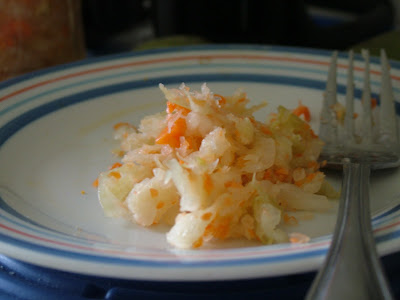
Something interesting I noticed is that the sour flavor really resides in the food itself, not the juices. Those are a bit sour, but not as sour as the cabbage. The carrots cut the sourness a bit, as they are sweeter, and the onions add a different tang. All of the vegetables, as you may have noticed, are raw, but with the fermentation they don't quite taste raw. However, they're still crunchy and much more flavorful than cooked vegetables.
I don't really know how to describe the flavor beyond that. It really didn't taste like the sauerkraut I'm used to. Perhaps it would be more familiar if I'd used just cabbage, and left it for longer. I'm not all that patient, but one jar is still unopened, so I'll have to see if that one's more sour.
Sauerkraut is excellent alongside bratwurst. In fact, this traditional combination is very sensible, because the acids and bacteria in sauerkraut spur the digestion, helping your stomach handle the heavy bratwurst. I have a hard time handling bratwurst myself, so I'll have to try it with sauerkraut and see if that goes down better! Sauerkraut is intended to be a condiment or a small side-dish -- it probably wouldn't be a good idea to eat the whole jar in one go. Try it alongside heavy or fatty foods.
All in all, my first lacto-fermentation success was very easy. You don't have to be scrupulously clean and sterilize everything, like you do with canned foods, because the salty environment keeps nasty bugs at bay. I did rinse off the vegetables, but there's no need for boiling. The results do need to be kept cool in a fridge or root cellar, and they don't last forever, but through the winter is all that was really necessary for our pre-refrigeration forebears. In any event, I was pleased with the results that a half-hour's work got me. I definitely recommend making this!
Salting was one method -- often used for meat. Food would be so heavily salted that the salt needed to be rinsed off before eating. Salt pork is one example of this.
Other foods were pickled. Today we think of pickles as vegetables that are bathed in a strong vinegar solution before being canned. However, traditional pickling methods -- often called refrigerator pickles, crock pickles, or lacto-fermented foods -- don't use any vinegar at all. Instead, they rely on friendly bacteria to provide the acidic environment that hinders spoilage.
Foods fermented in this way include yogurt, pickles (cucumbers, beets, etc.), and sauerkraut. A salty environment hinders the growth of harmful microorganisms while allowing friendly bacteria to grow, lactobacilli such as acidophilus and bifidus. These bacteria produce lactic acid, which preserves the food and makes the environment much too sour for harmful bacteria to grow.
From what I've read, these bacteria (and the lactic acid they produce) are also excellent for human digestion. The friendly beasties live inside the human GI tract and help digest foods we can't -- like certain kinds of fiber. They keep the environment of the GI tract sour enough to hinder growth of harmful microorganisms, from E. coli to yeast (candida). Sometimes people who have gone on strong antibiotics experience diarrhea, lactose intolerance, and other ills because their friendly bacteria have been killed along with the harmful ones. In these cases, eating probiotic foods like yogurt or lacto-fermented vegetables can be a surefire cure.
I've tried this method before, but without success. I made cucumber pickles, and either something was wrong with them or with me -- they made me throw up! It was probably the morning sickness, but I ended up tossing the jar out all the same.
This time, I decided to follow the directions more carefully. I was going to make sauerkraut!
I decided on sauerkraut because of all that cabbage I bought (yum!). And I chose to lacto-ferment it to make it a bit more digestible (it seemed to be giving the baby a tummy ache) as well as make sure we had enough healthy bacteria in order to prevent yeast infections like thrush. Besides, this is something I've wanted to do for a long time.
The method I used includes whey, in order to introduce friendly bacteria and shorten the fermentation time. Whey isn't sold in stores, but it's easy to obtain: simply line a colander with a damp cheesecloth (or flat-fold baby diaper ;) ) and dump in a quart of yogurt. Set the colander over or inside a bowl, and within several hours, you should have enough whey collected beneath. As an added bonus, your yogurt will now be thicker and less sour, like Greek yogurt. If you leave it longer, you may get cream cheese! (Note: the ends of the cheesecloth must be inside the colander, or the whey will just end up on the counter. Guess how I know this.)
Here's the recipe, which I got from here and cut in half:
1/2 head cabbage
1 carrot
1/2 onion
1/4 cup whey
1 tablespoon salt
Shred the cabbage or chop it finely. I started by doing it in the food processor, but found it quickly turned my cabbage into tiny cabbage crumbs, so I did the rest of the cabbage by hand. The onion and the carrot I did want finely chopped, so I used the processor for those. Everything goes into a big bowl, along with the whey and the salt.

Mix everything well. Then you have to start pounding. I started with this "wooden" spoon and used a potato masher later. The goal is to extract the juices from the vegetables. The salt does some of this job, so you save some effort if you take your time. A couple minutes of pounding, let stand for ten minutes, a couple more minutes of pounding ... overall it took about half an hour. You know you're done when the juice is splashing over all the vegetables when you pound.
Then put the kraut into jars. The recipe makes about a quart, so two pint jars were all I needed. You may need to pound a little more once it's in the jars (the wooden spoon worked well for this) to make sure the juice comes up over the vegetables.
My recipe insisted that my vegetables remain submerged to make an anaerobic (airless) environment for fermentation. That didn't seem necessary to me, since sauerkraut was traditionally made in an open crock, but I decided to trust my recipe. It takes a long time to make sauerkraut and I didn't want to wait all that time only to find it had been ruined! What you do to make sure they stay submerged is nest a small ziplock bag into the top of the jar and pour water into the bag. The bag expands as it fills up and squeezes out all the air pockets. Soon you can see the juice coming up the sides of the bag instead of air. Close the ziplock, pushing out as much air as you can, and fold the bag into the jar. Then put the jar lid on.
Then leave the jars in a warm, dark place. You can see them nestling in my cupboard next to the sourdough.

Leave for three days to get the bacteria going. Then move the to fridge. You can eat it at this point, but it's not very sour ... just salty and kind of funny-tasting. So I recommend exercising patience and waiting a bit longer.
It's been a week now that the kraut's been in the fridge, and it's developed a nice sour taste. However, it's not nearly as sour as storebought (vinegar-pickled) sauerkraut. I'm sure it will get a bit more sour the longer I leave it; however, I hear lacto-fermented foods are never as sour as vinegar-pickled foods. It's a milder flavor, but also a bit more interesting ... not brash and strong, but allowing the original flavors to come through while adding a lot of new flavors.

Something interesting I noticed is that the sour flavor really resides in the food itself, not the juices. Those are a bit sour, but not as sour as the cabbage. The carrots cut the sourness a bit, as they are sweeter, and the onions add a different tang. All of the vegetables, as you may have noticed, are raw, but with the fermentation they don't quite taste raw. However, they're still crunchy and much more flavorful than cooked vegetables.
I don't really know how to describe the flavor beyond that. It really didn't taste like the sauerkraut I'm used to. Perhaps it would be more familiar if I'd used just cabbage, and left it for longer. I'm not all that patient, but one jar is still unopened, so I'll have to see if that one's more sour.
Sauerkraut is excellent alongside bratwurst. In fact, this traditional combination is very sensible, because the acids and bacteria in sauerkraut spur the digestion, helping your stomach handle the heavy bratwurst. I have a hard time handling bratwurst myself, so I'll have to try it with sauerkraut and see if that goes down better! Sauerkraut is intended to be a condiment or a small side-dish -- it probably wouldn't be a good idea to eat the whole jar in one go. Try it alongside heavy or fatty foods.
All in all, my first lacto-fermentation success was very easy. You don't have to be scrupulously clean and sterilize everything, like you do with canned foods, because the salty environment keeps nasty bugs at bay. I did rinse off the vegetables, but there's no need for boiling. The results do need to be kept cool in a fridge or root cellar, and they don't last forever, but through the winter is all that was really necessary for our pre-refrigeration forebears. In any event, I was pleased with the results that a half-hour's work got me. I definitely recommend making this!
Wednesday, August 11, 2010
Help!
All right, this is a post that is 100% baby. I am in need of some help. I know a lot of my blog readers aren't parents, but many still know a lot about babies, and others have had lots of babies and might be able to help me out. Feel free to skip if you're not interested.
Here's the problem. Since Marko was about 12 weeks old, he has been very difficult to get to nurse. When he's not hungry, it's not an issue -- he simply turns his head away and I put him down again. But when he is hungry, it's a huge issue. He throws himself backward and screams, seeming to be either in pain or very angry. I know he's hungry because it's often been quite some time since he's eaten, and he also gives some strong cues like biting on my shirt or sucking on my finger. And yet, he won't nurse!
I've mentioned before that he used to nurse with a plastic shield, which was a huge pain. At 10 weeks he weaned himself off of it and nursed just fine ... for two weeks. Then the arching and screaming started cropping up. At first it was just when he was overtired; now it's pretty close to always.
It's not that he'd prefer a bottle, because the first bottle of his life was yesterday. I'd offered them before, but he was never interested and I didn't push it. This time, after a lot of screaming and misery, I offered a bottle of expressed milk and he drank it right down before falling asleep.
Things that help: nursing him every 45 minutes; starting him off on a pacifier or finger and switching; trying to get him to self-attach (sometimes); nursing lying down; nursing the moment he wakes up from a nap. Things that don't help: waiting for him to get hungrier. He will go for 3-4 hours without nursing before screaming himself to sleep (and then I nurse him on awakening). Repeat: it is NOT that he is not hungry!
So I have a few ideas of what it could be, based on some research I've done on nursing strikes and nursing aversion.
Thrush: a yeast overgrowth in baby's mouth. Why he might have it: Thrush can cause nursing to be painful, so a baby will refuse to nurse. Why he might not have it: There are no other symptoms -- no white patches in the mouth, no bad diaper rash, no apparent yeast on me, etc.
Silent reflux: acid gurgling up in baby's throat and hurting him. Why he might have it: Babies with reflux occasionally come to dislike nursing because they know it will make their throat hurt later. He has some symptoms: occasionally a gurgly noise in the throat, frequent hiccups, when I lay him down on his back he rolls onto his side and arches into a banana shape, frequent nursing helps. Why he might not have it: Usually reflux appears very early on, not at 12 weeks. He's not a big spit-upper. He doesn't cry when laid on his back or when his throat makes that gurgly noise. He's a good sleeper.
Teething: teething babies often refuse to nurse because the sucking motion can hurt their gums. Why he might have it: he's drooling, chomping on everything, and these past couple of days he's been very fussy and soothed by a cold pacifier. Why he might not have it: he's been doing this for over a month, and no sign of a tooth. Besides, he likes to suck just fine -- in fact he sucks on everything -- he just doesn't like to nurse.
A behavioral issue: It's possible that using that shield has confused him somehow, so that he doesn't know how to latch well and gets confused about it when he's upset or tired. He also seems to have developed a preference for pacifiers, and doesn't like the real thing as much. I have never yelled at him while nursing or any such thing. The funny thing is, originally he just minded nursing in one single position, and if I switched things up a bit he wouldn't mind. But as he's caught onto my various "tricks," suddenly he gets suspicious and will cry if he's brought even remotely near a breast. It's the strangest thing.
Does ANYONE have anything that might help me? I'm planning to take him to the doctor and see what they can tell me, but he appears healthy other than this one thing, so I'm not sure they will be able to help. I just would like to get my little boy to like nursing again.
Here's the problem. Since Marko was about 12 weeks old, he has been very difficult to get to nurse. When he's not hungry, it's not an issue -- he simply turns his head away and I put him down again. But when he is hungry, it's a huge issue. He throws himself backward and screams, seeming to be either in pain or very angry. I know he's hungry because it's often been quite some time since he's eaten, and he also gives some strong cues like biting on my shirt or sucking on my finger. And yet, he won't nurse!
I've mentioned before that he used to nurse with a plastic shield, which was a huge pain. At 10 weeks he weaned himself off of it and nursed just fine ... for two weeks. Then the arching and screaming started cropping up. At first it was just when he was overtired; now it's pretty close to always.
It's not that he'd prefer a bottle, because the first bottle of his life was yesterday. I'd offered them before, but he was never interested and I didn't push it. This time, after a lot of screaming and misery, I offered a bottle of expressed milk and he drank it right down before falling asleep.
Things that help: nursing him every 45 minutes; starting him off on a pacifier or finger and switching; trying to get him to self-attach (sometimes); nursing lying down; nursing the moment he wakes up from a nap. Things that don't help: waiting for him to get hungrier. He will go for 3-4 hours without nursing before screaming himself to sleep (and then I nurse him on awakening). Repeat: it is NOT that he is not hungry!
So I have a few ideas of what it could be, based on some research I've done on nursing strikes and nursing aversion.
Thrush: a yeast overgrowth in baby's mouth. Why he might have it: Thrush can cause nursing to be painful, so a baby will refuse to nurse. Why he might not have it: There are no other symptoms -- no white patches in the mouth, no bad diaper rash, no apparent yeast on me, etc.
Silent reflux: acid gurgling up in baby's throat and hurting him. Why he might have it: Babies with reflux occasionally come to dislike nursing because they know it will make their throat hurt later. He has some symptoms: occasionally a gurgly noise in the throat, frequent hiccups, when I lay him down on his back he rolls onto his side and arches into a banana shape, frequent nursing helps. Why he might not have it: Usually reflux appears very early on, not at 12 weeks. He's not a big spit-upper. He doesn't cry when laid on his back or when his throat makes that gurgly noise. He's a good sleeper.
Teething: teething babies often refuse to nurse because the sucking motion can hurt their gums. Why he might have it: he's drooling, chomping on everything, and these past couple of days he's been very fussy and soothed by a cold pacifier. Why he might not have it: he's been doing this for over a month, and no sign of a tooth. Besides, he likes to suck just fine -- in fact he sucks on everything -- he just doesn't like to nurse.
A behavioral issue: It's possible that using that shield has confused him somehow, so that he doesn't know how to latch well and gets confused about it when he's upset or tired. He also seems to have developed a preference for pacifiers, and doesn't like the real thing as much. I have never yelled at him while nursing or any such thing. The funny thing is, originally he just minded nursing in one single position, and if I switched things up a bit he wouldn't mind. But as he's caught onto my various "tricks," suddenly he gets suspicious and will cry if he's brought even remotely near a breast. It's the strangest thing.
Does ANYONE have anything that might help me? I'm planning to take him to the doctor and see what they can tell me, but he appears healthy other than this one thing, so I'm not sure they will be able to help. I just would like to get my little boy to like nursing again.
Subscribe to:
Posts (Atom)
