On my way to work the other day, I was worrying. A lot. I have kind of a lot that can be worried about these days. It occurred to me that my attitude wasn't the most grateful, Thanksgiving-ish spirit I could possibly have. Instead I was grousing about the things in my life that aren't the way I want them.
These days I feel like Jeremiah: "You duped me, O Lord, and I let myself be duped; you were too strong for me, and you triumphed." The whole state of our lives right now feels like a trick.
A month before we got married, everything in the world was going for us. John had a job; I had a lead on a job. John was promised a 20% raise that would allow me to quit work if I had a baby (something very important to me as well as practically necessary). We were being welcomed by the people up here; this "strange city" promised to be very friendly to us. Already people were bringing us into their circles. We had some good plans. John would stay with the paper and make good pay; I would work for the school year and then probably quit. The money I made in that year would pay off at least one of our loans.
Then the paper folded. We were left with no job and a month till the wedding. We decided (maybe a bad decision -- but it was ours) to stick with our plan to live in Philly. I took the teaching job that was offered to me here. The contract would last a year.
Soon after the wedding, the paper restarted. It looked hopeful. But soon we found that not only weren't we getting the expected raise (this was not surprising), but we got a large pay cut instead. Also, they would no longer cover any benefits. John's job wouldn't pay all our bills in itself. My paycheck couldn't be used on debt; it would have to be used to make ends meet.
Around that time we discovered we were expecting. This wasn't a bad thing, of course, but the timing frightened me and still does. I will have to stop working in April, before the end of the school year. That is one paycheck, and possibly two, that we won't have.
We've made some slight progress -- John now works at the bank, which is better in terms of stability and benefits, even though the pay is no better. But we're stuck in a bind, because we can't leave Philadelphia until the end of my contract, and then the instant the contract is over, we are no longer breaking even. John's bank is not headquartered here; the jobs within the company that he would like to get are all in other cities. So he is stuck at present as a teller, and we pray that the perfect job will show up at the perfect time. (Perfect jobs have shown up before -- but the timing was wrong, and they had to be passed up, more than once, because of my contract. That job is making ends meet now, but it seems to be hindering us in the long term.)
Socially, the people who opened their arms to us so much when we first arrived have lost interest, for complicated reasons. We don't really have a social life anymore. I realize more and more how far away we are from the people we love. It is lonely here, and I wish so much that we could be near family. This Christmas, we can't go home because John is new at his job and can't get the time off. I wish so much that we could.
All in all, I feel like God has tricked us. Like he dangled all kinds of good things in front of our noses to convince us it was a good time to get married, and then pulled those things away. Like he lured us to Philadelphia, while making things different here than we thought.
But when I hit on this thought, I realized that maybe this is exactly what did happen. God wanted us here, wanted us married right now, wanted me teaching where I am and John working where he is. So he arranged things so that we could and would end up in these situations. For most of us, he doesn't appear to tell us where to go, but acts through our circumstances. Aren't these circumstances his acting as well?
I am not going to presume to know God's reasons for bringing us here. Instead, I will point out a few good things that happened because we came here.
First, we did get married. We had waited until the "prudent" moment, but when it came down to it, our circumstances weren't any better than anyone else's. I feel that we did our part in trying to set everything up before we got married, so I don't think we were irresponsible. But we were made to rely on God's providence (and the kindness of others) from the very beginning. How would I feel if we'd had to wait longer, if I were still living on my own and missing John? I would be missing out on the happiness of being with him -- a happiness that isn't lessened at all by my worries about practical things.
Second, because we got married when we did, we are going to have this baby when we are. All the "tricks" God had to use to get us to this point suggests to me that he wants this baby very much, more even than we do. That gives me a sense of holy wonder: "What, then, will this child be?" I do not think I have ever been more grateful for anything than I am for this baby. I know none of this was my doing, that the creation of a new life is something only God can command. I'm just the place where it's happening ... which is a deeply humbling thought.
Then there are a thousand smaller things. The reliance on each other we are learning as we survive in this city with little money and few friends. The blessings I receive every day from my job -- teaching children is one of the most beautiful and humbling tasks there are. The pride I feel in keeping my little house and making my little dinners. The time I have for prayer on my long commute every day. The closeness I feel to my own parents, even though they are so far away. The courage and faith we are being taught as we face up to the uncertain future.
From time to time I worry and even panic, imagining a future I can't see and wondering how things will come together. But most of the time I feel a great peace. Things I don't need are being taken from me: certainty, stability, the goods of this world. But things I do need are mine in abundance. All my life I have wanted to have a family of my own, and here it is. In the evenings I sit in our tiny living room, and I am sometimes overcome with thankfulness. Here is my husband, my best friend, part of my family forever. Here is our child, who is quietly growing now, but who soon will be right there to see. I have never laid eyes on him, but I love him more than I could ever say. The family I was born into is far away, but the family I am making is with me daily.
My life has never been so uncertain, but I do believe I am more thankful this Thanksgiving than I have been any year of my life. I have never in my life had so much to be thankful for.

Wednesday, November 25, 2009

Saturday, November 14, 2009
Thoughts on education
So, I've been reading some more of this man John Taylor Gatto, whom I posted about below. I hit on him by accident in the course of my blogreading, but on further research, I'm discovering a thinker who voices (much more clearly than I) my own views on education. I'm reading one of his books, which luckily is available free online: The Underground History of American Education. It traces our current state of education all the way back to Plato, and with fascinating conclusions.
His basic point is that education, as practiced today, teaches very little that children cannot learn with relative ease outside of school. However, what it does teach is the concerning part: unthinking acceptance of information presented to them, the stratification of society (through class rankings and grades), blind obedience to authority, and sameness. These things are very useful to the leaders of society -- it is good for them to have a populace which is ready and willing to obey and slow to question, and handy as well to have adults appear on the scene already pre-sorted into "gifted" and "delayed." But they are not particularly good for the children themselves, and they are certainly not good for the American ideals of individual ability, responsibility, freedom, and self-government. We complain constantly of how the general mass of people accept unquestioningly what is offered to them by the media or the government. Yet I have not often realized that this acceptance has been taught to them from the age of six, or even earlier, in our schools.
(Note that I do not say public schools. Private schools fall prey to many of the same problems. In many ways, it is near-unavoidable that these problems be continued in order for school to do the job it is "supposed" to do.)
Anyway, that got me thinking about alternatives. Another part of my reading that has touched on school lately was my rereading of the Little House books. Laura Ingalls Wilder was a teacher, after all, and so education comes into her books a lot. In those days, school was pretty different from the way it is now -- John Dewey hadn't yet appeared on the scene, and there weren't any other interests deciding what children learned besides the practical interest. The school boards were local, and the purpose of the schools was basic: teach children to read, write, and cipher; have them learn something of history; introduce a little literature. The students were all the same building, but they weren't expected to be on the same level. The stratification of students didn't happen to the same extent as it does now.
So I pondered what qualities of the one-room schoolhouse might be introduced to today's schools. Would the mixing of grades together help? Small class sizes? Or can the results of those schools be duplicated without the universal standards of discipline and good raising that the children arrived at school with?
It occurred to me then that Laura Ingalls Wilder learned most of what made her a great writer outside the walls of any school. She didn't even go to school until Plum Creek, when she was around eight. She could not read a single word before she arrived at school, either. However, she knew dozens, perhaps hundreds, of songs by heart. She knew how the words came together to make something beautiful. She also knew more about nature, about everyday life, about basic survival, than most of us ever learn. If her education had been expected to come exclusively out of that one-room schoolhouse, she never would have been the great writer she was.
The book I read last was Farmer Boy. This, of course, is the story of Laura's husband, Almanzo Wilder, and his childhood on a farm in New York. What amazed me about that book was how little Almanzo went to school. He started at eight. Then he was allowed by his parents to miss school for his birthday, if there was work to be done at home, or to learn some new aspect of farming. Then he dropped out of school as soon as he could get away with it. Very little of the book takes place in school.
One day he is sitting at the dinner table, thinking about the business of the farm, and says absently, "Fifty bales of hay at two dollars a bale is one hundred dollars," or some such math problem. His father smiles and says he can stay home from school, because he is putting his learning to work. Many times Almanzo begs to stay home to bale hay, or break oxen, or go to town and sell their crop, and his father just says, "You won't learn any younger," and lets him. Almanzo learns how to follow his dream -- being a farmer -- by watching his father farm, by helping out on the farm, and by taking on responsibilities himself. Half the time he is not even told how to do what he does: he learns by doing the work wrong, and then figuring out how to do it right.
If there were an ideal educational system, this would probably be it: a small amount of book-learning -- preferably based on the child's interests as much as possible, as Almanzo is motivated to succeed in school by knowing a farmer must know math -- combined with a large amount of real life.
We tend to isolate our children from the grown-up world and give them special children's things to do and places to be. Instead of real things, they are given toys and games. This is all very well, but it does not force the child to stretch out and try something beyond him. He is given something exactly at his level -- and therefore he remains at his level. He further learns that what he does does not really matter. If he messes up, he will lose points in his game or perhaps break a toy, but none of his actions have serious consequences. This artificial children's world leads to a delay in adulthood. While maturity used to be considered reached in a person's teens, now it is pushed back, not just to eighteen or twenty-one, but indefinitely.
Grown children live at home years after they are capable of moving out. Then they do move out, but live a sort of bohemian existence with friends for years more. When they finally have their life "put together," at the age of thirty or so, they still don't have the air of an adult, of someone who takes full responsibility for his life. Instead they blame others for their failures, move from job to job and relationship to relationship, delay marriage and children, and in response to criticism, answer, "But I'm only thirty-five. But I'm only forty."
I know it is a little risky to allow children access to real, grown-up things. The world is not as safe as it was. And it's not just the children we worry about harming. We don't want to trust real things to children for fear of messing up our own projects. It is much easier for a mother to cook the dinner herself than to step back and let her child try to do it. She's got to keep an eye out for danger, to answer questions, to deal with the possible failure. She has to leave herself open to the possibility of having peanut butter and jelly for dinner, in case the pizza burns. And this is only a small instance -- what about bigger things? If we give children real responsibility, we will have to accept that they will not succeed on the first try. It is a good deal easier to give them a video game and go about our own business.
On the positive side, however, children are incredibly eager to get their hands on real responsibility. It seems to be innate, and indeed it makes sense for it to be: where would our species be if we were born preferring games to life, the false to the true, meaningless competition to meaningful success? These twisted preferences are born from habit rather than nature. It takes years and years of giving games to children to break them of their desire for work. But it is what we are teaching them, isn't it? Isn't this the way the average Gen X-er or Y-er is tending?
Now, I don't think I'm an unschooler in my outlook exactly, even though what I have laid out sounds a little like unschooling. I do think that book-learning is important, especially in our modern day when things like SAT scores can determine our destiny. And, though I think children should be encouraged to follow their interests, I know it is bound to happen that a child will truly need to learn something that he would rather not learn.
However, more of school needs to be directed toward life, and less toward "educational goals" or the framework of a certain curriculum. Obviously I am a fervent believer in homeschooling. But I will go a step further and say that there is no need for homeschoolers to "justify ourselves" by assigning twice as much book-learning as the public schoolers are doing, or spending seven hours a day on school and giving homework at the end, simply because the public schoolers spend that much time on it. I truly believe that, without the trouble of "classroom management" (a job which is 90% of any teacher's job description), the essential things can be learned in a fraction of the time schoolchildren spend. The rest of the time can be spent on other essentials: life skills, the adoption of responsibilities like chores and jobs, watching adults at their work, following interests, studying things not in the curriculum which might someday blossom into a career or might not.
This is just the overflow of my mind at the moment, filled with all I have been reading and pondering. Later, I hope to develop my ideas further and have a more organized statement of my educational philosophy. Suffice it to say that I have had a fire in my belly for years about education, and I am still waiting for a chance to try things my way. I am just hoping that, by the time the opportunity is ready for me, I am ready for the opportunity.
His basic point is that education, as practiced today, teaches very little that children cannot learn with relative ease outside of school. However, what it does teach is the concerning part: unthinking acceptance of information presented to them, the stratification of society (through class rankings and grades), blind obedience to authority, and sameness. These things are very useful to the leaders of society -- it is good for them to have a populace which is ready and willing to obey and slow to question, and handy as well to have adults appear on the scene already pre-sorted into "gifted" and "delayed." But they are not particularly good for the children themselves, and they are certainly not good for the American ideals of individual ability, responsibility, freedom, and self-government. We complain constantly of how the general mass of people accept unquestioningly what is offered to them by the media or the government. Yet I have not often realized that this acceptance has been taught to them from the age of six, or even earlier, in our schools.
(Note that I do not say public schools. Private schools fall prey to many of the same problems. In many ways, it is near-unavoidable that these problems be continued in order for school to do the job it is "supposed" to do.)
Anyway, that got me thinking about alternatives. Another part of my reading that has touched on school lately was my rereading of the Little House books. Laura Ingalls Wilder was a teacher, after all, and so education comes into her books a lot. In those days, school was pretty different from the way it is now -- John Dewey hadn't yet appeared on the scene, and there weren't any other interests deciding what children learned besides the practical interest. The school boards were local, and the purpose of the schools was basic: teach children to read, write, and cipher; have them learn something of history; introduce a little literature. The students were all the same building, but they weren't expected to be on the same level. The stratification of students didn't happen to the same extent as it does now.
So I pondered what qualities of the one-room schoolhouse might be introduced to today's schools. Would the mixing of grades together help? Small class sizes? Or can the results of those schools be duplicated without the universal standards of discipline and good raising that the children arrived at school with?
It occurred to me then that Laura Ingalls Wilder learned most of what made her a great writer outside the walls of any school. She didn't even go to school until Plum Creek, when she was around eight. She could not read a single word before she arrived at school, either. However, she knew dozens, perhaps hundreds, of songs by heart. She knew how the words came together to make something beautiful. She also knew more about nature, about everyday life, about basic survival, than most of us ever learn. If her education had been expected to come exclusively out of that one-room schoolhouse, she never would have been the great writer she was.
The book I read last was Farmer Boy. This, of course, is the story of Laura's husband, Almanzo Wilder, and his childhood on a farm in New York. What amazed me about that book was how little Almanzo went to school. He started at eight. Then he was allowed by his parents to miss school for his birthday, if there was work to be done at home, or to learn some new aspect of farming. Then he dropped out of school as soon as he could get away with it. Very little of the book takes place in school.
One day he is sitting at the dinner table, thinking about the business of the farm, and says absently, "Fifty bales of hay at two dollars a bale is one hundred dollars," or some such math problem. His father smiles and says he can stay home from school, because he is putting his learning to work. Many times Almanzo begs to stay home to bale hay, or break oxen, or go to town and sell their crop, and his father just says, "You won't learn any younger," and lets him. Almanzo learns how to follow his dream -- being a farmer -- by watching his father farm, by helping out on the farm, and by taking on responsibilities himself. Half the time he is not even told how to do what he does: he learns by doing the work wrong, and then figuring out how to do it right.
If there were an ideal educational system, this would probably be it: a small amount of book-learning -- preferably based on the child's interests as much as possible, as Almanzo is motivated to succeed in school by knowing a farmer must know math -- combined with a large amount of real life.
We tend to isolate our children from the grown-up world and give them special children's things to do and places to be. Instead of real things, they are given toys and games. This is all very well, but it does not force the child to stretch out and try something beyond him. He is given something exactly at his level -- and therefore he remains at his level. He further learns that what he does does not really matter. If he messes up, he will lose points in his game or perhaps break a toy, but none of his actions have serious consequences. This artificial children's world leads to a delay in adulthood. While maturity used to be considered reached in a person's teens, now it is pushed back, not just to eighteen or twenty-one, but indefinitely.
Grown children live at home years after they are capable of moving out. Then they do move out, but live a sort of bohemian existence with friends for years more. When they finally have their life "put together," at the age of thirty or so, they still don't have the air of an adult, of someone who takes full responsibility for his life. Instead they blame others for their failures, move from job to job and relationship to relationship, delay marriage and children, and in response to criticism, answer, "But I'm only thirty-five. But I'm only forty."
I know it is a little risky to allow children access to real, grown-up things. The world is not as safe as it was. And it's not just the children we worry about harming. We don't want to trust real things to children for fear of messing up our own projects. It is much easier for a mother to cook the dinner herself than to step back and let her child try to do it. She's got to keep an eye out for danger, to answer questions, to deal with the possible failure. She has to leave herself open to the possibility of having peanut butter and jelly for dinner, in case the pizza burns. And this is only a small instance -- what about bigger things? If we give children real responsibility, we will have to accept that they will not succeed on the first try. It is a good deal easier to give them a video game and go about our own business.
On the positive side, however, children are incredibly eager to get their hands on real responsibility. It seems to be innate, and indeed it makes sense for it to be: where would our species be if we were born preferring games to life, the false to the true, meaningless competition to meaningful success? These twisted preferences are born from habit rather than nature. It takes years and years of giving games to children to break them of their desire for work. But it is what we are teaching them, isn't it? Isn't this the way the average Gen X-er or Y-er is tending?
Now, I don't think I'm an unschooler in my outlook exactly, even though what I have laid out sounds a little like unschooling. I do think that book-learning is important, especially in our modern day when things like SAT scores can determine our destiny. And, though I think children should be encouraged to follow their interests, I know it is bound to happen that a child will truly need to learn something that he would rather not learn.
However, more of school needs to be directed toward life, and less toward "educational goals" or the framework of a certain curriculum. Obviously I am a fervent believer in homeschooling. But I will go a step further and say that there is no need for homeschoolers to "justify ourselves" by assigning twice as much book-learning as the public schoolers are doing, or spending seven hours a day on school and giving homework at the end, simply because the public schoolers spend that much time on it. I truly believe that, without the trouble of "classroom management" (a job which is 90% of any teacher's job description), the essential things can be learned in a fraction of the time schoolchildren spend. The rest of the time can be spent on other essentials: life skills, the adoption of responsibilities like chores and jobs, watching adults at their work, following interests, studying things not in the curriculum which might someday blossom into a career or might not.
This is just the overflow of my mind at the moment, filled with all I have been reading and pondering. Later, I hope to develop my ideas further and have a more organized statement of my educational philosophy. Suffice it to say that I have had a fire in my belly for years about education, and I am still waiting for a chance to try things my way. I am just hoping that, by the time the opportunity is ready for me, I am ready for the opportunity.
Wednesday, November 4, 2009
Interesting article on education
I'm sicker 'n a dog right now, as my grandma would say, so the book review I've been working on for you will have to wait until I recover from the virus that's got me down. (Yup, this time it's not the kiddo -- it's the side effects of being a teacher. I was sick all last winter, too -- one cold after another.)
So, to make it up to you, I'm posting a link to this intriguing article on education in America. If you know me, you know that I am in favor of homeschooling -- that all my time teaching in institutionalized schools has only served to solidify my distrust of them. As the writer of this article says, schoolwork is largely busywork. Learning seems to happen very little.
However, at least in the Catholic schools where I've taught, this isn't part of any conspiracy. It's simply in response to the fact that it is easier to teach large groups with busywork. Furthermore, it is easier to grade them with tests. And students raised on lots of tests learn for the test, study to the test, and forget after the test. Any time I would try to make them think, to analyze, to wonder, inevitably they would smack me back to reality with a raised hand. "Will this be on the test?" And if you answer "no," they tune out instantly.
Luckily the younger kids are not yet so conditioned, and I try to avoid doing so. Yet it is almost impossible to teach them without streamlining them more than is good for each of them individually. It's a case of "the needs of the many outweigh the needs of the few," so I have to hurry one up who is still struggling to understand and force one to wait who has grasped the material days ago, even though I long to teach to each of them.
I can't testify to what this author says about public schools, never having taught at one, and having little memory of anything I learned while going to one. In my experience, public school teachers are enthusiastic and try extremely hard to break the pattern of busywork and failure that cripples their students. However, there seems to be something intrinsic in the structure of schools, even in the nature of any school so long as it is institutionalized, that makes this pattern almost impossible to break. Schools seem to encourage mediocrity, blind and thoughtless acceptance instead of critical thinking, and learning that only lasts until the exam.
So, read the article and tell me what you think. I know it does seem a little extreme in parts. But whether there is an agenda behind the failure of schools or not, the failure is just as evident, and the author's solution is just as necessary.
So, to make it up to you, I'm posting a link to this intriguing article on education in America. If you know me, you know that I am in favor of homeschooling -- that all my time teaching in institutionalized schools has only served to solidify my distrust of them. As the writer of this article says, schoolwork is largely busywork. Learning seems to happen very little.
However, at least in the Catholic schools where I've taught, this isn't part of any conspiracy. It's simply in response to the fact that it is easier to teach large groups with busywork. Furthermore, it is easier to grade them with tests. And students raised on lots of tests learn for the test, study to the test, and forget after the test. Any time I would try to make them think, to analyze, to wonder, inevitably they would smack me back to reality with a raised hand. "Will this be on the test?" And if you answer "no," they tune out instantly.
Luckily the younger kids are not yet so conditioned, and I try to avoid doing so. Yet it is almost impossible to teach them without streamlining them more than is good for each of them individually. It's a case of "the needs of the many outweigh the needs of the few," so I have to hurry one up who is still struggling to understand and force one to wait who has grasped the material days ago, even though I long to teach to each of them.
I can't testify to what this author says about public schools, never having taught at one, and having little memory of anything I learned while going to one. In my experience, public school teachers are enthusiastic and try extremely hard to break the pattern of busywork and failure that cripples their students. However, there seems to be something intrinsic in the structure of schools, even in the nature of any school so long as it is institutionalized, that makes this pattern almost impossible to break. Schools seem to encourage mediocrity, blind and thoughtless acceptance instead of critical thinking, and learning that only lasts until the exam.
So, read the article and tell me what you think. I know it does seem a little extreme in parts. But whether there is an agenda behind the failure of schools or not, the failure is just as evident, and the author's solution is just as necessary.
Saturday, October 24, 2009
I Succeed at Chicken Soup
After a lot of trying, I finally managed to make chicken soup good enough that it didn't make me wish I'd just thrown in a couple of bouillon cubes instead of doing all that work. Here is my recipe.
Bonier parts of one chicken (I used wings, drumsticks, the neck, and the giblets, except for the liver, which John was charitable enough to take off my hands)
Carrots
Onions
Celery, including a few leaves
Water -- should have used more water; although the stock was strong enough, there wasn't much of it
Simmer for 4 hours. By this point it was ten o' clock, so I threw it in the fridge with the idea that I'd do something about it tomorrow.
In the morning it had completely gelled into a firm aspic. This is what a good chicken stock is supposed to do. I was tempted to just eat it as it was, but it wasn't salted at all, and besides, I wanted soup. So I put it back on the stove and melted it again.
I took out all the chicken parts, pulled the meat off and chopped it, and put the meat back in. I chopped up the gizzard very finely, which helps make the chewiness not a problem. (You see I'm not big on giblets.)
Then I had the idea of, instead of throwing the rest of the vegetables in raw and letting them simmer, of sauteing them in olive oil. I believe this was the secret that made it so good. I sauteed onions, carrots, celery, and garlic, just until they were beginning to soften but before the celery lost all its crunch.
Then I threw all the veggies in, added some rice, salt, and pepper, and served it up. It was GOOD. It didn't need seasoning. I was amazed. Then I remembered I had been going to put sour cream in it, so I put a spoonful in my bowl. Then it was even better. And it hadn't even been very hard to make.
Now, however, I am on a celery kick, and want to know what other ways I can cook it to get that yummy taste. Raw, it is so uninspiring to me, but cooked in chicken broth, it becomes exactly what I want. Does anyone have a recipe for celery soup?
Bonier parts of one chicken (I used wings, drumsticks, the neck, and the giblets, except for the liver, which John was charitable enough to take off my hands)
Carrots
Onions
Celery, including a few leaves
Water -- should have used more water; although the stock was strong enough, there wasn't much of it
Simmer for 4 hours. By this point it was ten o' clock, so I threw it in the fridge with the idea that I'd do something about it tomorrow.
In the morning it had completely gelled into a firm aspic. This is what a good chicken stock is supposed to do. I was tempted to just eat it as it was, but it wasn't salted at all, and besides, I wanted soup. So I put it back on the stove and melted it again.
I took out all the chicken parts, pulled the meat off and chopped it, and put the meat back in. I chopped up the gizzard very finely, which helps make the chewiness not a problem. (You see I'm not big on giblets.)
Then I had the idea of, instead of throwing the rest of the vegetables in raw and letting them simmer, of sauteing them in olive oil. I believe this was the secret that made it so good. I sauteed onions, carrots, celery, and garlic, just until they were beginning to soften but before the celery lost all its crunch.
Then I threw all the veggies in, added some rice, salt, and pepper, and served it up. It was GOOD. It didn't need seasoning. I was amazed. Then I remembered I had been going to put sour cream in it, so I put a spoonful in my bowl. Then it was even better. And it hadn't even been very hard to make.
Now, however, I am on a celery kick, and want to know what other ways I can cook it to get that yummy taste. Raw, it is so uninspiring to me, but cooked in chicken broth, it becomes exactly what I want. Does anyone have a recipe for celery soup?
Monday, October 12, 2009
Thoughts about the little miracle
Now that I've finally gotten the blogjam of old updates out there, it's time to do some serious musing. The things that people ask, and that I always wondered myself before, are mostly along the lines of, "How do you feel? Do you feel different knowing that you're pregnant?"
By and large, the answer is, not really. I always thought that with all those physical changes, there would be this emotional change, something telling me, "You're grown up now. You're a woman now. You're a mom now." But there isn't. I look in the mirror and I look like the same person I always did (just a tiny bit poochier around the midsection). And I have felt like I've looked the same my whole life -- I never noticed a sudden moment where I thought, "I don't look like I'm six anymore." So a big part of me still feels six, and looks at myself saying, "I look six!"
I'm a married lady with a rather noticeable ring on my finger, so it seems I should feel like a grown-up now, or at any rate feel different than when I was single. But I feel the same, and the main difference about being married is that there's this man wandering around "my" apartment all the time. I don't feel that I have come into any new, mysterious knowledge, like I always imagined married people did -- that every time I saw someone who was newly married, they were thinking, "Well, I'm married. Things are different now, and these single people couldn't possibly understand." I don't feel that way at all. I feel just the same as I did before.
On the other hand, I have noticed slow, almost imperceptible changes. Like how at work, I gravitate toward the (much older than me) married teachers when it's lunchtime, instead of the (only slightly older than me) single teachers. I just find their conversation more interesting, and I don't feel like a pig for talking about my husband all the time. (When I'm surrounded by single people, talking about him feels like I'm name-dropping or bragging -- like people who say "my boyfriend" every other sentence. With married people, talking about one's spouse is perfectly natural, and everyone asks after mine.)
Then there are so many things about me that don't need to change to be a wife and mother. For example, my interests. At college, people thought I had no opinions of my own, simply because I am not very politically minded. I can tell you what doesn't work, but I never have any better solutions to offer, and everything I hear from other people sounds so plausible I want to agree with everybody. But if you bring up other issues -- like birth control, discipline, childbirth, nutrition, vaccination, circumcision, or breastfeeding -- I am all over the conversation. I am brimful of opinions, often overflowing. It was just that these issues didn't come up much in college.
Of course, having opinions on things doesn't make one ready to be a good mother. I do have some experience, though. With the exception of one summer job (I cleaned houses), I have worked in childcare in every single job I've held. And of course I helped out an awful lot with the little kids when I was a teenager.
However. None of these things makes me feel remotely like a mother. Even the fact that I am one, technically speaking, does not make me feel like a mother either. At this point the little munchkin is indistinguishable from a stomach bug. (Or perhaps some nastier form of parasite ... I feel pretty wretched sometimes!) I don't look pregnant, I don't feel motherly, I just feel like plain old me, about six or twelve years old, playing house. I can't quite see myself, a few short months from now, carting a baby around everywhere I go that is actually mine.
I'm excited, though. I'm excited the way I've been excited about every major life change -- when I can't quite picture what's on the other side, but I'm looking forward to it all the same. I think of what this kid might turn out like. I dream about him all the time (in the dreams it's generally a him). And it's kind of scary how much I love the little stranger already. I drive more carefully, cross streets more carefully, and eat more carefully just because of him (or her). I live in a passionate carefulness, for fear of doing anything that might hurt her (or him). In the middle of the nastiest stomach upset or the loneliest wakeful night, I find myself thinking, "I wish I didn't feel this way, but I'd rather feel this way than not have the baby coming." When it's unpleasant, it's unpleasant in a worthwhile kind of way -- like the way I felt at the orthodontist, only more so. I'd rather have no suffering and all joy, but I'll take the suffering if I can get the joy.
It is getting late -- for me -- so I had better go. (My pregnant self needs even more sleep than my old self did, and teaching is grueling anyway, so I'm really better if I turn in by nine-thirty. What an old fogey I'm becoming.) I hope to post my thoughts in here from time to time, if only (in case no one reads this blog) so that I will remember them later. My pregnancy journal is as empty as the day I bought it, except for a page where I was translating stuff from the Greek and needed some scrap paper. Perhaps this will serve a little better.
By and large, the answer is, not really. I always thought that with all those physical changes, there would be this emotional change, something telling me, "You're grown up now. You're a woman now. You're a mom now." But there isn't. I look in the mirror and I look like the same person I always did (just a tiny bit poochier around the midsection). And I have felt like I've looked the same my whole life -- I never noticed a sudden moment where I thought, "I don't look like I'm six anymore." So a big part of me still feels six, and looks at myself saying, "I look six!"
I'm a married lady with a rather noticeable ring on my finger, so it seems I should feel like a grown-up now, or at any rate feel different than when I was single. But I feel the same, and the main difference about being married is that there's this man wandering around "my" apartment all the time. I don't feel that I have come into any new, mysterious knowledge, like I always imagined married people did -- that every time I saw someone who was newly married, they were thinking, "Well, I'm married. Things are different now, and these single people couldn't possibly understand." I don't feel that way at all. I feel just the same as I did before.
On the other hand, I have noticed slow, almost imperceptible changes. Like how at work, I gravitate toward the (much older than me) married teachers when it's lunchtime, instead of the (only slightly older than me) single teachers. I just find their conversation more interesting, and I don't feel like a pig for talking about my husband all the time. (When I'm surrounded by single people, talking about him feels like I'm name-dropping or bragging -- like people who say "my boyfriend" every other sentence. With married people, talking about one's spouse is perfectly natural, and everyone asks after mine.)
Then there are so many things about me that don't need to change to be a wife and mother. For example, my interests. At college, people thought I had no opinions of my own, simply because I am not very politically minded. I can tell you what doesn't work, but I never have any better solutions to offer, and everything I hear from other people sounds so plausible I want to agree with everybody. But if you bring up other issues -- like birth control, discipline, childbirth, nutrition, vaccination, circumcision, or breastfeeding -- I am all over the conversation. I am brimful of opinions, often overflowing. It was just that these issues didn't come up much in college.
Of course, having opinions on things doesn't make one ready to be a good mother. I do have some experience, though. With the exception of one summer job (I cleaned houses), I have worked in childcare in every single job I've held. And of course I helped out an awful lot with the little kids when I was a teenager.
However. None of these things makes me feel remotely like a mother. Even the fact that I am one, technically speaking, does not make me feel like a mother either. At this point the little munchkin is indistinguishable from a stomach bug. (Or perhaps some nastier form of parasite ... I feel pretty wretched sometimes!) I don't look pregnant, I don't feel motherly, I just feel like plain old me, about six or twelve years old, playing house. I can't quite see myself, a few short months from now, carting a baby around everywhere I go that is actually mine.
I'm excited, though. I'm excited the way I've been excited about every major life change -- when I can't quite picture what's on the other side, but I'm looking forward to it all the same. I think of what this kid might turn out like. I dream about him all the time (in the dreams it's generally a him). And it's kind of scary how much I love the little stranger already. I drive more carefully, cross streets more carefully, and eat more carefully just because of him (or her). I live in a passionate carefulness, for fear of doing anything that might hurt her (or him). In the middle of the nastiest stomach upset or the loneliest wakeful night, I find myself thinking, "I wish I didn't feel this way, but I'd rather feel this way than not have the baby coming." When it's unpleasant, it's unpleasant in a worthwhile kind of way -- like the way I felt at the orthodontist, only more so. I'd rather have no suffering and all joy, but I'll take the suffering if I can get the joy.
It is getting late -- for me -- so I had better go. (My pregnant self needs even more sleep than my old self did, and teaching is grueling anyway, so I'm really better if I turn in by nine-thirty. What an old fogey I'm becoming.) I hope to post my thoughts in here from time to time, if only (in case no one reads this blog) so that I will remember them later. My pregnancy journal is as empty as the day I bought it, except for a page where I was translating stuff from the Greek and needed some scrap paper. Perhaps this will serve a little better.
Sunday, October 11, 2009
Finally back
Sorry, everyone, for being gone from this blog so long. The longer I'm gone, the less I want to blog, because there are going to be SO many updates to give!

However, I'm back now, so it's time for a long bunch of updates.
The "important project" I've been working on is 13 weeks along and now has all its fingers and toes, but it's still only about two inches long.
So, that's my main excuse for not posting. I know a lot is forgiven when I tell people it's because I'm pregnant! And I'm milking that for all it's worth, because this has been hitting me pretty hard. I have been pretty sick, on and off, and the morning sickness is STILL not gone, although at least I'm not spending all day in bed anymore.
This "project" will not be done till April 16th, so I can't promise I'll be posting as much as I did before until then. After that, why, anything goes -- I have no idea if this will be an easy, sleep-all-the-time kid or a screamer, but given my family history, I'm guessing a screamer. So it'll be a blog-when-I-can life for me.
For those people who like details when it comes to health in pregnancy, the doctor thought I looked very healthy. However, I still have not gained a single pound, which is frustrating because I feel like I am eating my weight in food every day! (Feel being the operative term -- I have lost most of my appetite and tons of my favorite foods look disgusting to me.) I have very low blood pressure, which the doctor said was a good thing, but it does lead to dizziness, especially at work. Luckily, the kids are in tiny little first-grader chairs, so I can sit in my big grown-up chair and still tower over them. (Teaching high school, it was rare for me to sit down at all, all day!) And of course my formerly cast-iron stomach has decided it's not friends with me anymore. Generally I just feel queasy and unwell, which I can push past, but it's not fun. And the newest development is migraine headaches. I do hope this gets better before the end.
Okay, that's the biggest update. Second one is that I have started teaching again for this year. I have the 1st and 2nd grade, combined. It's been pretty good so far, but SO different. The kids are so much more happy to be in school, more easily impressed, more excited than the high school kids were! It is a bit more energy-intensive -- less teaching of information, and more classroom management. In high school, I would teach the information, give the homework, and dismiss them. Everything else was up to the kids, and I expected them to be responsible. Here, I have to check that they write the homework down, that they bring all the right books home for it, that they get their bathroom breaks, that they wash their hands, that they walk in a nice line ... So, even though I have only 15 students instead of 120 like last year, it takes more constant attention than teaching high school did. The grading load, however, is SO much lighter, so I don't bring much work home. (And a good thing, too: with my commute, I leave the house at 7:15 and get home at 4:15. I would hate to have to bring a lot of work home!)
Update three: John is no longer working for the paper. It was too much stress, too far from home, too little money, no health benefits ... and with the baby coming in the spring, he didn't like the fact that he was 45 minutes from home even at the best time of day, and trying to get home in the middle of the day sometimes took well over an hour. The thought of me going into labor with him far away at work made him rather nervous. And I have to admit, I didn't much like the schedule -- he came home at 6:20, which left only about three hours before I had to go to bed. (Between the exhausting job and the pregnancy, staying awake till ten o'clock is beyond me.)
John's new job is at a bank. He will be working as a teller. So far, he is just doing training, but he is happy with it. It's very detail-oriented, which suits his desire to be methodical. The deadlines on the paper never gave him a chance to do that. Also, he is much closer to home -- four miles -- and so he is riding his bike to and from work. I feel awful that he has to do that (I have the car), but he is actually pleased, because it's a chance for him to "get in shape." Now he is still a beanpole, but I guess exercise is good for everyone. I know I could use more myself. Other advantages include that he is getting home not long after I do, and that we will get to switch to his insurance, which costs about less than our current insurance does.
Another update, which luckily I get to tell with the happy ending, is that John has been sick. His whole digestive system was having trouble for something like a month. After seeing two doctors, getting a bunch of lab work done, and going on a special diet, the problem went away on its own. The test results came back, and he does not have any of the horrible things it could have been. It was probably just some stomach bug or infection that didn't go away as fast as it was supposed to. But he is fine now, and celebrating by eating everything in the house.
Final update, which is not terribly interesting, is that our oven is broken. I'd been smelling a gas smell around it for a month, but as my sense of smell is uncannily sensitive right now (believe me, you do not want to smell the things I smell!), I was the only one who could smell it, and was inclined to put it down to just a normal smell of gas ovens which I was oversensitive to. (Never had a gas oven before -- I much prefer electric.) Well, we finally got the gas company in to check it, and they shut it off. Turned out it had a slow leak all that time. (It got way more obvious as the colder weather set in and we had to keep the windows shut.) So cooking has been limited to the crock pot, the kettle, and this "multi-cooker" pot which is fairly handy. Perhaps this is all a blessing, because it has taught me how to cook a lot of things a lot of ways I wouldn't have tried before. But I'm just happy that a guy is coming to replace our stove on Wednesday. Between my food aversions, John's bottomless pit stomach, and the lack of time and energy in my life, I will be happy for more options to cook with. Perhaps if I have time (ha!) I will post some of the recipes that have gotten me through this month or so with no stove.
And I think that's all the news! It is good to be back blogging.
Monday, August 24, 2009
Think about it ....
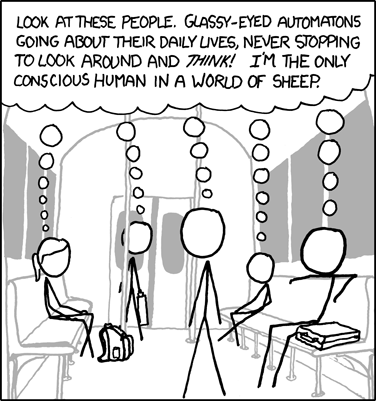
From xkcd.com. I used to think this way too (perhaps due to a little too much Ayn Rand) when it suddenly occurred to me that it was a prideful point of view. Why should I assume my fellowman knows less than I do or thinks less than I do? When I tried working an honest living (cleaning houses) for a summer, I learned that the "average person" seems to be a pretty decent sort. Like me, he can be deceived, but like me, he tries not to be. I could be good friends with the average person.
Sorry about the sporadic updates ... I am working on a big project that is going to be a surprise. I promise to tell you all about it when it's done -- or at least, more done than it is right now.
Subscribe to:
Posts (Atom)
