Pages

Sunday, September 6, 2020

Tolkien, because fair's fair

 It is possible that I am a lot readier to pick apart Lewis than I am with writers I like more. Because, while I absolutely adored Lewis when I was about 6-12 years old, it's not meant for adults and I was always going to find something lacking when I went back to them.

So let's talk about Tolkien. I got into Tolkien at maybe 12 years old, because my brother read the first one to me. Then I tried to read the second on my own, but I wasn't ready. Then something happened and I was ready, and I read them all, and The Silmarillion too. I was in love. Few books transport you to another world so thoroughly--a world that extends much farther than the eye can see in every direction, where the ruins are already moss-grown. You feel like a guest there, seeing a tiny shred of all that can be seen. And that's probably why it's such a great place to write fan fiction. There's room for it.

There are plot and style problems, of course, but I won't get into those. The book clearly works even if it's not written the way theoretically books should be. So long as we all understand it's to be enjoyed, not imitated. You couldn't pull off Tom Bombadil. You probably don't even know when to use thee and when to use thou. Tolkien spoke archaic language like a mother tongue. Those of us who don't, shouldn't try.

The books, though, don't just have archaic language. They have archaic concepts which even when he wrote the books were already beginning to be noticed as a problem.

Tolkien was inspired by the Germanic mythos. He felt that the English nation deserved an epic myth like Germany had, in part because he didn't like seeing English people fall in love with Germany's and start calling themselves Aryan. Here's one point to Ravenclaw (you KNOW Tolkien was Ravenclaw) for being anti-Nazi.

However, I feel like he missed the real problem with this. The whole concept of a romanticized ideal of a nation, with a founding mythos and so on, is a counter-Enlightenment concept which has led to fascism more than once, in more than one country. Instead of saying "we love our country because it has a good government and is fair to everyone," these myths teach us to say, "I love my country because I am English and we are special."

For years I puzzled over the idea of creating a founding mythos for America. Elves in America maybe? But in America, we know who was here before us, and it wasn't elves. White Americans know that exactly zero of us are descended from any special prehistoric elf king. We know we don't belong here. Now, the project has been attempted; it's called Mormonism. But Mormonism's mythos is horrible about Native Americans so . . . it fell right in that pitfall.

The fact is, your birth does not in fact make you special. It's actually important for us to recognize this, because obsessing over birth is a common human failing that's resulted in stuff like declining monarchies with increasingly worthless heirs, to say nothing of ethnic cleansing. And "your birth makes you special" is one of the underlying assumptions throughout Tolkien's work.

Consider: Hobbits are like this. Bilbo is a little different from average. Is that because he's chosen to be? Haha nope, it's because he's part Took and Tooks are a special lineage that's maybe a little bit Elf (but probably not). Dwarves, on the other hand, are like that, and all Dwarves without exception are like that. It's really great that Men, Dwarves, Elves, and Hobbits all have their strengths and can appreciate one another for who they are.

Till you get to Orcs and then it's just awkward. Are Orcs born evil? Do they have free will? When we kill Orcs (which we do, without compunction, throughout the book) are we punishing them for something they couldn't help? I kind of think the concept of an evil race is a serious problem that we should never do.

There's also the assumption of feudal and monarchic bonds throughout. A lot of people read Sam's relationship to Frodo as a romantic one, or just deep friendship. And it's neither of those. It's feudal. Sam goes to Mordor with Frodo, not because he loves Frodo (though it's clear he does, especially as the books progress) but because he is Frodo's gardener. That's why he constantly supports and uplifts Frodo, while Frodo . . . doesn't really return that in kind, ever. Sam is proud to be Frodo's servant, and that makes us feel okay about it where we might not if it were compelled--though, to be clear, most servant-master relationships in Tolkien's day were compelled.

Merry has a feudal bond as well with Theoden, and Pippin with Denethor. Both of them seem someone confused about what the expectations are, in a milieu so different from the Shire, but they end up with a similar kind of pride in their lords as Sam has.

Monarchy is assumed, everywhere but the Shire. Aragorn is going to be the king of Gondor, we understand, because he was descended from Isildur. Not because he's good at ruling (though he is). Even if Denethor had been an excellent ruler and Aragorn had been incompetent or oppressive, it's clear that authority is not given Denethor to deny the return of the king. Despite the fact that Denethor and his ancestors have ruled Gondor for centuries, while Aragorn's ancestors have been toodling about in the North doing whatever it is they do. It's Aragorn's bloodline that makes him worthy of courting Arwen, of curing illnesses with athelas, and of ruling Gondor. It's all very convenient, that in this monarchy there's no dispute between good people about who has the better claim. The people of the city are pretty willing to accept whatever their betters decide, and once Faramir's in charge, he's happy to yield to Aragorn.

I'm not exactly complaining; it was a long enough book as it was without a civil war over the rule of Gondor, or a referendum on who the Gondorians thought most worthy. As a fantasy, it's nice. Unfortunately, a lot of people (myself included, for a while) get a very romantic notion of kingship from these books. They think lineal monarchy results in badasses like Aragorn, who are both naturally virtuous and trained to rule, rising to the throne. In reality, they tend to result in secession wars every few generations, and even if you avoid that, you might get this:

A portrait of Charles II, whose face is deformed through inbreeding

You just don't know! It could be a total mess. But people who romanticize Tolkien often contrast our real government, which of course is light-years from perfect, with fictional monarchies and think that what we really need is hereditary monarchy. Let me assure you: that is the last thing we need.

So: Tolkien, consciously or not, romanticizes racial and family determinism, feudal bonds, and monarchy. And that's not great. But I bet you thought I was going to talk about women, so here I go.

There are not enough women in The Lord of the Rings. (The Silmarillion is a little better; The Hobbit a lot worse.) If I were rewriting it, I'd make Merry, Pippin, Gimli, and maybe Aragorn all female and it would be a noticeably better story. (Sure, you could pick different people; that's my set. I especially like the idea that nobody knows Gimli is a girl till the very end, because female Dwarves look the same as the men.)

But honestly, I think the women that do make it in are portrayed better than the women in C. S. Lewis. Lewis's women are only allowed to be certain ways; if they're too girly that's bad (Lasaraleen, Susan) but if they're not girly enough that's also bad ("wars are ugly when women fight," right before sending children into a literal pitched battle and making a little girl be a battle medic, what the heck?). Tolkien's women are, at any rate, unique. Arwen has only a minor role, yet we see she's making huge sacrifices for love and going against what was expected of her. Galadriel is immensely powerful, overshadowing her husband (who seems to be supportive as heck and not at all threatened). Eowyn is the most fleshed-out of all, and she chafes against the restrictions she is expected to live with. She does go to war (which, surprise surprise, is ugly all-around and not just for her) and being female turns out to be an unexpected advantage.

I'm not entirely happy with the way she just quietly stops being a shieldmaiden at the end; it's not entirely clear to me whether it's because she feels there was something wrong with being one before, or just that she no longer feels herself caged the way she did in Rohan. But I love how Faramir woos her: "I do not offer you my pity. For you are a lady high and valiant and have yourself won renown that shall not be forgotten." That's not the kind of random, meaningless chivalry Lewis's men pour out all over the place. It's specifically tailored to her; he is proud of her accomplishments in battle and has no desire to minimize them or gloss them over. We need more supportive dudes like that.

I still think there should be more women in the book. But there's something special about the way the men are supportive of each other, soft, unafraid to cry, deep and lasting friends. I, myself, don't think that would be at all impossible with women around, as some men do and Tolkien might have done. But I'm almost willing to sacrifice having many female characters for this degree of wholesome masculinity. Sam carrying Frodo up the mountain is one of the most beautiful and moving things in all fiction, and it's an example that more men could stand to look to when it comes to supporting their bros. Steal fireworks! Sing in the tub! Cry for your losses! Just so long as, in the end, you carry each other up the mountains you can't climb alone. I like that the emotional-support roles weren't just shoved off onto any available women, if only because there weren't any.

I would give (and have given) these books to my kids to read and love. I don't think they should be the only books kids read, though. I want books where boys and girls team up to beat the baddies, books where evil kings are overthrown and not replaced with nice kings, books where Orcs turn out to be decent family men who hate having to work for dark lords and are happy to be liberated. It's something to keep in mind, if you ever try writing fantasy. 

Monday, August 31, 2020

Why I am not an Aslanite

It's been a while since we've had a religious post, hasn't it? (Or any post. Jackie does not like me using my laptop and not letting her push buttons.)

I've been reading a review series on C. S. Lewis's Narnia books, which, much as I love them, clearly had a lot of flaws I didn't pick up on the time. Some of which I'm quite happy to continue overlooking, because Lewis didn't like complicated worldbuilding and to be honest, I don't really care where the Beavers got their potatoes during their hundred years of winter. The story still works and the intended audience is kids, who rarely notice that stuff.

But other things actually are problematic, like the Dufflepuds being kept as slaves or Caspian white-savioring all the Narnians even though being the male descendant of conquerors doesn't actually make him more worthy of kingship than any other Son of Adam. (And what is with the necessity of Narnian rulers being human anyway? Doesn't it make sense that Animals would be the best rulers of Animals?)

Most vital, though, is the theology. The Narnia books are heavy allegories, from which I got a lot of my subconscious impressions of Christianity. I certainly read them long before I read any of the Bible, and long into adulthood I've had theological disagreements settled with, "It's just like in Narnia! It makes sense in Narnia, doesn't it?" So I thought I would go over a few of the key theological lessons from Narnia and ask whether they hold water as a comparison with the real world.


Aslan's Death and Resurrection

That's the part that gets cited the most. When I was struggling with the doctrine of the redemption in Christianity, I considered and discarded an awful lot of theological theories. (Did you know there are many, and that more than one is considered acceptable to Catholics?) And the Narnia theory is one of the most cited and believed. Clearly humanity owed some kind of debt because of the evil that we did, and God was obliged to sacrifice a life because of it. Rather than sacrificing ours, he sacrificed his son's, and that's why everything is okay now.

Let's look at how it works in The Lion, The Witch, and the Wardrobe. Edmund betrays his family--or at least, he sides with the Witch over Aslan, and that makes him bad even though he doesn't know who the good guys are when he eats the Witch's enchanted food. He pretends to himself that he doesn't actually mean any harm to his family, but secretly he knows they're going to be hurt. 

Because he's done such a horrible, traitorous thing, the Witch insists that she has the right to Edmund's blood. Aslan backs her up, saying that this is a rule written on the throne of the Emperor across the sea and that Narnia will be destroyed if she doesn't get what she wants.

That's where I get hung up. Why does the Emperor have such a horrible thing written on his throne? Did he write it there? Why? Is the Emperor just really brutal, to have declared the death penalty even for children who do bad things they don't full understand, under the influence of magic? Why did he pick Jadis as his hangwoman, knowing of course that Jadis is super evil? Wouldn't it make sense, if you want to exercise justice and punishment within your realm, to pick someone who's actually on your side to enforce it, so that you can temper the punishments with mercy as applicable?

The Emperor, of course, is not all-powerful, or he could indeed scrub the words off his throne and have nothing bad happen. Nor does he seem to be omniscient, to predict the rules would backfire in this way. (Unless this whole thing was his plan, of course, but it's a pretty complicated and painful plan compared to "nobody has to die ever, I the Emperor say so.")

But there's a loophole in this law, which is that Jadis is entitled to one person, not necessarily the person who did the crime, so if we can talk her into a switch, Edmund can get off. Again, this is a really weird rule for the Emperor to have. What is the point of punishing someone who isn't the criminal? Why is Jadis the one who gets to decide if she's okay with the swap or not?

In Mere Christianity, there's a whole bit justifying this, in that Jesus was "the perfect penitent" since he didn't do anything wrong. But he's justly able to apologize for all sins because he's the one sinned against in every sin. Or something like that. I don't really buy it. Wouldn't he have to be the one who had sinned in every sin to be able to apologize for every sin?

It's just really odd that one of our intuitions ("bad people should be punished") is in fact a law so strong it binds even God, but the other one ("the punishment should be applied to the bad person, specifically") is not. Again, where do laws that bind God come from? From logic? Who was supposed to have created logic?

The Stone Table scene is beautiful and moving if you are a Christian, but if you're not, it just seems kind of upsetting. None of it makes any real sense. And I don't think it brings us any closer to a reasonable understanding of what redemption could mean.


Not a Tame Lion

This is a line that appears over and over in the books whenever Aslan does things we don't like. After all, he's not tame. He does what he wants and he comes and goes as he pleases, you can't expect any given thing of him. But you are supposed to trust him. Also he may roar at you at random, and most of his appearances involve him being stern and scary.

I remember Aslan being a snuggly, nice lion, because of the romp scenes with Lucy and Susan in the first and second books. But skimming back through, not every character gets such a positive experience. Most of Aslan's appearances, he's no fun at all, and he's often terrifying. Take Jill's first experience of him:

But although the sight of the water made her feel ten times thirstier than before, she didn’t rush forward and drink. She stood as still as if she had been turned into stone, with her mouth wide open. And she had a very good reason; just on this side of the stream lay the lion.

   It lay with its head raised and its two fore-paws out in front of it, like the lions in Trafalgar Square. She knew at once that it had seen her, for its eyes looked straight into hers for a moment and then turned away—as if it knew her quite well and didn’t think much of her.

This, by the way, is how for years I pictured God looking at me. As if he knew me quite well and didn't think much of me. And no matter how much I told myself he wasn't like that, I couldn't help seeing that version when I closed my eyes. I kinda want to blame Lewis for that.

“If I run away, it’ll be after me in a moment,” thought Jill. “And if I go on, I shall run straight into its mouth.” Anyway, she couldn’t have moved if she had tried, and she couldn’t take her eyes off it. How long this lasted, she could not be sure; it seemed like hours. And the thirst became so bad that she almost felt she would not mind being eaten by the lion if only she could be sure of getting a mouthful of water first.
   “If you’re thirsty, you may drink.”
   [...She] realized that it was the lion speaking. Anyway, she had seen its lips move this time, and the voice was not like a man’s. It was deeper, wilder, and stronger; a sort of heavy, golden voice. It did not make her any less frightened than she had been before, but it made her frightened in rather a different way.
   “Are you not thirsty?” said the Lion.
   “I’m dying of thirst,” said Jill.
   “Then drink,” said the Lion.
   “May I—could I—would you mind going away while I do?” said Jill.
   The Lion answered this only by a look and a very low growl. And as Jill gazed at its motionless bulk, she realized that she might as well have asked the whole mountain to move aside for her convenience.
   The delicious rippling noise of the stream was driving her nearly frantic.
   “Will you promise not to—do anything to me, if I do come?” said Jill.
   “I make no promise,” said the Lion.
   Jill was so thirsty now that, without noticing it, she had come a step nearer.
   “Do you eat girls?” she said.
   “I have swallowed up girls and boys, women and men, kings and emperors, cities and realms,” said the Lion. It didn’t say this as if it were boasting, nor as if it were sorry, nor as if it were angry. It just said it.
   “I daren’t come and drink,” said Jill.
   “Then you will die of thirst,” said the Lion.
   “Oh dear!” said Jill, coming another step nearer. “I suppose I must go and look for another stream then.”
   “There is no other stream,” said the Lion.


The poor girl has never heard of Aslan till this morning. She has no reason to know Aslan is good. And Aslan does not seem to care to convince her. He's just . . . I don't know how to describe this but throwing his weight around. Demonstrating to her that she has to trust him because she has no choice.

And I could take this as just happening for plot reasons (though it seems very deliberate to me) if it were not that this is exactly how I've heard being Christian described. Is it horrible a lot of the time? Yeah. Has it historically harmed people? Oh definitely. But you don't have a choice because you will perish if you don't obey.

I'm sorry, that's just a . . . really terrible worldview! One which people believe with complete sincerity. And yet later, we will be told that Puddleglum chooses to believe in Aslan because even if it's false, it's better. It doesn't seem that much better to me! If we can choose to believe in things that are nice, simply because they are nice, I would choose to believe in an Aslan who said, "You poor thing, you must be so traumatized from seeing Eustace topple off a cliff; it wasn't your fault, okay? And I'm sorry about all the terrible bullying you're going through. By the end of this book you won't ever get bullied again."

But Aslan never does what a decent person would do, because he's not "tame." I'm not tame either, but I'm still capable of being compassionate. Having a God who can be predicted to take compassionate actions isn't "taming" God or attempting to "put him in a box." It's predicting his behavior based on his known nature. Why can't we do that?

Of course, for plot reasons it's necessary for Aslan to hold back from pitching in until things are horribly desperate, and to fail to explain things just so we can be kept in suspense. But for theological reasons, it's just as necessary. Because, while there is little we can say about God, we can say with certainty that he doesn't intervene to help when people are in trouble or provide comfort when we're sad, not with any reliable consistency. Just like Aslan.


Puddleglum's Stomp

Next, since I just referred to it, let's talk about that pivotal scene in The Silver Chair, when Puddleglum stomps on the fire and tells the witch that the sun and Aslan are real, and even if not, he'll still believe in them.

“One word, Ma’am,” he said, coming back from the fire; limping, because of the pain. “One word. All you’ve been saying is quite right, I shouldn’t wonder. I’m a chap who always liked to know the worst and then put the best face I can on it. So I won’t deny any of what you said. But there’s one thing more to be said, even so. Suppose we have only dreamed, or made up, all those things—trees and grass and sun and moon and stars and Aslan himself. Suppose we have. Then all I can say is that, in that case, the made-up things seem a good deal more important than the real ones. Suppose this black pit of a kingdom of yours is the only world. Well, it strikes me as a pretty poor one. And that’s a funny thing, when you come to think of it. We’re just babies making up a game, if you’re right. But four babies playing a game can make a play-world which licks your real world hollow. That’s why I’m going to stand by the play-world. I’m on Aslan’s side even if there isn’t any Aslan to lead it. I’m going to live as like a Narnian as I can even if there isn’t any Narnia. So, thanking you kindly for our supper, if these two gentlemen and the young lady are ready, we’re leaving your court at once and setting out in the dark to spend our lives looking for Overland. Not that our lives will be very long, I should think; but that’s small loss if the world’s as dull a place as you say.”

People cite this scene a lot, as what it's really like to almost become an atheist and then turn back to believing again. Because you can get into a state of mind where you almost don't believe, but you can (and should) always turn back and believe again.

The first issue is that enchantment isn't real, so when you almost don't believe in God, it's probably because of reasons that seem true to your mind. (Or perhaps a deep depression--seeing the visible world as a nasty, gray, underground hole is definitely a sign of depression.) So there's no real reason to assume that the thought that God isn't real is less reliable than the thought you previously had that said he was.

The second is that there are any number of possibilities with different levels of optimism. There are much nicer realities we could choose to believe in than Christianity: we could believe in a completely agreeable deity who saves everyone regardless of what they do, who approves of any conceivable action we might want to take. We could believe that aliens are shortly going to come and take us all to a better place. We could choose to believe in fairies! Puddleglum is choosing between a simple binary: cruddy underground kingdom, or the nice world he half-remembers from outside. We are not.

And the third, at most vital, problem with this is that reality actually matters. You can't navigate the world you live in if you're in denial about what world it is. If Puddleglum thinks the Overland exists when it doesn't and spends his life looking for it in vain, he'll waste any number of opportunities to make the real, underground world better. What if his dream of a sun is an inspiration to create a fusion reactor? Sure, that's not as cool or poetic, but it could improve the lives of everyone down there.

It's really hard for me to argue why it's good to believe the truth, because the truth is what believing is for. Our minds are a tool that's principally good for finding the truth about things and making plans for how to navigate that truth. If you refuse to use it that way, it's kind of like using the good sewing scissors making paper dolls. Sure you can, but it's a terrible waste of something that's good for more than that. And yes, I do think willfully believing false things on purpose will ruin your mind in the long run, just like paper does to sewing scissors.


Things People Secretly Know

In Narnia, it's a very common experience for people to claim, even within their private thoughts, to believe one thing, while actually they secretly know or suspect they're wrong.

Digory knows he's not enchanted into ringing the bell that wakes Jadis, but he pretends he is.

Edmund knows the White Witch will be cruel to his siblings, but he pretends to himself that they'll be treated well.

In Prince Caspian, Susan secretly knows Lucy is telling the truth about having seen Aslan showing the path out of the woods, but ignores that because she's in such a hurry to get out of the woods.

Self-deception is a real thing! I'm not going to pretend (even to myself, haha) that it's not. We sometimes simultaneously believe two things, and keep one uppermost in our mind because it's the one that jives best with our self-image. I get that.

But it's not actually easy to tell which one is real, so the amount of blame characters get for doing this is pretty frustrating. It's not like being confused about which thing you believe is a moral fault. It's more that figuring out the truth is hard. I would blame Susan if she explicitly knew Lucy was telling the truth and lied and said she wasn't (you know, like Edmund does about the wardrobe after his first visit) but in this case, she's not even aware she's deceiving herself till afterwards . . . yet it's still considered a fault.

I also call BS on many of these circumstances, because if these characters really secretly believed in what they claim to, they wouldn't act the way they do. For instance, if Susan secretly knows Lucy saw Aslan showing the path out of the forest, and she's in a tremendous hurry to get out of the forest . . . wouldn't she immediately follow Lucy? Her behavior only makes sense if she really, truly does not believe Lucy.

Compare to a Christian who, on some level, knows God isn't real but pretends to herself she does. (This isn't any of you, this is me immediately pre-deconversion, okay?) If you ask her if she expects a miracle to happen, she might say there's a chance of it. But the true belief is visible in the fact that she never acts like she has the slightest expectation that a miracle will  happen. If people actually believed, strongly believed, in hellfire, they would never even be tempted to commit mortal sins. Why not? Well because nothing could be worse than hellfire, certainly not a missed opportunity to commit some good sins. If people really believed that prayer would have vast positive results in their lives, they wouldn't be lazy about it. I'm not lazy about taking my vitamins, because I know they work well and have experienced this! I got lazy about praying sometimes, as everyone does, because I had tried that approach and had no good effects.

If Edmund really thought that the Witch was going to be horribly cruel to his siblings, he wouldn't rush back to her like that because he would be afraid for his own life. If she's like that to them, she could be like that to him. But he doesn't worry a  bit about it, because in fact he doesn't think of her as a cruel person at all. Not explicitly, and not "secretly" either.

But this is part and parcel of Lewis's belief that atheists secretly know God is real and are just pretending they don't. Or that every bad action that we think isn't willful, truly is on some secret level. He wants us to believe we are all much more responsible for our mistakes than we are. And I think that gave me a lot of shame as a kid, worrying that what I thought were mistakes were really something I could have resisted if I'd tried harder. The Narnian kids are never, ever given any leeway for mistakes. Aslan always knows they're lying, even when they don't. That was a pretty scary thing to believe as a kid.


Liar, Lunatic, or True Narnian

When Lucy first comes back from visiting Narnia, the other kids don't believe her. Which seems reasonable, since she's making extraordinary claims and they checked the back of the wardrobe.

We learn, over the course of the story, that believing Lucy on no proof is virtuous. Always. She is always one hundred percent reliable, and she's usually put in positions where she's the only witness of Aslan so you have no choice to believe her. We know, as the reader, that she's telling the truth, but the other characters don't. They're still supposed to believe, because believing on no evidence is Good. (But not, you know, believing the White Witch or Shift the ape or the Green Lady or the Giants, whom we are supposed to figure out are Bad.) This is part of Lewis's moral lesson he's trying to make about faith.

   "We were afraid it mightn't even be lying," said Susan; "we thought there might be something wrong with Lucy."
   "Madness, you mean?" said the Professor quite coolly. "Oh, you can make your minds easy about that. One has only to look at her and talk to her to see that she is not mad."
   "But then," said Susan, and stopped. She had never dreamed that a grown-up would talk like the Professor and didn't know what to think.
   "Logic!" said the Professor half to himself. "Why don't they teach logic at these schools? There are only three possibilities. Either your sister is telling lies, or she is mad, or she is telling the truth. You know she doesn't tell lies and it is obvious that she is not mad. For the moment then and unless any further evidence turns up, we must assume that she is telling the truth."

This is a restatement of Lewis's "Liar, Lunatic, or Lord" trilemma about Jesus. If a person isn't known for being a liar, and they aren't obviously insane, they must be telling the truth.

It's wrong in Mere Christianity, and it's wrong here too. There are so many other things that could be going on here. Maybe the mothballs are hallucinogenic and Lucy had a wild dream in the wardrobe. Maybe she's traumatized by the separation from her parents and is turning to her imagination so strongly that she can't tell the difference anymore. Mental illness isn't actually diagnosible by "only looking at" someone, and even people who are mentally healthy may occasionally hallucinate, experience mass hysteria, or be deceived. There are so many reasons why people say things that aren't true besides that they are lying or crazy.

But Lewis doesn't seem to believe so. Everyone who is wrong "secretly knows" that they're wrong, in his books. Nobody sees a swatch of tawny leaves in the woods and hopes so much to see Aslan that they think it might be him. Nobody is scared or doubtful of Aslan unless they're secretly bad. I get that it's a kids' book and things are simplified, but I think Lewis actually believed this to some degree. The Apostles couldn't hope that Jesus is somehow still alive and have some spiritual, nonphysical experiences that got magnified by later writers into physical appearances. Nope. They are con men, lunatics (which they can't be, because they can put sentences together), or Jesus is alive. 

The unpleasant corollary of this is that the prophets of other religions are all liars or lunatics, because we take as given that they're not lords. It also seems that Lewis believes atheists are lying too, at least if we take Edmund and Susan as examples. Each claims, at one point, that Narnia was only just a game, but both clearly know that's not the case. 

I don't know how to prove that atheists do not, in fact, secretly know that God is real. Except, I guess, that there's no real benefit in it. If I knew I was going to burn for eternity for lying about believing in God, I can't think why I'd do it. I want to act ethically--it's my primary motivation most of the time--so failing to use the best information available on how to do that would be pretty dumb of me. Just like it's pretty dumb of Susan or Edmund to pretend Narnia isn't real. What do they get out of it? How is Edmund going to tempt his siblings into Narnia so he can get another hit of magic candy if he pretends it's not there? 


Worshiping Aslan All Along

Time to talk about my least favorite Narnia book, The Last Battle. Mostly I hate it because it ends all of Narnia; I would have preferred not to read it and let Narnia continue on indefinitely in my imagination. Second, I hate it because Lewis did Susan dirty. I don't think he hated Susan particularly; I think he just wanted to make a point about how even people who have truly experienced God can wander away from him. But, like I said, Susan actually does believe and is lying, which makes her a very bad example of an atheist.

But let me talk about a bit people really love, which is where Emeth, a follower of the false god Tash, finds out Aslan is the true God of Narnia.

“Then I fell at his feet and thought, Surely this is the hour of death, for the Lion (who is worthy of all honour) will know that I have served Tash all my days and not him. Nevertheless, it is better to see the Lion and die than to be Tisroc of the world and live and not to have seen him. But the Glorious One bent down his golden head and touched my forehead with his tongue and said, Son, thou art welcome. But I said, Alas Lord, I am no son of thine but the servant of Tash. He answered, Child, all the service thou hast done to Tash, I account as service done to me. Then by reasons of my great desire for wisdom and understanding, I overcame my fear and questioned the Glorious One and said, Lord, is it then true, as the Ape said, that thou and Tash are one? The Lion growled so that the earth shook (but his wrath was not against me) and said, It is false. Not because he and I are one, but because we are opposites, I take to me the services which thou hast done to him. For I and he are of such different kinds that no service which is vile can be done to me, and none which is not vile can be done to him. Therefore if any man swear by Tash and keep his oath for the oath’s sake, it is by me that he has truly sworn, though he know it not, and it is I who reward him. And if any man do a cruelty in my name, then, though he says the name Aslan, it is Tash whom he serves and by Tash his deed is accepted. Dost thou understand, Child? I said, Lord, thou knowest how much I understand. But I said also (for the truth constrained me), Yet I have been seeking Tash all my days. Beloved, said the Glorious One, unless thy desire had been for me thou wouldst not have sought so long and so truly. For all find what they truly seek.”

I don't entirely hate this. I do think you can worship a better deity than you think you do, if as you pray you imagine something a little different than the texts describe. And there are people who worship a pretty horrific version of the Christian God, as you can tell by what they think that God will do to people they don't like.

But it feels very disrespectful of people's agency to just say, hey, you're one of us now! I like the idea that I could die and pick a deity who best embodied what I sought in my lifetime. I don't like being told by other people that I'm secretly Christian even though I am not. I guess it's because the focus isn't on whether God is acceptable to me, but on whether I will be acceptable to a God I didn't choose. Does that sound horribly egotistical? I just think that people should have the agency to decide for themselves if they really were "worshiping God all along." And maybe that is meant by Emeth falling at Aslan's feet, that Emeth recognizes that Aslan is what he in fact wants. That just isn't the part that people focus on when they cite this verse at me. They think they are reassuring me when they say I might really be one of them. In reality, it feels like they're reassuring themselves--because they believe there is only one right answer, and they want to believe that I'll make it in somehow.


I still like the books, on some level. The scenery is beautiful, the style is charming, and if none of the human characters have that much agency in the plot, I never noticed that while reading them. I've given the books to my kids, and they love them too.

But I don't buy the theological lessons that are in these books. I am not sure I ever could have if I were older and not primed to read them like scripture. Maybe Tolkien was right and allegory is a fool's game. (Want me to write a post nitpicking Tolkien? No, right? I would hate doing it because of course it has flaws, but man, those books were formative.)

Friday, July 24, 2020

Agoraphobia

I've never really liked going out. I mean, sure, as a kid I enjoyed the park and the beach, but I preferred to sit in the car for an hour than go into the store with my mom. Going to school every day was this whole exhausting thing.

At boarding school it got worse. A lot worse. Our only trips out were to the park, and that wasn't too bad since I like the outdoors. But every once in a while I would accompany an adult to the store (they weren't allowed to be alone, ever) and it was horrible. Ads everywhere. So many brands. Music. Noise. Strangers. I felt like I was braving the devil's territory. Airports were even worse.

I got over that some when I got back. I think what it really was, was a lack of practice. If you haven't been to a grocery store for a year, it's a big overwhelming experience. If you go a lot and know your way around, it's no big thing. I went to community college and had a number of jobs and the leaving the house bit was tiring, but I wasn't scared to.

Kids, of course, changed the equation. There's just so much to remember and so many ways your attention is divided. You've got to have diapers and wipes and spare clothes and keys and a wallet and sunglasses and sunscreen and a sweater and and and ..... And of course you can't come home without the bread or the milk you left to get. I pride myself that I usually make it through without disaster, but the effort of making sure it's not a disaster is real.

Over the past couple of years, I have worked hard at building normal adult routines. Leaving the house every day, dressing up for work, doing the work, maybe even going to work and doing several chores on the same day! Making phone calls the day I think of it instead of months later. Having meetings with teachers at school where I don't forget what day it is and where I show up with my ID so I can get in. I can't say it's been a huge success. I mean, this past year I did hold down a job and even kept records of what the  kids were learning without anybody telling me to. I felt like I was adulting well, but it wiped me out. Jackie too--I mean, that was a big part of it, that two hours at daycare made her need constant attention for an hour or two before and after. Before the pandemic, I'd already decided not to do it a second year. I was going to try to put Jackie in preschool, but while she was there I wanted to stay home. I thought maybe I could take an editing job. Just anything where I didn't have to put on uncomfortable clothes and remember twelve different items.

The pandemic took a big burden off my plate. There's no work, no preschool, and no big kid school. I don't have to remember what day or time it is. I don't have to get dressed at any given hour or find anybody's shoes for them or pack any lunches. At first this felt like a relief.

But the lack of structure is really getting to me. I'm trying to build my own routines, but it's not the same. Whole days seem to just disappear into filling sippy cups and scrolling facebook. Like, where do they even go? Why is it four in the afternoon? When did that happen?

Worse, I'm out of practice going out, and that means every trip out is that much harder. Where are my keys now? Where's my purse? Why aren't my sunglasses in the car? This, of course, isn't helped by the extra stuff I have to do because of the pandemic: wash my hands, forget and touch my face as I'm heading out the door, wash my hands again, find my mask, check if the store is even open at the same hours, worry about what might not be in stock . . .

Then I get there and it's this whole overwhelming thing, just like when I was in boarding school. Noise! Strangers who may or may not be scowling at me! Signs! Remembering not to touch my face! The stress I feel morphs into fear, as I remember that I could catch the coronavirus on this trip, and that it's my job to do all the things to make sure I don't. I can't just decide not to care, like with many of my other fears I can choose to ignore. I'm anxious all the time about whether there's hand sanitizer at the entrance, whether everyone is masked, whether the aisles are one-way now, whether I'm keeping my six feet (or whether I can, in a narrow aisle), whether people are mad at me, whether they think I'm mad at them, whether I'll accidentally try to buy more loaves of bread than the limit, whether someone will spit or cough on me on purpose because they think the virus is a hoax, whether they'll have any tuna . . . on top of all my usual store fears of going over budget, forgetting something important, forgetting the reusable bags, or embarrassing myself.

Some of these fears are rational, and some are not. So far I haven't caught the coronavirus or been spit on. I have tried to buy too much bread, bumped into people, forgotten bags, and embarrassed myself. My emotional reactions to going on out seem to be getting worse. My mask makes me feel like I'm gagging, and while I know there's no physical reason for this, I can't think it away.

I feel really ashamed of this. As long as I can cope with it, it's my problem only, but if I decide I can't do it? If I order groceries or have John do it? Well, then I'm a failure. My fear of going out is making me incapable of doing something that has always been my job--something I want to be doing myself. I'm not even any good at making a list for someone else, because I can't remember the stuff I need to buy till I see it. (Somebody needs to make a VR Instacart.) I feel like I do so little as it is, especially with my job gone. How do I justify my existence if I can't go out? How do I feel like a grownup if I can't go out?

Even deeper than this fear is the fear that, the more I cede ground to my fear, the less I'll be able to face it. What if I give up grocery shopping, and then the library becomes overwhelming? What if I give up the library and then the park is too much? What if I can't see my friends anymore, even when the pandemic is over? I know lack of exposure makes it worse. So is this pandemic going to set off a chain reaction that ends with me being somebody's weird grandma who lives in a single dark room with the curtains drawn, and she'll text but you can't call because the phone is too scary?

For now, I'm keeping up with groceries. I went to the closer store the other day for just a couple items and that was pretty okay. Everyone was masked and I didn't stay long enough for my mask to bother me. Sunday I'm supposed to go to the further, cheaper store, where I usually take a good 45 minutes to get my shopping done. Last time I went, I thought I was going to puke in the parking lot, the stress got to me so much by the end. I am trying not to psych myself out that this time will be the same. Maybe it'll be different. I'm going to make myself a better mask with a nose bridge and elastic on the sides instead of bias tape, and maybe that will help. I need to succeed at this.

John says it doesn't matter if I can't. That not being able to go out in a pandemic is not the same as not being able to go out ever. That when it's over, I can slowly step up where I go, knowing this time that there's less to worry about. That giving up the store trip now doesn't condemn me to being bricked up onside the house for the rest of my life. I know he's right. But I'm scared, all the same.

Am I the only one who is getting like this lately?
Does anybody still read this blog?

Thursday, June 11, 2020

7 birthday takes

1

I had a birthday on the 7th. Not much notable; it's only 34, not a red-letter birthday. But I did get some nice presents, and we had cake in a friend's yard, each family on a different blanket a distance apart. Jackie has finally stopped crying about the birthday song and participated happily, but then melted down because there were no candles for me to blow out. Sorry, kid, expectorating aerosols all over something we're all gonna eat just doesn't appeal anymore. I wonder if that tradition is gone for good.


2

Black lives matter, right?

I about had steam coming out my ears today when I read a blog post where someone explained why she wasn't obligated to do an anti-racism post "just because it's in vogue right now." This is true. Nobody needs to say something right at this exact second. Hopefully, one has already said something, so that there's no doubt where they stand. You don't have to jump on the bandwagon if you were already on it.

But yeah, you do at some point, as a white person in America, have to "come out" as anti-racist. Because there are a lot of racists still in this country, and they rely on the rest of us to be quiet and not say anything, maybe get quietly flabbergasted if they're too blatant, but to look the other way so long as they're subtle about it. I want racists to notice that allll their friends have a problem with that behavior. I want them to feel uncomfortable at my parties the way I feel uncomfortable at their parties. I want them to wonder if maybe they're wrong. And if they don't get that far, I want them to realize the consensus is so far against them that they can't just spew bigotry all over the place.

I feel like nobody is in any doubt about my views, but I'm vehemently anti-racist and in favor of those protesting police brutality. The latter is a subject I've been following since my libertarian days, first because I was shocked that officers of the state would act that way, and later because I realized there is also a racial bias in who is getting targeted for this behavior. (I haven't noticed the All Lives Matter folks actually doing what I did in those early days, and vocally objecting to police brutality when it's visited on a white person. But I have seen Black Lives Matter people with pictures of white victims on their sighs. Funny, that. Reminds me, more than anything, of people who dismiss COVID with "the flu is worse" but didn't get their flu shot.)

The longer I've followed the issue, the more ugly stuff I've uncovered. Lynching, redlining, massive resistance, Tulsa massacre, MOVE bombing. The history is chilling, and there's no golden moment you can point to when racism suddenly ended. It's still with us.

I think a lot of white people grew up thinking racism was over. Just something people used to think, back in the olden days when people were inexplicably stupid, and is now gone and we are all equal and friends. I sure did. So when you notice how unequal the outcomes are -- and you'd have to be oblivious not to notice the difference in wages, net worth, rates of incarceration, etc. -- the automatic assumption is that Black people are inferior. That they're just not as smart as we are, not as virtuous, not as good at raising their kids. You don't say that out loud, because you know that's rude to say, but deep down you think there must be something about it. If, after all, the opportunities are all equal now.

Well, these days people are saying it out loud a lot more. And the rest of us have had to take a long, hard look and ask: are the opportunities as equal as I thought? And they are not; they are emphatically not. They're not equal when a Black person looks for a job, when they apply for a mortgage, when they are under suspicion by police, when they have their day in court. None of this is equal in any way. And if you take as given that a black person is your equal in every interior way, you have to admit this. Equality of opportunity was promised, but it has not arrived. And that means that the things you strove for and achieved, a Black person just like you strove for just as hard and could not achieve.

It's hard to accept that. Especially when you had such a shining vision of America, where everything was free and fair. And I see why people turn away from it and try to come up with another explanation. But the right thing to do is to open your eyes and look. Even when it hurts.

3

To that end, we went to the BLM march in our town. OUR town. You know, the itty bitty, kinda racist one? We actually had a march!

I wasn't really meaning to go, on account of coronavirus, but I figured a few spaced-out people, outdoors, in masks, should be fine.

Well, actually it was enormous. Over a thousand people came. I have never seen a crowd like that in my town, not for a fair or a concert or anything. There were Black people, there were white people, there were Republicans! There were Catholics that I knew. There were cops marching along. I just . . . I was deeply, deeply moved. So often I feel alone, living here, as if the whole town was one big redneck monolith. And it is not. Not only is it not all rednecks (there were people with purple hair! there were Episcopalian women ministers! there were people with rainbow shirts!) but the rednecks are often as anti-racist as the purple-haired ladies. Everyone was there. Everyone cared. It meant so much.

Ahead of the event, there were warnings on facebook that there would be armed counterprotesters, or that people had threatened to drive into the crowd. That did not happen. There was one suspicious truck with Confederate flags that drove around nearby, but the road was blocked by police cars, and if they had any bad intent, they didn't carry it out. Also when we marched by a diner, three bored-looking young men idly booed. I don't know if they were counterprotesters or just obnoxious.

The boys were not enthused about being there, so they just held my hand and walked along. Miriam was very excited and held her sign up high and did all the chants. The next day she was still running around the house hollering "No Justice, No Peace!"


I don't know what is so special about this moment, compared to other times a high-profile police killing sparked protests. But I do believe it's making a difference. More and more people who never said anything before are now starting to oppose racism and delve into the history of it. Towns are considering massive overhauls of their police departments. Even Congress is mulling over options. I think maybe some change is actually going to happen. But, of course, we can't let this be a one-moment thing. People are going to need to keep the pressure up, not just by marching in the streets but by every method open: voting, keeping tabs on whether our elected officials are keeping their promises, even running ourselves. People more deeply involved than I am could surely recommend a lot of ideas.

2020 has been a dumpster fire of a year, but this whole thing might be the bright spot. As horrible and terrifying as some of it has been. Peaceful protesters maced and beaten, an old man pushed over till he cracked his skull, a young woman tear-gassed to death, just now I read that cops are cutting people's wrists on purpose when they take their zip-ties off. It's sickening stuff. But I think the police are only proving the point that they can't be given unchecked authority like this. Nobody can.

4

Okay, moving on from that. Because most of my life has not been marching in protests, it's been staying at home every day with a passel of bored children.


Really, they're doing okay. Much better than previous summers, even without access to the pool and the park and their friends. We managed one outing to the national forest and waded in a creek, and we filled up the wading pool. I painted the back deck, like I've been meaning to do for about a year. We've played outside. Currently Marko is making up a collectible card game involving dinosaurs. Miriam and Jackie decided to learn sign language today. Some days Michael and Jackie pair off to build with blocks and Marko and Miriam play Star Wars in the yard. That's not a pairing that ever used to happen. That's the nice thing about having four kids, they resort themselves all the time so they're not getting annoyed with the same playmate all day.


School is over, and good riddance. I don't know what we're doing for school next year, because I don't know what the school is doing. My guess is that whatever they do will be chaotic, a compromise between not spreading germs and still educating in which both goals lose about half the time. So I may be homeschooling. I don't want to, but it may be the best of the available options. I'm also thinking that it may be a relief to the school not to have to deal with all of my kids, so they can focus on the kids whose parents aren't home to teach them all day, and the special needs kids who were actually getting something out of all that therapy. (Marko . . . has really not seemed to, lately.)

5

I started querying the novel I started last November, the solar sailing one. The last thing I did before sending it out was dive deep into the physics to figure out how fast my ship could go, how big the sails would have to be, and how exactly it all works. To my shock I found I had totally missed that sails can take you both away from and toward the sun, because you can set the sail at an angle and get enough thrust to degrade your orbit so you fall sunward. This messes with some plot details, but it also meant I got to add a lot more sailing bits to account for that.

Then I had so much fun with the math, including lots of diagrams and Excel charts and new physics formulas, that I thought, you know what I could be doing? More math!

So I'm trying to learn more math, but it's slow going. Somebody heard of teaching math on the internet and thought, what we'll do is VIDEOS. But I hate videos; they never go the speed I think. (The speed I think is 90 mph, freeze, glitch, 90 mph, wander sideways, wait, what is this video about?) Plus then the kids are like, "What is that? What's a percent? Why isn't that like the math I do?"

Someday, I think I would like to take some math and science courses. Christendom was sadly lacking in both. Science, I love for its own sake. Math, I mostly like for the sake of being able to do science with it, but algebra is pretty fun.

6

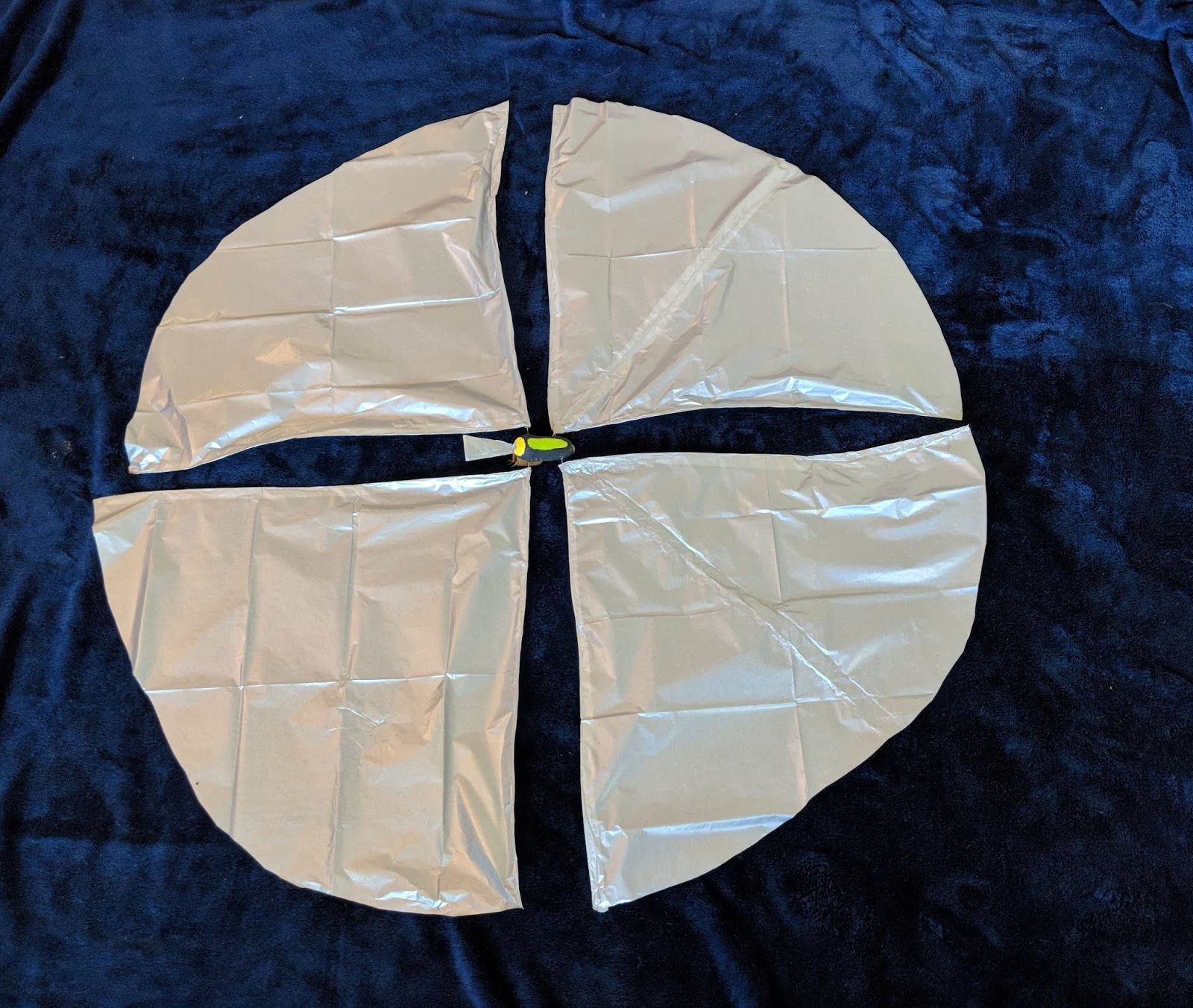
Oh, and on the topic of solar sails, I made a model. It's still not right. The sails should be bigger and shinier. Think ten feet across and shiny as a mirror. I'm not sure what materials I could use to make that happen. Heck, I'm not sure what my astronauts will use either. It's the future, let's assume they have figured some things out.


7

Things are slowly reopening, even though coronavirus is far from gone. I find this terrifying, even though I knew it was going to happen at some point. I mean, I find going out terrifying enough as it is. On any given outing, I could forget my purse, lose a kid in the store, get heckled by a stranger, burst into tears at the cash register, get lost on the way home, have to change a dirty child when I didn't bring any spare clothes, get a flat tire, get in a wreck, stammer, get pulled over, run into somebody I know and find they don't like me anymore . . . on and on. Now I get the added joy of worrying I will forget my mask, worrying I will touch my face, worrying I will cough, worrying I will forget to wash my hands when I get home, worrying the groceries are contaminated, worrying people are giving me the stink eye for wearing a mask, worrying they will think I am giving them the stink eye for not wearing one, worrying that people won't know I'm friendly if they can't see me smiling, worrying that people are mad at me because I can't see them smile, worrying people won't be able to understand me because my voice is muffled, worrying I misheard someone because their voice is muffled . . . .

Let's just say the social anxiety slash agoraphobia is worse than ever. And I don't even know if it's going to get better when all this is over, or whether this has scarred me so much I'll huddle at home for all of 2021 too.

John is back at work, and of course that worries me too. He's going to be doing hold pickups at the library, which means dealing with the public in a city that's been much harder hit by coronavirus so far than ours. He'll have a mask and precautions are being taken, but I still don't have to like it. However, I'm extremely thankful for our own local library's curbside pickups, so I can hardly begrudge the patrons John serves. I just hope they don't cough on him.

How are you all doing, in the Year of Chaos Twenty Twenty? 

Tuesday, May 26, 2020

Animal Crossing, that capitalist hellscape

I am not much of a gamer. I play exactly two video games: Stardew Valley and Animal Crossing. I just really like going around picking cherries while peaceful music plays, I guess.

But I've been thinking a lot about how different they are, economically. In SV, you inherit a house from your beloved grandpa, fix it up, and start farming on a small scale. In AC, you purchase a "deserted island getaway package" from Tom Nook, and spend the rest of the game making it as little like the deserted island you came to as possible.

It occurs to me that Stardew Valley is a distributist paradise. Land owned free and clear, small workshops, everything purchased for cash only. The villain is Joja Corp, the awful company that runs the chain grocery store across the river. Everyone has a job and contributes something to the rest of the town. And almost everything you need is available locally.

Animal Crossing, on the other hand, is firmly capitalist. House upgrades are always bought on credit. You're always trying to make the island bigger and more developed. And most of the decorations you can buy are kitchy and commercial: vending machine, port-a-potty, cotton candy stand. Nobody in the town works, because they have purchased the experience of an island getaway.

Distributism, I believe, is more of an ideal than a practical system. Of course having the means of production broadly distributed is a good thing. But I have read a lot of Chesterton and Belloc trying to figure out how they intended to do it, and remains vague. In a way, it's almost an aesthetic: these things are good and fit with the scheme; those are not. That's why I don't identify as a distributist anymore; the ideals are great but I don't trust anybody that's vague on details.

That said, I do think that there are reasons why a place would become a capitalist hellscape rather than a distributist paradise, and vice versa. After all, there's no truly free market. We have regulations and limitations. It seems to me that having easy credit, a stock market (or, in AC, the stalk market, for selling turnips), and millionaires like Tom Nook are going to push an economy into a large-scale, very un-distributed kind of capitalism.

So what am I saying here?

I am saying that the Able Sisters, Blathers the owl, and I are going to rise up and overthrow Tom Nook. Too long have I sold and purchased everything at the same company store! Too long have I paid money for the privilege of giving away some of my precious, unspoilt island for Tom Nook to sell to a stranger! Too long have I picked native weeds to plant hothouse flowers in rows! Too long have I sweated for his meaningless five-star rating and concerts with a mediocre dog guitarist!

Vive la revolution!

Thursday, April 16, 2020

Let's call this individualized education

E-schooling may be the thing that does me in.

The first two weeks we basically did nothing, because the school extended spring break to give themselves a chance to plan something. It was great. We watched a lot of documentaries.

After that we were emailed a giant packet for each kid, with pages to print for each day. The computer fought me about printing everything in the proper format, but I got the pages for them to do. Or, for at least one kid, to scream at and refuse to do any.

Then they had a drive-thru to pick up print copies because obviously not everyone has a printer or can afford to toner to print out 90 pages per kid.

I thought that was just how it was going to be, set up a nice routine to do the work, and eventually got Marko doing most of it. But it turned out that was only enough for two weeks, and at the end of that they rolled out yet another system. Except that it's not so much a system as a giant flood of different stuff.

Each child's teacher has a different system for informing us what work needs to be done, and in Marko's case, uploading the work after. I have had to log into half a dozen sites, and since they all have to log each other out and themselves in, I have to remember all those logins. For extra fun, one of the sites had "first initial and last name" for a login. All three of my school kids have the same first initial and last name!

Miriam has her work in a Google Slides presentation with different categories for subject and week. There are these itty bitty YouTube videos embedded which take a deft hand to pop out so they're viewable.

Michael's teacher is my favorite right now, because all the work for each day is on one page. I can open ONE file and know what his work is for the day. Also, all of the work is independent, which of course means the world when I have the other three all needing attention at every moment. (Not that Michael doesn't still demand attention, but at least it's theoretically possible for him to do it all.) Downside is, all of it is on the computer and we have only two computers. Also a tablet, but not all of the learning websites work on it, and anyway Jackie's got it most of the time we're doing school. Also the second day of school I couldn't find the document because it was posted on the general stream of the Class Dojo app and somehow the app doesn't think I need to see posts from two days ago.

Marko's work is the worst. He has a "choice board," also known as a paralyzing array of options, all of which he hates. Plus twenty minutes of this one app and twenty of another app and 30 minutes of reading. We are supposed to take photos of him doing the work and upload them on yet another confusing app.

It's the turning in that gets me. If the other kids don't finish something, their teachers probably won't know. If Marko doesn't, there are blanks in the app. I don't like leaving blanks in the app. But I also don't want to spend the entire day pressuring him to pick one of several activities, all of which are reviewing skills he already knows.

Normally his special ed teacher has tricks to coax him to do the kind of repetitive work he hates. But she's not here, and we have been informed our IEP has been reduced to a 15 minute group live chat weekly. I'm not sure what good this is expected to do. But I also don't know what else the teacher could do.

The worst part of it all is watching my kids do something awesome and interrupting it. Marko made tickets to Neverland and was getting Miriam to write repeating patterns of shapes to earn one. Michael built a space station out of Legos and we discussed the physics required to keep it in orbit. And I had to stop them from doing that and make them play frustrating, timed math games.

Not that I cave to the pressure entirely. I wrote off Marko's assigned writing activity and let him write a medical text about healing dragons. (Him: can I write it in the original Draconic? Me: uhh how about you write at the top that it's a translation from the original Draconic?) He's sending that to his teacher. That'll be fun.

Miriam was supposed to draw and write about a picnic. Instead she drew an angry stick figure and wrote "I HAYT PIGNIGS." Who cares.

Michael was supposed to write a letter to a classmate. Instead he wrote about how it's Thursday and Thursdays are okay but not as good as Saturdays.

I'm still getting the hang of this new regime, and deciding how much of the stuff they throw at us we're actually going to do.  I get the feeling they sent a lot because they are afraid of not sending enough, and not because they actually expect us to do it all. I'm trying to chart a course between "you do actually have to do some work" and "screw it, we're doing what works for us."

Friday, April 10, 2020

Plague journal #3

Things have been a lot better since I last posted. The kids are doing proper schoolwork now; not a lot, but some. John is doing some amount of work at home--answering the phones, handling library questions by live chat. I'm used to the ongoing drumbeat of tragedy now. It only makes me anxious once in a while. Other times I can go look at the death tally and it's like I'm reading it in a history book from a long time ago. It's so bad I can't quite imagine; my mind just recites the numbers and feels nothing.

It does make me angry seeing people still minimize it. COVID-19 kills more people in the US every day than any other condition. It's killed more than six times as many people as 9/11. And there are still people saying it's overblown. I guess it's hard to change your mind and admit you didn't predict this.

My energy level seems to have dwindled to fit the amount there is to do. I don't have work to do or school to get people ready for, yet I still don't manage to get the chores done. Plus it feels kind of pointless to get the house clean when we're clearly not going to be having any company. The mess got to me a couple days ago and I vacuumed. But it's back to looking medium sloppy.

In general, I like staying home. The yard is blooming; our cul-de-sac is full of pink trees. Most days it's been nice enough to play outside, and I've planted some things. I've had time to do some more crafting than I have in a while. I even bought a huge loom and made a scarf. (My small loom got left at work, with the kids' project on it. I hope we can finish it someday....)


Jackie has been nightweaned at last. Some nights she sleeps through, and it's so wonderful. Other nights, she wakes up at 4 am and goes crazy and punches and screams. Nothing calms her down. I get very tempted to just nurse her, but I would hate to go back now. I lost quite a lot of sleep the first few nights after I quit nursing her. The first night, she woke up at 4 am and didn't go back to sleep at all.

Some days, she's very chill about hanging out with the big kids. It's like Christmas to her to have them around all the time. Other days she just isn't happy and trades off climbing on me and climbing on John. Which is still an improvement from having her climbing on only me all the time!


I've had more time to spend on each kid individually, which is really nice. Marko seems to be flourishing in particular, because I've poured some extra attention on him. He still gets flustered by all the work he has to do, and isn't quite doing it all, but given the reason I put him in school was mainly that I couldn't get him to do any work, I'd say we're doing okay. Michael has learned to spin and sew. He really loves making things. Miriam has done a lot of chores. She's the only kid who really connects chores done with screen time earned and dedicates herself to making it happen.

 I finally got unstuck on my novel and finished the first draft. It was harder to finish than anything I've written in years, but now it's there on the page for me to start perfecting. I think it's pretty good already, but there's a lot that needs to be fixed. I've made myself a firm promise not to query it till my birthday at least. Because I know, from past experience, that some of the corrections that need to be made don't appear till you've left it aside for quite a while.

I went to the store today. I hoped to stock up more so we didn't have to go so often, but the stores can't handle everyone stocking up. At first the shelves were scarily bare. Now everything has limits: 2 loaves of each kind of bread; 1 pack of toilet paper; 6 gallons of milk; 4 cans of tuna; 2 cans of beans. The first time they told me I couldn't buy eight loaves to last us the two weeks, I tried to argue with the poor cashier that I have too many kids to live off two loaves for very long. Then I felt horrible for arguing with the poor guy, who didn't make the rules, and I started to cry. I wanted to cover my face but I couldn't, because of germs. That's probably going to be one of my big memories from all this. This time, I paid closer attention to the limits. The only one I missed was tuna; I accidentally tried to buy six. And when the cashier told me I'd messed up, I chirped, "Oh, sorry!" and moved on with unloading my cart. We're all doing our best here. Him, me, every other person there getting what they need.


Today was my first time wearing a mask, and I was pretty self-conscious. But almost everyone else was wearing them too. I heard a couple of people ask each other, "Do I know you? I can't see enough of you to be sure!" People actually kept six feet apart this time. There was hand sanitizer at the entrance and exit. I feel like everyone is taking it seriously and doing their best, which I didn't feel two weeks ago.

Several friends are out of work or soon going to be. Friends with their own businesses are worried about making payroll or shutting down. It's really hard on people everywhere, and no end in sight. I was distressed to hear that the virus' death rate is disproportionately high among everyone who's already less privileged. It just feels horrible that poverty and racism not only still exist, but that they intensify the awfulness we're already going through.

Lots of other things are horrible right now, too. Domestic violence is worse, of course, where neither wives nor children can escape even for a school or work day. Special needs kids are getting no services. Parents who were barely coping are now not coping. Seniors are lonely and depressed. An autistic girl committed suicide the other day in England, because there's nothing that destroys an autistic person's ability to cope like completely shattering all the routines that work for them.

Some countries are handling this better than others. The US seems to be one of the worst. We're not fighting the virus well, and we're not cushioning the shock to workers either. Online, I see people from other countries worrying about us, pitying us. Those poor Americans. Tomorrow our death toll is expected to pass Italy's for the highest in the world.

The Democratic primary is basically over and the candidate I liked the least has won. So now we've got a race ahead of one sexual predator against another sexual predator. Not the choice I would have liked to have to make. But when do we ever get to choose the greater of two goods? That seems too stupidly optimistic for 2020. I should have guessed. Meanwhile Elizabeth Warren keeps having great ideas and then the people in charge keep not doing any of that.

That stuff is all pretty heavy. And yet, like I said, I feel okay most days. Some days it feels like my chest has gone all hollow, and I want to curl around this world-sorrow and cry. And then later on it's gone, and all I can see is that the sky is blue and my children are laughing. It's as well sometimes that I can't see past the edge of our yard: I can't encompass the world's grief every moment. Sometimes it's the best thing to focus on the fact that I, myself, am all right, that my family is all right, that so far no one I am close to is sick.
Related Posts Plugin for WordPress, Blogger...