Pages

Monday, July 29, 2013

Trees

I have always been a tree-hugger.  As in, literally, I like hugging trees.  I think they're snuggly.  When I was a kid, my best friend was a holly tree.  It was actually more like a 50-foot bush ... it had six trunks and was taller than our house.  Once you got inside the prickly canopy of spiny leaves, it wasn't thorny at all, and I even built a treehouse inside.  That tree taught me that plants can be male and female (ours was male; his girlfriend next door bore all the berries) and that they all have flowers, even if those aren't always obvious.


Hollies are still my favorite tree.  I love their grey-green, smooth, slightly fuzzy bark.

But I have been frustrated for years that I can recognize so few trees.  Sure, I know maples, oaks, and hemlocks, but beyond that I can barely even guess.  Here in Virginia it's even worse, because there are so many trees here I'd never even seen before.

And once I see a tree I want to know more about, it's very difficult to do anything about it.  You can google a tree's name and get pictures of it, but how can you google a leaf if you don't know the name?  Most tree guides I've seen expect you to know everything about the tree -- down to the shape of the twig and the branching pattern, which I generally don't know by the time I get home. 

So I've been getting into tree identification, checking out books about trees, learning about different tree families and features, and skimming pages and pages of tree photos to find the ones I'm looking for.

There is this tree that's had me stumped (lol) for YEARS.  I always see it on highway medians.  It's tallish and very slim, and grows in big clumps of identical trees.  The leaves look rather tropical and feathery; I found out these are called compound leaves.  And there is this weird flower or fruit on top of the branches in red, brown, or green bunches.  Unfortunately I couldn't run it through any identifier guides because I had no idea what its branching pattern was, what shape the twigs were, or even any details about its leaves, because I only ever saw it while cruising by at 60 mph.

After many, many searches and tree lists, I found it in a list of trees with compound leaves.  It's called ailanthus!


Later I was able to obtain a twig and discover that sure enough, if you snap off a leaf, it leaves a leaf scar in the shape of a heart.  It also smelled just a little bit like peanut butter, which is another clue.  Definitely ailanthus.  This area is riddled with them; apparently they are invasive.

Before I discovered this, though, I spent some time researching black walnuts and seeing if that was the mystery tree.  Black walnut trees look like this:


They're another very common tree around here, and they also have compound leaves.  But they tend to grow very large, not like the slender ailanthus, and they have walnuts of course.  The nuts tend to grow in pairs (or sometimes threes, like this one) and if there aren't any on the tree, there are likely to be shells on the ground.  They're quite good to eat, though it took a year of collecting them and wishing for a nutcracker before I had a brainwave and cracked the shells with a rock.  My paleolithic ancestors would be ashamed.

Another suspect, briefly, was locust.  This is also really common around here, more as an understory tree though -- usually smaller than ailanthus.  It also has rounder leaves and its fruit is a little bean pod.


It's in the legume family, so it's handy to have -- it fixes its own nitrogen.  The pods are useful for animal fodder, or St. John the Baptist.  Apparently it was locust beans he was eating in the desert along with his honey, not grasshoppers.

My final discovery in the past few weeks has been the sycamore.  I saw a mention of it in a tree book, but flipped on past because I thought I'd never seen one of those.  Not a week later, I found myself by a creek with the kids, absolutely surrounded by them.  If you see that camo-looking gray bark, you know you've got a sycamore or one of its relatives.


Now that I know what to look for, I'm seeing them everywhere.  Every time we cross a creek or river, sure enough, on the banks you see their very large maple-like leaves.  They're brighter green than most, so they seem to twinkle against the background of other trees.  And then in the winter, they're those white trunks I used to see without paying much attention.  They're dark gray and ridgey near the bottom of the tree, so you might not notice the white bark in the summer unless you're right underneath.

I'm very proud that Marko can now identify sycamore trees too, and declared his friend's spiky bouncy ball to look like a sycamore seed.  That's my boy!  It's one of my many homeschooling goals to have my kids able to identify the most common plants in our area.  But before I can teach them, I have to learn myself, and boy do I have a lot to learn.

Want to learn to identify the trees near you?  A few tips:

1.  Study up on tree terms.  The more you know, the more you'll notice about an unfamiliar tree, and the easier it will be to search for.  A bit of study has taught me to notice things about trees besides just leaf shape, like whether the twigs appear in pairs on either side of a branch (opposite branching) or a twig on one side followed a foot or so later by one on the other (alternate branching).  Since alternate branching is more common, if you find one with opposite branching, you will be able to narrow the tree down right away.  You can also find charts of leaf shapes with their technical names, so instead of googling "leaf-shaped leaf" you can try "elliptic" or perhaps "lanceolate."

2.  Look at the whole tree, not just the parts you find interesting.  This is frustrating to me, because if a tree has an interesting seed, for instance, I think I should be able to find it from that.  In reality, many tree guides expect you to know a lot of details about the tree in order to narrow it down.  If you have a notebook with you, you might want to take note of the following: branching pattern, twig shape, leaf scar, buds, flowers, fruit, bark, and roots.

3.  Look up trees when you're not looking for anything particular.  Do a search on trees native to your area and read up on a few of the most common ones.  Once you can recognize one, you start noticing them everywhere.  Then try searching for trees similar to that one, and you'll be able to pick out the differences.  Or get a tree book and see how many species look familiar to you.  Your local library is almost guaranteed to have several books on native trees.

4.  Image Search!  Sure, you can't look up an image and get a name, sadly.  (Though John tells me there is an app for that!)  But you can take a wild guess, do an image search, and find out if you're right.

5.  If the tree you're curious about is near you, visit it in spring and fall to see if anything new appears to help you out.  All trees do flower, though some flowers are very subtle.  Look closely for flowers in spring, and take note of its coloring in fall.  If you have already identified the tree, see if you can spot each stage of its flowering and leafing out.  Go look at it every day.  Get close and watch the leaves unfolding from the buds.

I don't know if any of you guys are into trees like I am.  But I think everyone should have a few favorite trees to keep an eye out for.  I get a crazy little "zap" of excitement every time I see an ailanthus, because it's my tree.  I'd know it anywhere, and that makes me very proud.

What's your favorite tree?

Sunday, July 21, 2013

Three and one


Every so often, when I'm out and about with the kids, someone asks me their ages.  "Three and one," I say.  The look of profound pity I receive always startles me a bit.  Sometimes I wonder if they'll hug me in commiseration.  Sometimes they just say, "You must stay busy."  Which, of course, I do.

One, I knew was hard.  Marko was hard at one.  From twelve to eighteen months he was unstoppable and into everything and wouldn't take no for an answer.  And then from eighteen to twenty-four months he wouldn't nap and wouldn't go to bed and collapsed in a puddle of tears if you said no to him.  He threw tantrums lasting into two hours.  I thought he must be a difficult toddler to make up for having been such an easy baby.

Nope.  Michael was a much more high-needs baby, and he is even more into everything than Marko was!  He's fifteen months today, and he never stops except when he's sleeping.  He can scale onto the couch, over the arm of the couch, and onto John's desk to grab his computer in about four seconds.  This morning I heard yowling coming from the bedroom, and then Michael toddled out carrying the cat.  He pulls vegetables and likes to take a single bite out of every unripe plum.  My one consolation is that he cannot yet open doors, but I am sure he'll figure it out very soon.

But with all that, he is very good natured, usually happy (unless you take away something he wants; then he flings himself on the floor dramatically and wails) and relatively predictable.  He doesn't yet talk much, but he makes himself understood well enough and isn't often frustrated with his vocabulary of "ba" and "shyah," which two words he manages to use to describe everything.  He certainly understands us fine.  For instance, he'll go to the door and say "shyah," which in context must mean outside.  So I say, "No, you can't go outside, you're not wearing any clothes."  Next thing I know he toddles into the bedroom and comes back with a shirt and pants.  "Shyah!"

Michael is exhausting, but he's cute and charming and likes to hug, so it's not so bad.

Marko, though, is hard in completely different ways.  I wasn't expecting this.   I thought three was supposed to be easy.  My mom said it was.  But then she said two was hard, and Marko was delightful pretty much the whole time he was two.  I guess he's on an opposite schedule from my siblings or something.

All I know is, the kid who used to get very excited every time I asked him to do something, now has learned to say that no, he will NOT clean up this mess.  And furthermore, he will empty out the diaper basket onto the floor.  And then come up and spit on me.

It's something of a shocker.  I have been off balance for a couple of weeks, so startled I am at my formerly agreeable kid.  He hits, he makes guns out of everything, he pushes Michael to the ground.  He empties drawers and bookshelves onto the floor.  In the middle of a standoff with me about something else, he pees his pants while laughing maniacally.  Sometimes he is so far in fantasyland he seems not to hear what I am telling him at all.

At first I just tried yelling louder, being firmer, taking all his toys away, sending him to his room.  The trouble with the room thing is that he universally dumps out anything that can be dumped in there, and then he pees on the floor.  This is a child who has been (more or less) potty trained since Christmas.  I can't figure out if he's doing it to be defiant, or if, in all the screaming and sobbing and raging about how he doesn't like being in his room, he just loses control.  But at any rate it does not help my patience.  And anyway it wasn't helping at all.  The second he got back out, he was right back to the misbehavior.

So I tried to step back and observe.  To try to be absolutely calm, and to watch.  When was he doing this annoying behaviors?  What was I doing when he was doing them?  How was I reacting, and was that helping?

Well, what I learned was embarrassing.  It would go like this.  I would ignore him most of the time.  Michael would be getting into everything, dumping everything, digging in the litterbox, dancing on the table, and I was paying attention to Michael, getting him out of those things, and then trying to get back to whatever I was trying to do (computer, housework, whatever).  But the more I dealt with Michael and his mess, the more frustrated I got, so my temper would be eroding more and more.  Then Marko would make a mistake, usually something really unintentional like spilling something or having an accident.  And I would snap and scream at him.  I wasn't keeping track of who was doing what bad thing, so I would think "the kids are being bad, this is the millionth awful thing they've done."  Only it would only be the first thing Marko had done.

Once I started yelling at Marko, that's when the bad behavior would come out.  It was like he was practicing passive resistance on me.  He would tune me out, ignore me, sing when I was trying to talk to him, wander off.  And if that didn't work, he'd try being actively destructive or aggressive.  Obviously he wasn't getting very much out of this approach, but he was getting some attention and he was getting back at me for yelling at him.

I've figured out the calmer I am with him, the better he listens.  I have to be calm, or his brain shuts off and he just opposes me.  This has been very difficult, because with the amount of trouble the two of them make, I get very frustrated very fast.  When I've spent time cleaning, it's hard to see spilled dirt as an innocent mistake.  It feels like deliberate sabotage, and I start shrieking.

But children are little mirrors and they reveal to us all our faults.  Marko hasn't just learned phrases like "what the freaking heck" and "I hate this."  He's also giving me back the level of negativity and anger that I give him.

Now, that isn't all of it.  Some of it, I think, is just boundary testing.  I am not really sure what to do about that.  Do I step up the "punishment" side of discipline and send him to his room more?  It seems to backfire.  Or do I try to give him more control -- won't that create an even worse monster than I have?

I've been experimenting with different approaches, and finding a few that work.  One is giving him a choice.  At two, he collapsed in indecision if I tried to make him choose between a red shirt and a blue shirt.  At three, he will readily pick between walking to the bathroom and being carried there or between putting his truck away himself or having me do it.

The other is basically the trick I did when he was a toddler Michael's age.  I didn't punish him -- I made it impossible for him to misbehave.  If he was misbehaving with a toy (i.e. hitting the dog with it) I took it away.  If he was misbehaving in a certain room, we left the room.

That sort of thing isn't the main issue now; it's more a question of him following instructions, like "clean up the diapers you just dumped on the floor."  I decided that cleaning up messes he makes on purpose is a non-negotiable.  First, because I will be tempted to violence if he spends his time dumping stuff and watching me clean it up.  And second, because he'll dump less stuff if he has to be the one to pick it up.  So I'm resorting to a technique I thought I'd never use, "hand over hand."  In other words I take his arms and "make" him do the chore.

This could be awful, and I thought it would be awful.  I thought he would fight me and it would be a huge battle.  But in fact he always cooperates with this.  I give him a choice, "Clean it up, or I will help you clean it up."  Usually he chooses to do it himself, but sometimes he chooses to have me help him, so I hold his hands and "help" him.  I'm not sure what the appeal in this is for him.  Maybe he felt uncertain about how to do the chore, and having me direct him makes things clear.  Or maybe it's like a game to be operated like a puppet.  And maybe all he really wanted was my full attention.

Which leads me to the preventative stuff, which means giving him attention proactively instead of only reactively.  There have been stages in his life when he didn't need a whole lot of attention, and if he needed it, he would come and demand it.  Lately if I wait for him to demand it, it's already too late.  These days he really does better if I spend Michael's nap reading to him, like I used to when he was a new big brother.  I realize that sibling rivalry is becoming a bigger issue lately, as Michael gets into his toys or interferes with his games.  He needs extra love right now, and he's getting it.  I'm also trying to get out of the house more, heat not withstanding, because he is somewhat bored and understimulated (which leads to a lot of destructiveness right there, as he tries to find new uses for old toys).

I also have to supervise him a lot more closely when he's playing with Michael.  Michael is no longer the easygoing baby who readily gave up one toy for another.  He now has demands and can be rough.  I often see (now that I am watching carefully) Michael grab a toy from Marko, right before Marko decks him.  While the aggression isn't okay, it's not out of nowhere.  So I'm hovering a bit more, trying to prevent Michael from encroaching, and trying to coach Marko: "See, he's not trying to take your toy, he's trying to show you his.  Maybe he would like to trade?  Uh-oh, he's tugging at yours -- would you like to go into your room so he doesn't try to take it?"  I am not trying to remove the conflict so much as teach Marko what responses are and aren't okay.  He's getting much better at it.

For the rest, I'm trying to go to bed early, drink tea in the morning (I am afraid I am now addicted to it, sigh), get breaks when I can, do housework early in the day while the kids are mellower so I'm not scrambling to finish it in the evening when they're being awful, stop getting into Facebook debates so much, and overall nourish my mental health.  Because lately I've needed to have a LOT of patience, and I can't be running on empty.


Together they weigh 70 lbs.  This is not the sort of thing you can do while running on empty.

(Oh, and in this picture you can see that I have recently gotten a new haircut AND a new cat.  The cat is named Keva and she is John's cat.  Sadly she does not get along well with my cat.)

Saturday, July 20, 2013

Garden bounty

I have missed you guys.  I keep thinking about blogging but having no time or energy to do it!  The garden is just one of the many things that's been sapping me lately; hopefully I'll blog about the others soon too.

Ah, July.  The time when it's too hot to be outside, but suddenly you have to because the garden is producing fit to burst!

Really, I'm not picking very much -- just plums, green beans, garlic, and the occasional carrot.  Tomatoes and pumpkins are still green, no sign of cucumbers, lettuce has gone to seed, and cabbage and broccoli look like they've decided to just stay leafy forever.  Beets were a dead loss, Michael pulled up every one.

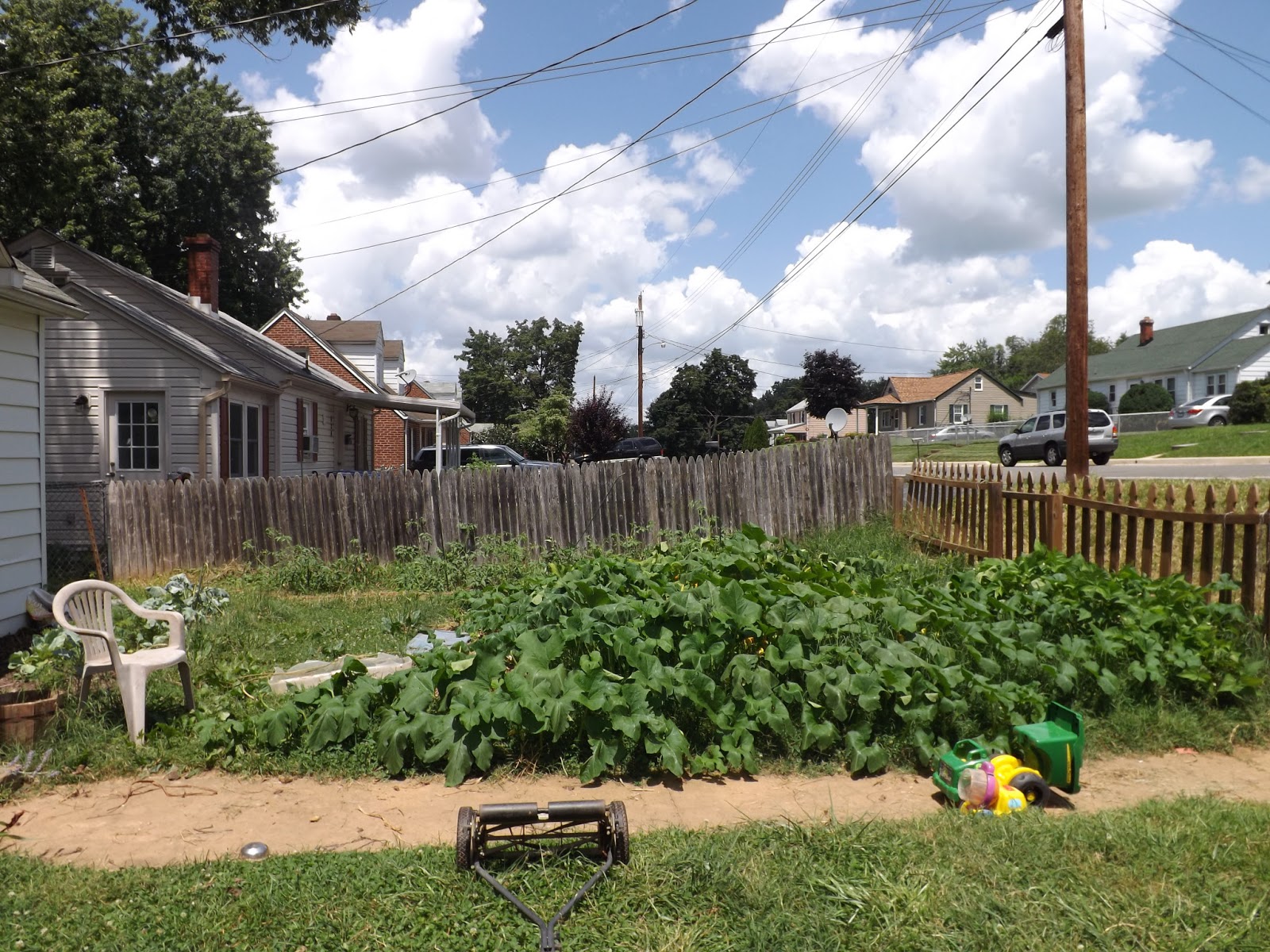
But oh, how things are growing!  Take a look:


Yeah, that whole side of the yard has basically been taken over.  I thought it would be fun for the kids to run around between the different beds, but no such luck.  The pumpkins have grown into the cucumber bed on one side and the bush beans on the other, and they are still growing!  Tendrils are heading toward the cabbage-and-carrot bed and under the fence to crawl up the hill.  All that mass of pumpkin vine is THREE plants.  Planted in May.  Those things never cease to amaze me!

The day I took this, the back corner (where it's starting to grow into the tomato bed) was looking a bit wilty.  I figured it was the heat, but the next day all those leaves were yellow, and then brown the day after.  I found out it's probably squash borers, so tomorrow I'll have to go take a look.  Basically the only thing for it is to cut off the dead leaves and slit open the stems to see if there are worms inside.  If I'd caught them at the wilty stage, I might have found a way to kill the worms without killing the plant, but at this point those leaves are dead anyway.  Luckily the rest of the vine seems unaffected.


 There are quite a few of these little green pumpkins -- perhaps a dozen.  And that's just those I can see -- it's hard to trek through the prickly vines to look for more!  Last year I had six around the end of July, and six more before frost.  This year I think the weather is too cool to get a double harvest like that -- the frost is likely to come sooner -- but you never know.


The green beans look good.  The bush beans (not shown because they're inundated in pumpkin vines) have been bearing for about two week, and the ones on the trellis just bore their first bean.  I get a handful or two every day or two.  Luckily I love green beans.  The kids don't as much ... though they do if I pickle them!


 Next is the gone-to-seed lettuce.  I was pretty good about picking it, but when it gets hot enough, it just bolts no matter what.  I let it, because I like to save the seed.  And it amuses me to have people ask what those giant things are.  They have tiny yellow flowers like dandelions which turn into balls of fluff when the seed is ready.  Both lettuce and dandelions are in the Aster family, hence the similarity.
 Can you see my poor smothered cucumbers?  My first sowing didn't work, so I planted these ones in June.  They are having trouble competing with the pumpkins that invaded their bed, but they are getting by surprisingly well despite that.  I have been carefully guiding the pumpkin vines away from the cukes so they get a decent chance.  I LOVE cucumbers, and have never grown them successfully.  Last year I got three; that was it and then the plant died.

Usually my tomatoes are the pride of the garden!  This year they've been a struggle.  My seedlings mostly died and what I did plant, I planted late.  Then I neglected them when it was time to stake them, and so they're everywhere.  But then that happens every year: I get some great new idea for how I'm going to stake them, and then I miss that crucial couple of weeks when they get tall and suddenly flop over all over everything.

And, of course, I can't really get to them due to all the pumpkins.  They do have quite a few green tomatoes though!  It seems to me not as many as past years, but maybe that's because some of the plants are so far behind they haven't set fruit at all.  The purchased seedlings are doing the best, then the homegrown ones, and last of all is the direct-seeded one.  It's fabulously healthy, but only about two feet high and no flowers even.


Here is the cabbage-carrot-broccoli-garlic bed.  Carrots are doing great, and from time to time I pull one up.  They're small yet, but delicious.  The cabbage and broccoli is just puttering along, not particularly interested in growing up, long after my neighbor has harvested his broccoli and the cabbage is all in nice heads.  Really, I think the soil here is not good -- that, and of course I put it all in very late.  The garlic which grew so fabulous for me last year didn't put on as good a showing this year.  Each plant grew a head, but a rather small one.  Probably they're disappointed at the cooler, wetter summer.  That, and the dog ran over them about twenty times too many.

I didn't get a picture of the watermelon plant.  I put it on the hillside, outside the fence.  It has a few yellow flowers and a tiny little melon, but looks rather like a bonsai plant.  Perhaps that's due to competition from all the other plants on the hill.  I didn't want to clear too large a space for it for fear of erosion.  Maybe we'll get a melon or two.


 But the real bounty right now is the plum tree.  I don't know why I didn't take a picture of the actual tree.  What you see here is one picking's worth ... considering I was picking, at that point, twice a day.  It's a dwarf plum tree, but its output is amazing.  The neighbor says it's never had a bad year.  So far I have gotten about 10 quarts of plum sauce plus all we wanted to eat fresh.  I even made a tiny batch of plum wine.

It's taken me three harvests to figure out the trick to this tree.  First, it needs to be harvested often, because the fruit ripens fast and the instant it is dead ripe, it falls off.  Then it gets a bruise and the bugs have all burrowed into it within a few hours of falling.  Second, it's okay to harvest a little unripe, for the same reason.  Third, I need to clear away all rotten fruit right away.  It discourages the bugs, and it makes it easy to see if any fruit has fallen more recently that is still good for sauce.  I threw four ice-cream buckets of rotten fruit into the compost, which is sad.  I wish I had a pig.  And fourth, I'll never get the fruit at the top of the tree (though standing on chair helps) so I just have to get out there often to pick up all the fallen fruit, cut out the bruises, and get it going for sauce.  I've been making sauce every day, because the fruit doesn't hold at all.

Neat thing about plum sauce -- you don't have to peel the fruit.  The peels actually dissolve into the sauce and turn it from golden to pink, and make it tarter.  I do have to add a bit of sugar to correct for that, but it's easier than peeling hundreds of plums.

I'm finally seeing fewer plums on the tree now, so plum time is beginning to come to an end.  I saw the first ripe plum with excitement, but I'll pick the last plum with relief.  Packing away fruit is exhausting!


There is really nothing in the world like eating out of the garden.  I feel so self-sufficient, so tied to the land, so rooted in tradition, and so ... wealthy.  I love having more than enough food to eat.  When I am worried about the grocery budget or the contents of our fridge, I invariably eat too much because I'm subconsciously afraid of going hungry.  When I have boundless quantities of plums and green beans all over the place, I feel satisfied.  I don't need to eat a lot because I know we have enough.  It's a beautiful feeling.  It also feels great to knock on my neighbors' doors and ask if they want plums, or to invite my friends over to pick them.  I feel like for once I have something of value to give.  It means so much to me.

Here are two great green bean recipes.

#1
Saute them in olive oil or butter till they're just a bit brown in spots.  Done!  But if you want to take it to the next level, sprinkle on parmesan cheese.  You can do this with almost any veggie.  Try one you don't like, and see if you now love it.  Eggplant is great this way, though you want to get it as dry as you possibly can first.  I sliced mine, wrapped it in a dishtowel, and left it in the fridge for three days.  It was kind of dessicated, but that meant it got crispy and perfect when I sauteed it.  Mmmm.

#2
Dilly Beans
Take a pint jar and a handful of green beans.  Snap off stems and rinse if you feel they need it.  Pack the beans in as tightly as you can, along with a clove of garlic and a sprig (or generous sprinkle) of dill.  Pour in 1 1/2 tsp of salt and fill the jar with filtered or dechlorinated water.  Leave the jar on the counter for 3-7 days, tasting from time to time to see how you like the beans.  When they taste like a dill pickle and have just the right amount of crunch, they're done.  The kids LOVE these -- though I have to call them pickles, not beans, or Marko won't eat them.  I just keep the jar open while I'm making dinner and when they come around begging for food NOW, I hand them dilly beans.  Doesn't spoil their appetite and it's good for them.

What's growing in your garden?  What gambles have paid off, and which have flopped?

Tuesday, July 2, 2013

Magnesium and me

We interrupt your regularly-scheduled natter about nothing for an exciting announcement couched in a very long story.

Way back when I was in college, I used to get headaches a lot.  I've had them from time to time since high school, and when I'm tired and under a lot of stress, I sometimes get bad ones every single day.  No fun.

I talked to my friend's mom, who knows a lot about nutrition, and she said I was probably deficient in magnesium.  So I went to the health food store, bought some capsules, and took them reliably for about a month.  Then the headaches went away and I stopped taking them (of course!).  Eventually I lost the bottle.

A couple of years later, when I was pregnant with Marko, I started noticing bad headaches again.  I also had a muscle twitch around my eye which was driving me crazy.  So I thought, "Aren't tics sometimes a sign of magnesium deficiency?  I'd better stop forgetting to take my prenatal vitamins."

And I did, but it didn't help.  I took them religiously for the rest of the pregnancy and some time after, but it wasn't till months later that I actually read the bottle and found there was no magnesium in those vitamins.  That baffled me.  I thought vitamins had everything you needed in them.  How disappointing.

So I plugged along, with my twitchy eye reappearing from time to time, the occasional bad headache, and now constipation as well.  I knew I should probably be getting more magnesium, but wouldn't that mean actually going to the store and buying some?  With money?  Yeah, between my laziness and stinginess, I didn't do it.

At some point I read this post and really got convinced.  Apparently at least half of Americans aren't getting the recommended amount.  It's in things like leafy greens and dried beans, but there isn't any one food that has a lot of magnesium.  Some people also don't absorb it very well.  A good sign that you are magnesium deficient is an intense, intense craving for chocolate.  And I had that for sure!

But did I go out and buy some?  No, sir, I did not.

Then I got pregnant with Michael.  Just as with Marko, I had some headaches, some eye twitches, some leg cramps, some sleeplessness.  And I had even more Braxton-Hicks contractions than with Marko, which is saying something.  Even though I drank more water and wasn't on my feet a whole lot, I was having really severe contractions even at 22 weeks.  It made me very nervous.

So I did some googling, and what did I find but that magnesium deficiency also causes Braxton-Hicks contractions AND preterm labor!  Delightful.  So I finally ran out to the store and bought some.

It helped so much.  Not only did the contractions disappear almost completely, but I slept better, had no eye twitches and few headaches, and even my back felt less sore.  Who knew?  I spent the rest of the pregnancy trying to stop myself from painting sheds and planting the garden in February.  Instead of dragging myself around like when I was pregnant with Marko, I was baking huge batches of food and scrubbing floors.  And oddly, I suddenly felt like chocolate was nice, but not as nice as other things.  I could take it or leave it.  Huh.

Since magnesium is used to relax your muscles (calcium is used when you tense them), I was told it would make labor easier.  And boy did it.  Three hours, start to finish, and at no time did it feel like more than I could handle.

But just after Michael was born, I ran out and didn't buy more.  And when he was about a month old, he started getting very constipated.  First he pooped every day ... then every other day ... then once a week, and with difficulty.

The trouble is, babies can't take capsules.  The solution is to get magnesium on their skin.  You can put magnesium salts in a bath, but that's rather a hassle, and you can dissolve them in water and put it on their skin, but it can sting.  So I had the idea of putting it in lotion.  It's a bit of a process, but I make a big batch at once and divvy it up into jars.  The base is coconut oil, with the magnesium water emulsified into it.  I use beeswax as an emulsifier, because "real" emulsfying wax isn't at all natural.  Since it's meant for a baby's skin, I figured if it separated a bit, that was better than putting harsh ingredients on Michael.  I made it dilute enough that it doesn't sting him at all.  I also added a few drops of lavender essential oil for a nice relaxing scent.

Did it work?  Amazingly well.  It cured the constipation within a week, and he does sleep better with it as well.  I put it on once a day, before bed, but it's fine to put it on more often too.  Marko seems to sleep better when I've put it on him as well.

So I decided to open an Etsy store and offer this stuff for sale.  To my knowledge, there's nothing like this available anywhere.  I did find one magnesium lotion, but it had a ton of ingredients and not a lot of magnesium.  My lotion has only five ingredients, and since it's not expensive to make, I priced it pretty low.  It seems an easy way to try and find out if a baby's -- or an adult's -- problems could be helped by magnesium.

Here are a few common health problems caused by magnesium deficiency: headaches, fluctuating blood sugar, muscle tics, muscle cramps, painful periods and PMS, insomnia, restless legs, morning sickness, false labor, and constipation.  And that's really just the beginning; magnesium deficiency can also cause more severe problems like heart disease.

Obviously most of those have other causes too.  But if you have some of those symptoms, why not check out my store and buy a jar of Calming Salve?  It can't hurt, it smells nice, and if it helps you, it's easy to keep it as part of your routine.


And, of course, you'd be helping a stay-at-home mom make a couple of bucks.  It's never going to be a full-time job for me, but it means a lot to me to make a little money of my own.

Pretty soon I'll be adding a few more items to the store.  I'll let you know here when that happens!

Thursday, June 20, 2013

Free-market agrarianism

I am really struggling to define my personal politics right now.  In general, I'm libertarian -- I believe that the law should stick to the bare minimum of what's necessary to protect everyone's rights.  And I think I believe in free markets -- because if you are not free to purchase, sell, and trade what you want, how can you be said to be free at all?  Meanwhile I've read a lot of economists and it seems clear to me that a free market is the most likely kind to result in prosperity for everyone.

However, I'm also to some extent an agrarian.  Not that I believe that everyone should be a farmer -- that would be counter to the idea of self-determination, considering that not everyone wants to be a farmer.  But I believe it shouldn't be so hard to be a farmer if you want to.  I think you should be able to make a living on a small farm.  People will tell you it's impossible, but what they really mean is that it's impossible in our current economic climate.  So I would favor changes in the economic climate that made small farms possible.

I also tend to believe that small farms and businesses are better than large ones, because they allow more people to be owners and fewer to have to be employees.  They can be more personal and responsive to people's actual wishes, instead of (as the mega-companies do) trying to create wishes in "consumers" for products we didn't previously want.

I believe that every human being has a responsibility for other human beings.  If an economic or political system does not work for the very poor, it does not work.  It doesn't matter how rich some people are able to get or even that the majority are doing fine.  If the bottom 1% is starving to death in the streets, that is a bad system.

Last of all, I believe we have a duty to be good stewards of the environment.  We are on earth only for a short time, but the land we live on and use remains after we die.  We have to leave it in good enough shape that our children and grandchildren can live on and use it too.

For point number one, allowing more people to farm or homestead, there are a few simple, free-market changes that would help.  First off, we have to get rid of our current Farm Bill with its system of subsidies for the biggest producers.  It is extremely unjust the way we pay people to make massive amounts of commodity crops (corn, wheat, and soy), and that the biggest subsidies always go to the richest farmers.  No farm bill at all would be better than what we have, though I am still studying the intricacies of agricultural economy and I'm not yet certain that no farm bill is the answer.  A truly free market would have no farm bill ... but before I could support that, I would need to be certain that this wouldn't result in catastrophe for farmers due to wildly fluctuating crop prices. 

Historically, there have been issues with farmers growing too much and creating a massive surplus.  That drives the cost of grain down, so that the only way to survive is to plant even more and create an even bigger surplus.  The original farm bill worked by paying farmers not to plant so much.  They got a check for not working.  Since the 1970's, we've done the opposite -- encouraged farmers to plant as much as they could, and paid them a subsidy to make up for the rock-bottom grain prices.  Then, to deal with all that extra grain, we've created grocery stores full of junk food made of corn, wheat, and soy derivatives that cost almost nothing to produce and make a fortune for food processors.  The rest goes to animal feed (read: feedlot cattle => McDonalds) and biofuels which cost more petroleum to farm than they actually replace.

Could we get by with no subsidies for anyone -- would the market adjust to this?  That's what I want to know.  Certainly for every other product, the market determines a fair price based on supply and demand.  But crops are special, first because the supply varies hugely from year to year based on weather, and second because we all have to buy food.

For point number two, small vs. large, the free market can definitely help too.  Pages and pages of regulations make it hard for new businesses to start up, and make the cost of a small business proportionately bigger.  I've talked about this before; part of why we don't have more small businesses is because we don't have a free market.  It's not inevitable.

Without the Federal Reserve ripping us off, without bailouts for Wall Street -- which make it possible for them to make a fortune on risky ventures, leading to bubble after bubble and volatile prices -- we would have a much more equitable division of wealth than we do.

And yet, no matter how smoothly our economy was running, the poor we will always have with us.  Even when there is opportunity for everyone, there will always be widows, retirees who didn't save enough, disabled people, and people who didn't make the best choices.  If even one person starves to death in your system, something is terribly broken.  I don't think libertarians talk enough about this.

Of course the short answer is "private charity," but this answer isn't entirely satisfying to me.  What if people don't give to charity?  The same sorts of people who talk about private charity fixing everything are the ones who think that running a business that hires people is philanthropy.  It's not -- it's self-interest which happens to help others too.  I guess the answer here is the same as I always say -- the free market will not be virtuous for you.  Personal responsibility still exists, and sometimes you will have to do things that aren't personally beneficial.  Haven't you ever voted for a tax hike for schools or fire departments?  Most people have, and if this wasn't taken care of by taxes, they could give the same amount of money directly.

On the other hand, I don't completely agree with the "taxation is theft" rhetoric.  A small amount of tax -- my preferred tax is property tax, for reasons I'm going to have to go into later -- can provide a safety net for anyone who falls through the cracks of private charity.  I respect people's desires to have free choice over where every cent of every dollar goes, but I simply don't see the right to property as absolute the way the right to life is.

Last of all, the environment, and this is where it gets the hairiest.  Because we all know that it is often more profitable in the short term to destroy the environment than to care for it.  Strip-mining, water table depletion, pollution, and the mistreatment of soil are pretty much rampant, despite many laws intended to curb excesses.

John's answer is that if environmental depletion affects anyone besides yourself or crosses over your own property line, you should be punished.  And the lawsuit is the way to do that.  People should freely be able to sue if they are dealing with your nitrogen runoff, your feedlot stench, your coal slag, your fracking residue, or what-have-you.  If someone's well goes dry because you sucked up the whole water table to make bottled water, they should be able to sue you.  If they can present evidence of harm, they should get a hefty payout, partly to reimburse them for what they lost, but mostly to punish you, so that eventually it is too expensive for them to do business that way.

But that's not entirely satisfactory to me.  What about damage you do to your own property?  It's not going to be yours forever.  You can say, "Well, if I hurt the resale value, I'm only hurting myself."  But some people don't intend to sell.  There are businesses -- like Avtex here in my town -- that pollute the heck out of a parcel of land and then go out of business, leaving a worthless stinking eyesore behind.  Or you might die and leave your strip-mined mountainside to your son.  Is that fair to him?  When there's plenty of good land around, it's easy to say "Well, people will choose to buy unpolluted land, so owners will avoid polluting to keep up their property values."  But clearly this is no motivator; people still pollute.  And what happens when all the land has been polluted and there is no clean land left to buy?  I'm thinking particularly of soil depletion; most of the farmland in America is losing topsoil at such a phenomenal rate -- tons per acre per year -- that it's turning to rock dust which is only farmable with more and more chemical fertilizer.  Without natural gas to make the fertilizer, we could face a very sudden wakeup call that we no longer have much fertile land in this country.

It seems to me you're stealing from future generations when you mistreat the land, even if it's your own property.

Must we rely, yet again, on people's better natures?  That never seems to get us as far as I want.  But probably what is needed here is education -- that, and a halting of those subsidies that encourage polluting, unviable industries.

Whenever I talk politics, I end up at the same point again: what if people don't do the right thing?  It isn't just capitalism; it's any system.  Democracies are great, at least the Athenians thought so (though it only worked for them because they shut poor people and women out of the vote).  But in radical Islamic countries that adopt democracy, they use it to vote to persecute the non-Muslim minorities.  When a majority chooses to kill or otherwise injure the minority, democracy has failed.  And yet there is always some incentive to do it, because if you're the majority, why shouldn't you do everything it takes to get what you want?

Republics like the US should be, to some extent, immune to this because we have wise men representing us, right?  Except that every republic in history has learned in a hurry that representatives can be bought.  Take five minutes to research the Farm Bill or the so-called Monsanto Protection Act and you'll find that out in a jiffy.  And that's only because we're lucky enough to know about it.  I daresay there's much more corruption that we don't know about.

Monarchies can be good or terrible.  Alfred the Great's was good.  Louis XIV's was horrible.  It's just luck of the draw, whether you get a good egg or a bad one, and most of the eggs appear to be bad, if history is any teacher.

And anarchy?  It doesn't last.  When there is no government, we create one.  Rousseau liked to talk about the "state of nature."  Much as I love hutner-gatherers, the state of nature does not exist.  The most primitive tribe in the world has a social system that's been developing for countless generations.  Every time government disappears -- like in Sicily a century or two ago, or some areas of Afghanistan now -- mafias and organized crime rings take its place.  Because if there is no one to stop them, bad people will always try oppressing other people.

No, there is no magic bullet that is going to make people live in peace and harmony with no poverty or oppression.  We aren't in Eden anymore and there will always be problems.  We can minimize those problems by three means:

1.  Practice a life of personal virtue.  That means giving to charity (10% is a great benchmark, if it doesn't impoverish you), treating employees fairly, giving a good day's work for a good day's pay, taking care of the environment, and not overconsuming the goods of the earth.  That is your job.  No government in the world has successfully been able to make people do this 100% of the time, but you can do it 100% of the time all by yourself.

2.  Systems of checks and balances.  The Founding Fathers were so afraid of excessive government power that they split power any way they could slice it in the hopes that the different levels and branches would counter each other.  Certainly that's better than the alternative, though sadly it isn't working as well as intended.

3.  Keep leaders accountable.  That means government -- vote, write your representative, get involved on the local level, investigate corruption.  And it also means business -- refuse to buy from companies that exploit people.  That may mean a sacrifice in your standard of living.  Even so, you might not be able to do everything you'd like to.  I can't afford to stop buying mass-produced grains, meat, and vegetables, though I do avoid processed food (neatly boycotting both Nestle, one of the world's biggest offenders when it comes to exploitation, and all its competitors too) and I have a plan to work toward not buying the other stuff too.  I can't afford to give up the car, because John drives it to work, but we just have the one and avoid unnecessary driving.  I can completely boycott clothing producers, because I buy clothes at Goodwill -- which is great for the environment and obviously isn't an expensive decision.

It's clear enough to me, the more I study the issues, that while the free market may make it possible for me to live the agrarian dream, even if I could set up a system custom-designed for what I want, it still could not guarantee justice or happiness.  That part is our job.

However, I think that, since agrarianism is a movement rather than an economic or political system, it can coexist with capitalism.  That's why I think of myself as a free-market agrarian.

Do you think I'm just kidding myself to think I can be both?

Tuesday, June 18, 2013

Review: Save Three Lives

I love the gardening shelf at my library.  I've also discovered homesteading books in there and a couple farm memoirs.  But there aren't many, and I figured it was just the fault of my small library.  I tried the catalog for "farming," "homesteading," and "self-sufficiency" and came up with zero results.

Turns out I should have asked my librarian husband.  There was a TON of books on all the topics I wanted -- several shelves over, listed under "agriculture."  I've been missing out for two years!  I brought a big armful home.

The first one I read was Save Three Lives: A Plan for Famine Prevention, by Robert Rodale.  It's an excellent summary of the causes of chronic hunger in the Third World, especially Africa, and a detailed plan for soliving some of these problems.

The main point Rodale opens with is that famine relief sent by Western nations isn't just unhelpful -- it actually makes the problems worse.  We export our own super-productive, hybridized or GMO grains, especially corn, and encourage poor farmers to grow them as cash crops.  The trouble is, these grains are very hungry for soil nutrients; they won't grow well in Africa except with a lot of fertilizer.  It's hard to get fertilizer to all the remote places where it's needed, and often the farmers have to go into debt to buy it.  And then the soil itself becomes impoverished and even more reliant on artificial fertilizer the longer they keep doing it.  These crops are also very thirsty for water, and the impoverished soil, low in organic matter, doesn't hold water very well.  All it takes is a little drought and the crops all fail.  Since the farmers relied completely on the cash crop, not growing any subsistence crops, they lose everything.

We've been sold the idea that technology is going to save us.  But those who have studied different farming methods can tell you that more fertilizer and more pesticides only give improved yields for a short time before wearing out their usefulness.  As soil declines in organic matter, more and more nitrogen is needed.  And as pests become resistant to pesticides -- and their natural predators are killed by the same chemicals -- more chemicals are needed, and with less effect.  The book gives this statistic: "Percentage change, since 1945, in the amount of insecticide used on US crops: Plus 900%.  Percentage change, since 1945, in the portion of US crops lost to insects: Plus 86%."  And yet we are  giving these technologies to Africa, where the soil is much thinner and there are many more pests.  Consider this:

"In temperate growing zones, 15 separate diseases have been reported to attack sweet potato crops.  In the tropics, there are 111.  Rice?  Fifty-four diseases treaten harvests here.  But 500 to 600 have been recorded there.  Tomatoes?  In your backyard, this favored summertime crop may have to resist as many as 32 different diseases.  Move to the tropics, put the same plants in the ground, and now you're up against 278."

Meanwhile the idea of exporting Western-style agriculture, where a monoculture of cash crops brings wealth to everyone, isn't working very well in a place plagued by instability:

"Consider the roads, for instance.  Even if it made ecological sense to import those genetically engineered superplants and the chemicals and diesel-fueled equipment necessary to grow them, it simply can't be done, mostly because the roads just aren't there.  Where there are roads, there are also soldiers, waiting to waylay such shipments (and relief convoys as well), kill the drivers, and steal the trucks and their contents.  The chemicals, seeds, and equipment are then sold on the black market.  Relief food goes to soldiers.  Sometimes it is simply destroyed."

And then, worst of all, once famine does hit, we send big tankers full of American grain.  This is actually US law, to send grain instead of money, so that we can support American agriculture at the same time.  Sadly, the result of this is to undercut local farmers in the area who do have food to sell.  Other countries have had the smarter idea of sending cash and then buying grain just outside the famine area, which gets there faster and helps the impoverished region much more.  Rodale tells the story of a drought in Ethiopia which lasted three years.  By the time Americans had raised the money and sent food, the drought was already over: "Much of the food arrived, ironically, as local farmers were bringing in their first good harvests in years.  Harvests that, unfortunately, were now worthless to those impoverished farmers because the country was flooded with free grain."

Rodale urges that we must find local solutions, "Small solutions.  Too small for powerful people to trifle with.  Too small for an army or a group of soldiers to care about.  Too small to attract a lot of attention in troubled times.  But big enough to feed the family who tends this small solution."

His first solution is to plant drought-resistant "famine plants" instead of corn. Sure, according to American agronomists, the yields are lower.  But they're more reliable - they will keep producing their modest yields even in a dry year.  And many of them are more nutritious than corn -- like amaranth, for instance, which has twice as much protein as corn and many trace nutrients corn lacks.  You can also eat amaranth greens.  And since they won't die in a drought year, you don't have bare fields eroding in the wind.

Next, he talks about the problem of firewood.  The people of Africa use wood for their cooking fires, which also keep away mosquitoes and provide light.  Attempts to convert them to using fuel-efficient stoves has been unsuccessful; they can't afford the stoves and, since they just cook food and nothing else, the Africans don't want them.  But their search for firewood has been destructive: the hillsides are becoming bare of trees.  That means more erosion on the hillsides, less water brought to the surface by deep roots, and less rain altogether -- since evaporation from trees helps increase cloud formation.  And it means more of a burden on women, whose job it is to gather firewood as well as do all the farming, cooking, and water carrying, because they have further to go to get wood.

Rodale talks about the success the alley-cropping technique has had.  This is the method where trees are grown in alleys between crop fields.  This way the wood is right there, no long walks needed, and the farmers care for the trees personally because they own them.  Instead of cutting down the whole tree, they cut back the branches every year or two and use the prunings for wood.  The leaves make animal fodder and also help add organic matter to the soil.  The rows of trees stop erosion, especially in flood-time.  Rodale describes some amazing native trees that are able to live on barely any water, fix their own nitrogen, and grow in harsh conditions.

Next he talks about how to deal with pests without expensive pesticides that also pollute fresh water.  Most of his ideas are familiar to anyone who has gardened organically -- encouraging beneficial insects and birds, planting deterrent plants, and avoiding monoculture.  You see, when an entire continent plants the same variety of corn, pests leap from field to field like they're following a superhighway.  When each farmer has a field of this and a field of that, it's much harder for pests, whether weeds, bugs, or disease, to spread.

Organic techniques can also help increase organic matter in the soil so it will hold water and nutrients better.  He mentions a few native green manure plants that can do a lot of good.

Importantly, he talks about addressing any teaching to women, since they are the farmers in most regions.  Western farming experts have made the mistake in the past of addressing everything to the men, who nod sagely while the women keep on doing exactly the way they always have.  Increased education and rights for women fight poverty more than anything else.

Last he talks about water -- how to harvest it, preserve it, purify it, and make the best use of it.  He has page after page of small-scale ideas for different circumstances -- no giant dams required.  Among these are diverting small streams, terracing hillsides, and even raising fish in brackish ponds that are no good for drinking.  Turns out tilapia don't mind those conditions, and it means nutritious food with very little outlay.

By the end of the book I was angry about famine relief that doesn't work and so eager to change things, I was wanting to join the Peace Corps.  So I was hoping he would tell me what charity I could give to that was doing all this stuff.  Instead, he discussed how to lobby charities to start using smarter tactics.  You should write to them, detail the sort of projects you'd like to donate to, and tell them you have $100 you'd like to donate if they can guarantee it will go to that kind of project.  Pretty clever.  Better yet, he says, get your friends together and offer a larger donation.  His own charity is called the Famine Prevention Project, but I can't find any mention of it online, so my guess is that it's defunct now.  Probably because the author, as the forward tells me, was killed in a car accident in Russia in 1990.

I would recommend this book to anyone, especially if you've ever dealt with the argument (as I have) that we need GMO's [or pesticides, or whatever] if we want to feed starving people in Africa.  What we need is to teach them how to feed themselves, with native plants and ecologically sound techniques.

And if anyone knows a charity that actually does any of the projects listed above ... I'd like to hear about it.

Monday, June 17, 2013

Repost: Libertarian parenting

Creepy thing happened today.  I followed a link to one of my favorite posts on this blog, the one on libertarian parenting from February 2012.  Only the post was not there.  I looked every which way; it's just been deleted without a trace.

At first I thought the NSA did it because they don't like my dislike for authority.  On second thought, it's probably because it had a picture of Marko with no pants.  But I'd hate for the post to be lost for good, so I rustled it up on the Wayback Machine, and here it is.

* * *

John and I are both fervent libertarians. We are willing to forgo most government "help" in order to get something we want more -- freedom. The prime directive of libertarianism, as I express it, is that we possess all rights that don't interfere with anyone else's rights. So I believe in your right to smoke, for instance, but not in your right to share your second-hand smoke with me.

So it's no wonder that we tend toward a more hands-off parenting style. Of course, children don't have exactly the same rights adults do. They have more right to be taken care of, and they do not have the right to harm themselves. In this way, I see us as keeping our son's body in trust for him for when he's older -- I'd like to deliver him a healthy body at 18. I can't do that if, in the name of "freedom," I let him get himself killed by a passing car. Obviously.
However, I would consider our family to be fairly libertarian in its governing style. Not anarchist, mind you! Anarchists don't believe in government at all. Libertarians believe in government, but believe that it should restrict its actions to defending individual rights and organizing things that could not be done individually, like the building of roads. In the same way, like I said the other day, John and I are the boss of our family. There is no question of that, and I think it's impossible to avoid being the boss of your kids at least in some ways. It's just that, as the leaders of our tiny "state," we decide not to legislate most stuff.

We have a bunch of hard-and-fast rules. No hitting. No destroying property. No really unsafe stuff, like standing on our bed. All of these are rules we had to make for the common good. But rules like "say please" or "wear clothes in the house" or "play with the toys this way, not that way" just don't make much sense to me. I'm just not interested in micromanaging my kid. And I'm not convinced that two years old is the time to "civilize" him into a miniature adult. As he grows older, he will pick this stuff up, but for now, he's kind of like a little chimp (I mean that in the nicest possible way) and I don't really mind him running a little bit wild.

I keep reading sciencey studies lately about parenting. They tend to say, "Attachment parents are stunting their children because they 'helicopter' around them and micromanage their lives." Every time I see that nonsense, I want to ask: what "attachment parents" are they talking to? Most of us are pretty laissez-faire, in my experience. We provide snuggles and food upon request, but we don't stop our kids from playing the way they want to.

The one thing most studies seem to agree on is that we shouldn't micromanage our kids. And that makes sense to me. For all the complaining I hear about "lax parenting" being the reason kids are "so bad nowadays," the universal trend in parenting over the past 50 years has not been laxity. It's been control. We in the modern world pay an unprecedented amount of attention to our kids -- not affection, mind you, but attention. No mother before 1900 ever thought it worth her while to time her child's feedings by a clock or keep a diary of bowel movements. They all just fed their children when they were hungry, picked them up when they cried, and when they were happy, they plopped them on the floor or in a sling and ignored them. At night, there was no way they were going to lie awake all night listening to their child "cry it out" in a one-room cabin or yurt. That kid went right in bed with them, and nobody kept track of how many times it woke up.

Once a child was older, they'd give it a few simple toys and let it go. By four or five, kids didn't really need much, and would play in the yard all day. A few years later, and they'd roam far and wide, just messin' around, being kids. Think of Laura Ingalls Wilder and Tom Sawyer. They weren't constantly getting schlepped from one structured extra-curricular to another. They just took off. When they were with their parents, they had to learn to work. Once they'd done their work, they just played. Their parents didn't make up their games for them.

This is one of an excellent series of articles on child psychology. The author, Peter Gray, is my new hero lately. He gives a survey of child raising among hunter-gatherer cultures which I find just fascinating. In every one of these cultures, children spent most of their time in a big gang of other children, either unsupervised or at least without adult interference. The rest of the time, they spent watching adults and joining in adult work.

Today, parents spend a lot more time supervising and organizing their children's play, adjusting (whether through reasoning or punishments) social behavior, and doing "learning activities" than ever before. When I go to the library, I usually plant myself in a comfortable spot in the children's area and open a book. Some parents do the same. Others feel the need to sit down on the floor with their children, show them how the puzzles work, put letter chains together for them, and so on. Now I do keep an eye on my kid, and intervene if he starts smacking somebody or knocking over their block towers. But I see no reason to show him how to play with the puzzles. Either he'll figure it out ... or he'll make a new game from the same pieces. Either is fine with me. 
I admit that what they say about discipline is true: parents in the "old days" (say, 1850-1950 -- I can't speak for earlier, because I'm not an expert) did beat their children. But they weren't shadowing their toddlers around the house, smacking them a dozen times a day. No, the stories I hear are about older kids who are pretty independent and know the rules. Laura Ingalls' grandpa, for instance, gets whipped for going sledding on the Sabbath. Not for leaving the house, grabbing a sled, and sledding without telling anyone -- they did that all the time. Just for doing it on the Sabbath. Laura herself is free to wander wherever she wants around Plum Creek -- except by the creek itself, because she could drown. Her parents don't watch her, because they trust her. (I believe she is six or seven.) When she disobeys and goes in the creek, she gets the ultimate punishment: she has to stay in sight of home.

Gee, if that's punishment, most kids under 16 are getting punished every day!

And the idea of drilling your kids for future success was absolutely unheard of before the modern age. I can't really account for it, though I'm sure there are a lot of reasons -- fear of children not being able to get a job when they grow up if they aren't smarter than all the other kids, advertising, having fewer kids to focus on, guilt from various causes, etc. In any event, it's now not too unusual to have parents doing "Your Baby Can Read" or "Baby Einstein" with their children in the hopes of making them smarter. I once slogged through hundreds of comments about the former program, most of them from moms who used it. They swore up and down that not only could their babies read, they were smarter than any other baby ever -- read sooner, counted sooner, read bigger books, etc.

I wasn't raised like this, so I was shocked when I started my first job. I was a nanny, but I was supposed to do some tutoring too. The children were four-year-old twins. "I want you to do pre-literacy work with them," the mom said, "because they'll be starting kindergarten in a year and I don't want them to start out behind the other kids." Now I learned to read at four, because I happened to want to. But even so, my eyes kind of bugged out. Flash cards? At four? What the heck does your class rank matter in kindergarten?

Back to me, and my libertarian parenting style. I've always tried to meet Marko's needs, as he expresses them. When he was tiny, I mostly left him on a blanket on the floor as long as he was happy -- which he would be for an hour at a time, as long as I looked at him often. When he made a peep, I'd pick him up and feed him. (Yes, up to about three months old he was a ridiculously easy baby. The next baby, easy or not, is getting more sling time, because I'm on the go more now.) Now it's about the same, except he does more and wants more. He plays by himself, glances up at me or talks to me to check in with me, and periodically comes over for lap time, a drink, a snack, whatever. When he's not feeling so independent, he likes to be read to. I usually do say yes, but at the same time, I try to encourage him to play instead if he's willing.

He does require kind of a lot of attention on most days. He gets bored with his toys, or he makes a mess, or whatever. But if the weather is good, we go outside, and seriously, he wants for nothing. Today he played in the dirt for a solid hour without needing me for anything. I roamed around the yard, picking up sticks and raking, and he just stayed there, squatting in the dirt, running it through his fingers and pushing it into piles.

I got to thinking that a child is like a plant. I can't grow potted plants to save my life. They need so much attention indoors! They need to be watered all the time, they never get enough sun, and even if you do everything right they get sometimes get wilty. But the plants outside are no trouble at all. Marko's the same. Take him outdoors and let him go, with or without the dog, and he'll run around all day with no complaints.

My goal, I guess, is to give him as much of that as I can. Freedom to explore, room to play, and as little interference as possible. Yes, that does mean sometimes he's doing that exploration stark naked. (Outdoors, I do require him to wear a shirt, and pants and shoes too if it's under 60 or so. Please do not report me to CPS.) Sometimes he doesn't want to come in and eat, so I let him wander around with pieces of cheese or roast beef. Sometimes a bit of dirt ends up in his mouth. He's happy, and I'm happy.

The one thing he does enjoy doing with me is work. He will happily sit on the counter and work the faucet while I do dishes, or help me sponge down the cabinets, or clean up spills on the floor with a rag. He loves to fetch things for me, or put things where I ask him to put them. This is one area where what I believe is the "right thing" isn't the easy thing. It's usually easier to do the work myself. But his instincts demand to learn to do what the adults are doing, and I have to respond to this if I want him to learn to be an adult. So I try to do at least some chores with him every day. If ever he isn't interested, I don't push it, but he's almost always interested.

I hope school will be like this. School is the biggest enemy to libertarian parenting I know of. One day the child is playing in the dirt naked -- the next day he's shoved into "appropriate attire" and forced to sit still all day while information in which he is not interested gets shoveled into his head. It would be impossible to let everyone in a classroom have free choice about anything. (Though even as a teacher, I tried not to micromanage. Once a parent asked me, "My son always tries to do his homework while he's sprawling all over the floor instead of sitting up in a chair. What should I do?" I just couldn't fathom why this was a problem. Wasn't he doing his homework? So, despite the wishes of some of the parents, I did not try to stop their children from fidgeting in my class. It wouldn't have worked anyway.)

But if school is more like, "Hey, you were interested in that one plant, let's go find a book about it," or, "Here is your patch of dirt, what would you like to plant here?" or "I have paper and markers, do you want to write and illustrate a story?" ... well, that I could get behind. I am prepared to do what I'm doing now -- negotiate on all the negotiables. Can we have school outside? Yes! Can we have a day off when we're tired? Sure! Can we go to the fabric store and figure out prices per yard, and call that math? Why the heck not!

But then there's that one, undying, constant objection: how will the children learn they're not in charge unless you're always bossing them around? How will they learn self-discipline if they aren't doing any schoolwork that doesn't interest them? In short, am I setting them up for a lifetime of disappointment because the rest of the world isn't as accommodating as I am?

The short answer: I don't know for sure. I am pretty sure my son knows I'm the boss because I force him into his pajamas at night, force him out of them in the morning to get at his wet diaper, buckle him into his carseat ... and because there is no story-reading, no snacktime, no lap-sitting, no library trips, unless I say so, and I don't always say yes. He already deals with disappointment and frustrated desires at least a half-dozen times a day. Sometimes there are tears. He's learning that he does not control the world.
Meanwhile, I think he learns self-discipline better if I'm not always doing the job for him. I don't force him or threaten him very much; however, he has to sacrifice what he wants sometimes to reach a higher goal. Yesterday, he wanted to go outside. I told him, "Yes, but you will have to put clothes on." "No!" I collected the clothes and sat back down. Periodically, he would come up to me and say, "Outside?" "If you let me put your clothes on." "No!" He'd run away and go play with something else. About the fifth time, half an hour later, he walked up to me and said, "Ready for clothes." And he quietly let me put them on before charging outside. There were no tears. There was no force. He just realized that to get what he wanted, he had to put up with something he didn't want. I let him come to that decision on his own, because I had nowhere to be, and I had the time to let him work through it.

It's moments like that where I really feel this whole thing is going to be a success. Sometimes, the common good comes first, and he has to get wrestled into church clothes whether he wants to go or not. But when I am working on "training" him, when I have time to do what is actually best for him, giving him freedom seems to be working okay.

Am I totally off my nut here? I am beginning to feel like I sound a little ... out there. I'd love to hear if anyone agrees with me.
Link

Related Posts Plugin for WordPress, Blogger...