Pages

Thursday, April 28, 2011

Moving in bits and pieces

We have never moved all at once. Since John and I were married, every single move (from my apartment in Virginia to his in Philadelphia, from the apartment in Philadelphia to the one in Hatboro, from Hatboro down to where we are now, and now from here to the new house) has involved a number of trips over a number of days. A few boxes one weekend, a few boxes the next, and so forth, until we're moved. And then driving back to the old place to clean it out. Sometimes the stuff goes first, and we survive on the bare necessities till we rejoin it. Sometimes we go first, and then go back for the rest of our stuff. And sometimes (last time) the stuff goes down to storage, we live on bare necessities before and after the move, and then we get our stuff back.

Since we closed on the house, we've been down there a lot. Each time we bring down some of our things and do some work. I put in tomatoes and then a raspberry bush (which seems to be surviving! yay!). John painted the purple bedroom a lovely shade of blue. Together, we painted the living room white instead of brown. It's been really busy!

Let me tell you, a lot of this stuff is hard to do with the baby around. Painting, in particular. That one, we have only done when both of us are around. We just take turns with the baby. Can you imagine me trying to paint with the baby around? If he were younger, I'd have a lot of options, but with the trouble this toddler can get into in five minutes -- no way. We'd have handprints on the wall in no time.

The day the blue room (which is to be our room) got painted was the low point of the whole business. It was pouring rain, and I mean pouring ... the way it does here in Virginia. The whole sidewalk was a river, making unloading our things very difficult. The leaves I had used to mulch the tomato plants had blown right away in the storm, and the soil was eroding quite a bit. I did what I could, but in the end nothing could be done till the next time we came. By that point, the ground was cracked in the tomato bed -- alas! But I mulched it with grass clippings, which have stayed much better.

Anyway, while John was painting the blue room, I had the task of keeping the baby out of it. The house is quite small, and I know it will be tough to keep him inside on rainy days. But to keep him inside AND out of the one room where Daddy is and interesting things are happening? No way. He also didn't nap. We're still figuring out exactly how he will be sleeping in the new house. He has his own room, but I'm not sure if he can sleep his crib. I can't lay him down in it asleep with the side on, and with the side off (as I've had it so far, up against the bed) he would probably fall out. The plan is to have him sleep on the floor. He's sleeping on the floor now, in our current apartment, because we brought the crib to the house. I just really hope he makes the transition to the new house AND the new room okay. I may have to sleep in there with him for a few nights.

After that, though, it did get easier. The day we painted the living room, John and I took turns painting and playing outside with the baby. Then the baby did manage to nap in his room, and we painted like mad and got it done. Painting is hard work!

Another challenge was today, when I brought a bunch of boxes down by myself while John was at work. Do you know how hard it is to load up a car with heavy boxes with a toddler around? This apartment is on the second floor, so there are bound to be a few moments while I go up and down the stairs where the baby is unattended. He has to be carried up and down the stairs, and I can't do it holding boxes.

I tried what I usually do when bringing in groceries: putting him in his high chair. I even buckled him in, which I don't usually do, to be extra safe. But he wasn't hungry and didn't want to be in the high chair -- I heard him wailing as I rushed down the steps with the first box. When I came back, he was STANDING UP in the high chair, yelling like mad and preparing to pitch himself to the floor. Scratch that idea.

The next trip, I tried just leaving him on the floor in the apartment, involved in some playing he was doing. When I came back, he was flattened against the door weeping because he was sure I was never coming back! (He doesn't usually care that much, but perhaps I ought to mention that he's been laid low with a terrible cold these past three days. So have I ... which has made even surviving difficult, much less packing.) At least the baby was safe, but I was still nervous that he'd recover from his panic and decide to tear the apartment apart or stick my keys in the outlet, so I tried option three.

Option three is taking him down to the car, buckling him into his carseat, and leaving him there while I rushed up to get the rest of the boxes. Pros: baby is confined, baby is relatively happy (yay! outside! we're going somewhere! and Mommy's just out of sight in the front seat ... right?). Cons: Someone is going to see him there, notice he is both adorable and unattended, and either kidnap him or call the cops. Luckily neither of those things happened, and we got the car packed without incident. Thank goodness.

On Saturday, we're going to move for real. At least, we will move ourselves and the bare necessities still here. We still have another week on our lease, so we'll be back to clean. There are a lot of spots on the carpet (mostly due to food flinging) that I'm going to have to work on. The good news is that I've discovered a new weapon: vinegar. I got the huge splash of baby tylenol on the hall carpet (that stuff is horrible on carpets -- it's sticky and attracts dirt) out with white vinegar and elbow grease, after the "real" carpet cleaner totally failed.

I'm really looking forward to actually living in our new house! The best of it will be my new ability to let the baby play outside all day long without packing him into a stroller and taking him down to the playground every time. And if I realize I need something inside? I can just pop in and get it! Also, no cans and cigarette butts littering the grass.

It's going to be great!

Tuesday, April 26, 2011

What is nutrient-dense food?

So I was talking in my last food post about nutrient-dense foods. These are foods, usually animal foods, that are very high in nutrients (vitamins and minerals) for the amount of calories they have. I decided to illustrate what I mean by calculating the nutrient content for each of the parts of a sample dinner.

The dinner is beef liver, salad with dressing, and brown rice. I actually made and ate the salad ... not the liver though. I don't like it, but it's a common example of THE most nutrient-dense food there is. Other organ meats and shellfish are up there too.

First, let's look at the salad, where many people expect the nutrient powerhouse to be. It's a pretty good salad, containing lettuce, tomato, green pepper, carrot, and a bit of lacto-fermented kimchi, with an apple cider vinegar and olive oil dressing. Here's how CRON-O-Meter analyzes that salad, according to my benchmark of 2122 calories per day:

Most of the calories come from the olive oil in the dressing. I put down two tablespoons of oil because I like oil a lot and it was a HUGE salad. I made it in a mixing bowl for lunch. So, picture a great big first-course salad, not a tiny side salad.

Here are the specific vitamins present in the salad. The vitamin A is mostly from carrots and is in the form of beta carotene, which, as I've mentioned before, some people are not able to convert to vitamin A. But let's assume I am ... so I'm set for vitamin A from this salad! The rest of the vitamins are not as impressive. There's plenty of K from the green vegetables, and some C from the tomatoes, cabbage, and peppers. The level of E is good too (remember I was deficient in that lately?), because olive oil is a great source of vitamin E.

What about the liver? How is it doing for nutrients? This serving is one slice of liver, about four ounces.

It contains most of the protein from the meal. Liver isn't very fatty and has few carbohydrates. But it contains 42% of your daily vitamins from only 129 calories! That's very efficient, compared to the salad which had 19% of your vitamins in almost 300 calories. Of course calories are important too, but to get enough of your vitamins from salad, you would have to eat way more calories than you should.

All right, here are the vitamins in liver:


Almost five times the A you need! Seventeen times the B12! B12 is water-soluble, so it's virtually impossible to overdose on. A is oil-soluble and you can, theoretically, get too much. It's probably not a danger when obtained from natural foods, but liver should be more of a once-a-week thing than a daily dinner. Our B vitamins are plentiful. (Biotin shows as 0 because there is no RDA for it -- it's manufactured by intestinal bacteria.) It really pulls its weight as far as nutrients per calorie. Although it would be quite unnecessary to eat a lot of liver, having a little here and there is as good as a vitamin pill. Regular beef is not such a powerhouse, but it also contains large amounts of B12 and other important nutrients, so it's another good option for a nutrient-dense food at dinnertime. You can see, though, that to get enough K, C, and E, for instance, we have to turn to vegetables, like those in our salad.

Last of all, let's turn to the rice. I picked brown rice because it's supposed to be much healthier, though there's debate over whether we can actually absorb all the vitamins it contains. They are bound up with something called phytic acid which can block their absorption, and there are a lot of different theories as to how you'd get rid of these. For the sake of this experiment, I'm going with CRON-o-Meter and assuming we're absorbing all the nutrients available.

Rice of any kind is mostly carbohydrate. Brown rice, though, has a small amount of protein and fat -- 4 grams of protein and one of fat. In that whole cup of rice, there are only 4% of the vitamins you need. Minerals do a little better, though I didn't analyze those specifically. The main ones in brown rice are manganese, magnesium, and phosphorus. Here are the vitamins in the rice:

It's a good source of B vitamins, making up for the relative lack of thiamine in the liver, but it has very little else.

Here's our whole meal together. It comes in about right for calories -- just shy of 1/3 of my daily requirement. It's rather high in carbs and fat compared to protein. I still don't know what the ideal ratio of these three "macronutrients" is, but I could probably use a higher proportion of protein here -- perhaps by having less salad and more meat, or else throwing some chickpeas or sunflower seeds in my salad.


As far as vitamins go, we have more than 30% of every vitamin except D and E. D is a tough one, coming mainly from pastured meat and oily fish. It's also in dairy -- can you believe I came up with a dairy-free meal? Some of your daily D can also be obtained from about 20 minutes in sunlight. Don't take a shower right after, though -- give the skin some time to absorb the D! E is mainly found in seed and nut oils. I've had some trouble finding convenient sources of it, besides olive oil. I hear it's in broccoli, too; that might help. I didn't copy the minerals, but the only thing we're low on is calcium. Again, getting some dairy at another meal would be a good idea.


A fruit could make a nice dessert to this meal, but a sugary dessert or drink would pretty much ruin what we're trying to do here. Our calories would be increased with no nutrients gained at all -- and sugar spikes the blood sugar, too.

So here are a few questions to consider: What parts of this meal are most nutritionally valuable, and which are merely seasoning? If you were going to have seconds, what would you have seconds of? If you were trying to cut calories, what would you skip?

Conventional wisdom would tell us to leave the dressing off the salad. But that olive oil provides almost all of the vitamin E for the whole meal! Though it does add a lot of calories, we can't afford to cut it altogether. Instead, I'd skip or reduce the rice --it's mostly a cheap filler, making sure we don't go to bed hungry, while being a complex carbohydrate that doesn't upset the metabolism like sugar would.

And the most valuable, nutrient-dense food? Of course, the liver. No wonder it's so highly prized by traditional cultures!

Circumcision ... still wanna talk about it?

I got into a debate on Facebook the other day. It wasn't meant as a debate; I was sharing a link that I had found helpful and thought others might, too. But pretty soon, as often happens in moms' groups, people got emotional and offended and then before you knew it, every other comment included a "SHAME ON YOU." So ... that conversation has jumped the shark, and it's over.

But it did occur to me that maybe some people might still want to talk about it, or to find information. So I'm going to put a few links here, and if anyone wants to say anything, they can comment.

The advantage, though, is that, since this is my "house," I decide what goes. And what goes is any respectful debate. I don't mind if you disagree with me. But if you think I shouldn't be talking about this at all, you can go somewhere where they're not talking about it.

To me, circumcision isn't a HUGE deal. It isn't the be-all end-all of parenthood, and if you made a different decision than I did, it doesn't mean you're a bad parent, a sinner, or not my friend anymore. But it is a biggish deal, in that we're doing surgery on our newborn boys, and we really ought to give it some thought first. It will affect that boy for the rest of his life, one way or another, and the least we can do is do a little research before signing a consent form. Find out that it's not just a skin tag that's being cut off, and find out what the Church says, if you are Catholic. Here is my previous post that contains a bunch more links.

So, speak your mind, if you've a mind to.

Monday, April 25, 2011

Easter

Happy Easter everyone! A day late, but Easter is a whole season, right? Right? Ah, well.

Normally I get way more into the "Easter stuff" than I did this year. Usually, singing in a choir, I naturally get to go to every single Triduum service there is. I love them all, but especially the Vigil. This year, I couldn't get to Holy Thursday or Good Friday, and there was no hope of going to the vigil ... they all start at 8:30, and that's the baby's bedtime. We've been working SO HARD on getting him to go to bed on time, there was no way I was going to mess that up ... especially because I knew he'd be a big bundle of crankiness if we went somewhere right at bedtime.

Only, at the last minute, he fell asleep at six p.m. on the way back from Wal-Mart -- which is five minutes away. He was TIRED. I tried and tried to wake him, knowing a late nap throws a huge monkey wrench in his body clock, but to no avail. I left him on a blanket on the floor (we'd packed up the crib) and pottered around making noise, but he slept on. I thought, "Maybe he's down for the night!" But at seven, he woke up as grumpy as can be, but slowly coming out of it and getting energetic. John said, "Hey, he's going to be up till after ten whatever we do. Let's go to vigil." So we did!

It was beautiful and lovely and the baby was (relatively) good. There were very few children there, and only one other baby. Maybe everyone thought we were terrible parents for "keeping our baby up so late" but we had to chuckle ... it's never US keeping HIM up late. It's always the other way around.

For the first time in pretty much forever, I actually had some time to think and pray. And what I thought was this.

It's no wonder there are atheists. The world is so messed up. People are twisted and fallen and do such awful things. We always pray to God for him to stop it all, to prevent natural disasters, to cure diseases, to stop psychopaths. And more often than not, we don't get what we ask for. For thousands of years, there have been evil dictators and poverty and most people aren't living what we would consider a good life. It's pretty depressing. Every single animal knows how to live its life in a way that is best for itself and its species. We alone choose to destroy ourselves. Our instinct and reason battle it out until we have no idea what we should do. There's no instruction manual for being human, and none of us know how to do it right. The Israelites had a good thing going in their covenant, but they all admitted that they weren't capable of following it well enough. Even Moses, the righteous man, sinned.

But on the other hand, Easter gives us hope. Someone came to show us the "instruction manual," show us what a good life would look like. And then, because he was God, he actually gave us the grace so that we would be capable of living a life like that too. Most of us still fail, but the amazing thing is that some of us succeed! There are thousands of great saints, people whose lives are so inspiring that it's hard sometimes to believe that they did all that. Not pious people who say nice words and do nothing, but people who embraced lepers, died to save others, gave all they had to the poor. Somehow, they were given the strength to do what no one else had ever done before -- live the way people were intended to live. Their actions, instead of harming others to save themselves, saved others at the cost of themselves. They overcame both instinct and reason to do what was best overall, not just what was best for themselves. This notion became so inspirational that even those who did not believe adopted it as an ideal.

No longer did they have to agonize over this or that mistake made in the past. Sins were forgiven; they could put behind them the guilt that no psychoanalyst would ever be able to cure. They found in themselves the strength to do, not only naturally good things, like care for a child or smile at a stranger (things our instincts tell us to do), but supernaturally good things, like die for a stranger or be tortured without denying their faith.

Finally, our lives made sense. Rather than struggle with our contradictory inclinations, here giving in to our desire to eat (and eating too much) and here rising up to our desire to be kind (and then being angry when our kindness was met with scorn), we understood that we are not made for earth, that we are made for heaven, but that we are fallen. We can reject sin so as to live in the freedom of God's kingdom. When we sacrifice ourselves for others, we need not fear that our sacrifice will be in vain. And we need no longer fear death.

It's kind of an amazing thing, Christianity. I like it a lot, and though I don't explain it the best that anyone could, I believe it with my whole heart. I've been feeling a little depressed lately, feeling that my prayers are not answered as I would like, but at the vigil I felt hope. The amazing thing is not that prayers are sometimes not granted, but that they ever are. God rarely intervenes in the physical world to cause a miracle, to keep this child from dying or that war from breaking out. But he does give us the strength to cope when we ask him. People despair and marriages are torn apart when sorrow visits a family ... but often, when we turn to God and ask for help, these sorrows are turned to grace. I know so many families that have lost children, and they could despair, but instead they seem to be given an amazing kind of strength. I think I've lost sight of the fact that this, too, is a miracle.

Happy Easter, dear readers. And you should read Dr. Thursday's post, too. He's feeling quite unnaturally joyful, hee hee.

Wednesday, April 20, 2011

Vitamins

After that post yesterday about meal planning, I thought it would be a fun experiment to track what I ate in a day and see if I got the daily required amount of each vitamin and mineral. This would be a mammoth task, but luckily I have a computer program (CRON-o-Meter; you can download it for free) which does the actual calculations for me. I just put in what I ate and it counted up the amounts of everything, comparing them with the USDA recommended amounts.

Now, this isn't a perfect method. I've heard a lot of people say that we should be eating more of many vitamins, such as D and B12, than the RDA's suggest. Also, the amount eaten is not necessarily the amount absorbed -- I hear we can only get about 3% of the beta carotene in a raw carrot, for instance. But it was a good place to start.

Without taking any particular care -- I ate the food throughout the day and recorded in the evening so I didn't know how much I was getting -- I met almost all of the goals. In fact, I'm extra super good because I exceeded the calorie recommendation by quite a lot! Oops. But they do say nursing mothers need 600 extra calories. I also was particularly hungry that day. Ideally, though, you should get all your nutrients in before maxing out your calories. I had bacon and eggs for breakfast; an orange, a banana, some cheese, and a PBJ for snacks; and three homemade tacos with all the fixings (lettuce, tomato, green pepper, sour cream, salsa, cheese) for dinner. I also drank two glasses of milk.

I was way over the DRE's for almost every vitamin, often doubling or even tripling the amount needed! (None of these were anywhere near toxic levels.) I was a little lacking in three nutrients, though: vitamin K, vitamin E, and potassium. I could have met the DRE for K and E together with a dark green leafy vegetable ... perhaps a bit of spinach or kale for a snack would have been a good idea. I was at 75% of the total potassium, which isn't bad, but I could have improved that by having a bit more tomato with my tacos or maybe a second banana. Normally I get a lot of potassium, because I eat so many potatoes.

The big relief to me is knowing that it isn't too hard to meet the requirements of each vitamin, and you don't have to obsess over it. Having some animal foods each day helps, because they are high sources of many vitamins and minerals. I myself could probably use to eat more vegetables, though. Then again, I often do -- this was a rather meat, egg, and cheese-heavy day. I think today I'll have a salad for lunch!

What's your take on vitamins? Carefully calculate, eat a relatively balanced diet and assume it works out, or take a multivitamin to make sure?

Tuesday, April 19, 2011

Real food menu planning

Okay, this post is sort of misleading, because I don't menu plan like most people do. The way we eat is too simple for that. I just walk into Aldi and think, "Shall I buy beef, pork, or chicken?" And then I buy all the things I usually buy, making sure I've got all the ingredients that go well with the meat I've picked. If I get beef, I get tomato sauce, beans, and tortillas. Otherwise I don't need anything extra, except perhaps celery for chicken soup. The rest is all vegetables, potatoes, a little bread and pasta, and my favorite section ... DAIRY.

What I mean, though, is how I plan to make sure we get all the nutrients we need. I'm not an expert at this by any means. A couple of weeks ago I bought so little at the store that I was starving all week ... oops. John and I both have very fast metabolisms, and the baby eats more every day, so we really do need to make sure we buy a lot. And I try to make sure it's healthy stuff, and enough variety to get us all the nutrition we need.

My meal planning takes place at the store. I don't plan snacks or any meals at home besides dinner, but I decide what to buy that will work for snacks and lunches. I do have a rough idea in my mind of what dinners I'll make every day.

But when someone asked on Facebook recently how to balance her family's diet and food budget when eating real food, I have to admit I drew something of a blank. She was asking if we should use the USDA's food pyramid, to which I had to give an emphatic NO. 6-11 servings of grains? That's a LOT -- especially for something that isn't very nutritious. White grains in particular are pretty much just straight carbohydrates, with few vitamins. And you know I don't agree with what it says about fat.

This one would be a bit better. But I don't actually feel the need for a complicated pyramid. Does anyone else remember the "Basic Four"? Four food groups that were generally arranged in a square: meat and fish, eggs and dairy, fruits and vegetables, grains and beans. That setup works just fine for me to keep track.

Nourishing Traditions, the bible of real food, recognizes certain foods that are nutrient dense: organ meats, shellfish, other meat, bone broth, eggs, and raw or cultured dairy are the main ones. I try to have something that's pretty nutrient-dense at every meal. You'll notice these are all animal foods. Animal foods tend to have everything an animal (like us) needs, because they're made from (or, in the case of milk, for) animals! Most of the nutrients in animal foods are readily absorbed, too, because they're in the same form that we use and don't need to be converted into a usable form. Ideally you should pick the healthiest animals possible to eat, like grassfed beef, pastured chickens, and wild fish.

Once I've got a small portion of animal foods in each meal, I start thinking about vegetables. Vegetables provide vitamins that don't transfer as well from animal foods, like vitamin C, which is destroyed by cooking. Some vegetables should be eaten raw, and some, like broccoli and spinach, should be cooked. Some fat on your vegetables, like BUTTER for instance (yum) will help you absorb any fat-soluble vitamins they provide. They also make you more likely to eat a lot of them!

If I've got an animal food and a vegetable or two, I can really stop there. I use fruits as snacks throughout the day. (When I was a kid, I only ever ate one fruit a day, at lunch. I'm beginning to discover how nice it is to eat more than that! Some fruits are expensive, but some, like bananas, aren't.) But the other foods, like grains and beans, have a place too. Since they are not as high in nutrients as meat and vegetables, I don't make them the centerpiece. But they're good for filling up the corners if you have high calorie needs. It's important, though, never to let nutrient-poor foods crowd out the nutrient-dense ones ... something I do very often, when I bake bread. I end up eating the bread all day instead of having a real lunch. It fills me up great, but it's pretty deficient in nutrients! I do eat whole-wheat bread, but since it's a seed, most of its vitamins are bound up so as to be useless to us. I've read a lot about soaking, sprouting, or fermenting grains in order to free up those vitamins, but it's easier for me not to expect grains to be a big source of nutrients.

Ideally, you're supposed to eat a probiotic food, like a lacto-fermented vegetable or cultured dairy, at every meal. Lacto-fermenting ketchup and salsa are good ways to make that readily available. Sour cream also is an excellent garnish for many foods, particularly soup. Only a tablespoon or two is really necessary. Make sure to add them once the food has cooled so that you don't kill all the friendly bacteria.

So, I'd better give some examples. For dinners, we often just have a piece of meat (chicken or pork), a vegetable (spinach with butter, creamed collard greens), and potatoes (I count these as a starch, not a vegetable). Other days we have some kind of soup or chowder: bone broth, a vegetable, and a starch. An example would be carrot soup -- chicken stock, carrots, and potatoes are the main ingredients. Other times, it's some kind of combined dish: spaghetti contains meat, vegetables (tomatoes, onions, and mushrooms), and pasta. Shepherds' pie has meat, vegetables, and potatoes.

During the day, I tend to just eat whenever I'm hungry. Eggs make a better breakfast than cereal, being denser in nutrients AND higher in protein ... so that you're not dealing with a carb crash all morning. Sometimes I have a bit of fruit. Or if I have yogurt in the fridge, I have that with some jam. Later on, I might have some leftover vegetables, a salad with crumbled bacon and kimchi (SO GOOD), a sandwich, more fruit, cheese, and -- if I have any bread -- way more bread than I should be eating. To help keep me a bit more balanced in what I'm eating, I sometimes make things ahead of time that have a variety of ingredients: whole wheat carrot muffins made with eggs and milk or ham and cheese pockets. I don't really have a lot of discipline where food is concerned ... I eat what's there, whenever I feel like it. I could use to work on this -- once the baby's older, and we have (hopefully) more kids, I would like to just make one big breakfast and lunch and have us all eat it instead of snacking throughout the day.

So, that's not exactly what I'd call a carefully planned diet. I do make sure to buy a variety of vegetables so we're not always eating the same thing. But overall, as long as I'm not over-focusing on any one of the four food groups to the detriment of the rest, I tend to feel okay about what I'm eating. I could use a bit more discipline, though, and more knowledge would certainly not hurt. I'm aware I don't follow the WAPF diet completely, but I do try.

What about you? How do you know you are providing a balanced diet for your family (or yourself)?

Monday, April 18, 2011

Elimination communication, part 2

***Warning: This is a post about potty training. It may be mildly disgusting.***


I posted a long while back on Diary of a First Child about my (failed) attempt at elimination communication at about four months. The short summary is that it seemed to be making him upset, so we stopped and never really got around to getting back to it.

What is elimination communication? Some people call it "infant potty training," but it really is more parent training. You learn to watch your baby's cues and provide a potty when you think they might want to go, and they mostly take care of the rest! Most parents make a "cue noise" when they offer the potty, and the baby responds to that noise by going in the potty. Some parents do it a couple of times a day, just to provide another option. Some keep their babies diaper-free all day long! It is possible and doesn't have to mean a ton of mess.

EC is practiced by many other cultures, particularly where it's warm (making diapers uncomfortable, and a ton of other clothes unnecessary). By a few months old, babies are able to go only where appropriate and to signal their parents when they need to be taken outside or to a pot. Our American culture tends to stick with the idea that a child can't control his elimination until the toddler years, but it just isn't true. An infant is aware of when he goes and has some control over it, even from birth. But a year or more of always going in a diaper tends to build a habit and a lack of awareness.

Think about it: most newborns will go the instant you take their diapers off. Why? Because they don't like to be wet. Some babies cry before going because they don't want to go in their diapers. Take the diaper off, they go and stop crying! It's a great way to be responsive to a baby's need to eliminate away from themselves. After awhile, though, habits start to be formed. Either the baby, like an adult, automatically feels like going when their diaper is off and they're in the right place, or they ignore when they need to go and just go in their diaper, becoming accustomed to the wet feeling so it doesn't bother them.

For the parent, there are pros and cons to EC. Pros include not having to wash diapers, not having to buy diapers, and preventing diaper rashes. Cons include having to pay attention to your baby (if you're not already!) and take them to the potty right when they need to go, rather than in ten minutes when you're available for a change. It also can be a little more complicated when you're on the go, though parents do manage.

Anyway, that's an awfully long introduction. This post is about my experiences trying a bit of EC now, with Marko a year old. It's bound to be harder, because he's so used to going in diapers. But he does still seem to show some awareness that he is going, and he can be counted on to go at certain times (first thing after waking up, before bath, and often during changes). So I decided to try, now that I finally bought a potty and everything else in our lives is going fairly smoothly. Likely it will not result in complete potty training for quite some time, but it can blend into "real" training more seamlessly, and keep him used to the potty.

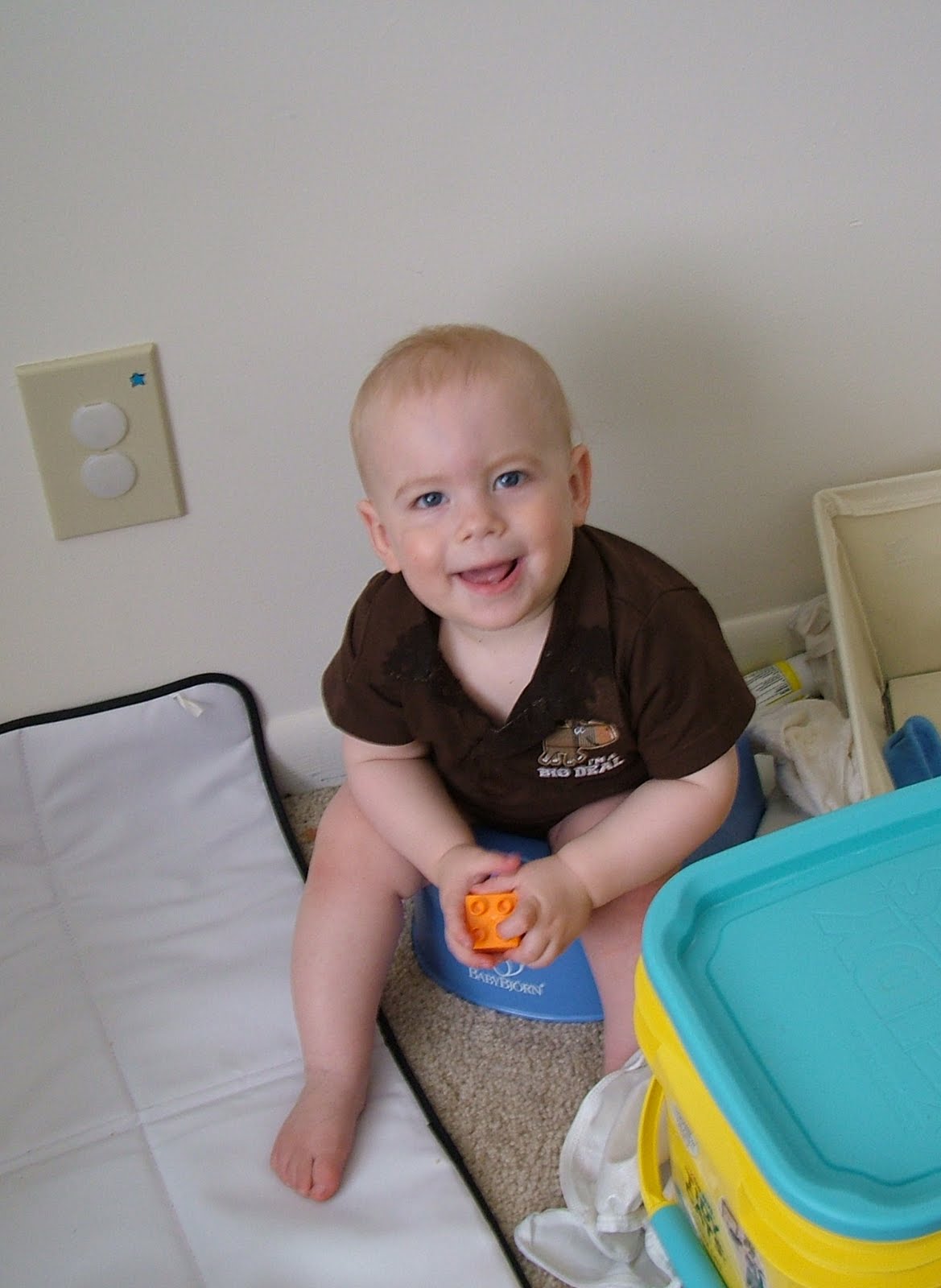
I got a Baby Bjorn Little Potty, which is small and convenient, as well as nicely sized for smaller children. I put Marko on it one day before his bath, and turned the water on. The sound of the water usually makes him go, as I've discovered when I take his clothes off too soon. The very first time, it worked! I made the cue noise (a "psssss") sound and signed "potty" so he would know what that sign and sound meant. Then I gave him a hug, put him in the tub, and dumped out the potty. EC doesn't use rewards, because it's not supposed to be something we're trying to coerce the child to do. Either they want to go in the potty (as babies generally do), or they don't. Anyway, I'm not much into rewards; I think that children usually are happy enough just knowing they're learning and doing well.

Since then I have been trying to put him on the potty a couple of times a day. When he wakes up from a nap, I put him on there and he usually goes. Sometimes he takes his diaper off, and whenever he does that, I put him on the potty. Each time I make the cue noise and sign "potty." When I make the cue noise and he doesn't go (which happens just as often), my guess is that he probably had just gone and doesn't need to. I'm not completely sure.

But the Holy Grail of the whole process has been getting him to poop in the potty. I thought that would be the easy part, because he tends to go after breakfast every day, and I can usually tell when he's about to go. But day after day, I've spent ten or fifteen minutes having him sit on the potty after breakfast, and eventually he gets bored and wants to get off. Five minutes later, he's gone in his diaper ... or, one time when I wasn't in a hurry about getting the diaper on, on the bathroom floor. Uh-oh.

Today, as he was finishing up his breakfast, he was making that face and I knew he needed to go. So I scooped him up, took his diaper off, and put him on the potty. The second he was on it, he began to cry! A toy to play with didn't help a bit. My guess is, he really needed to go, but didn't think he could do it on the potty.

So I sat behind him and reached my arms around him so it felt like he was sitting on my lap. I read a book to him. He calmed down, but he still wasn't going. The cue noise and sign didn't do anything; I think he associates them with peeing, not pooping. I remembered what I've heard elsewhere, that sitting is a bad position for pooping, and that squatting is much better. So I scootched his feet up toward him so he was more squatting than sitting. Of course, he started to stand up. So I stood next to him and squatted down ... which he imitated. So he and I just squatted up and down for awhile, him on the potty and me standing next to him. He was happy enough doing that that I wandered away for a moment ... but when I came back, he was standing up and looking in the potty ... which had a poo in it!

I know I'm not supposed to be making a big deal of it, but I did. I gave him a big hug and a kiss and told him he did a good job. Then I took him with me to the bathroom so he could see me dump it out and flush the toilet. I wanted to give him some diaper-free time after that, but unfortunately we had to leave for work right then. But I am VERY proud. Yes, sadly I guess this has to happen when you have a kid ... you start bragging about their bodily functions. I hope anyone who doesn't want to talk about those has left already! ;)

So, for now I'll just keep doing what I'm doing, having him sit on the potty a couple of times a day. It's no big deal if he doesn't go, and I'm okay with changing diapers the rest of the day. But it's a nice introduction. Once we move, I plan to let him play diaper-free whenever we're outside, because he hates wearing a diaper, and I figure that can help him remember the connection between the feeling of relaxing and actually going potty. We'll keep the potty handy, and he can go on it when he wants to. Seeing as he's so young, I'll keep it low-pressure. But if he's ready to try -- and I think he is -- there's no reason to hold him back just because he needs my help getting his pants off and sitting down.

Have any of you tried EC? If not, what was your method for potty training?
Related Posts Plugin for WordPress, Blogger...