Pages

Friday, December 3, 2010

On sickness

Nobody likes being sick. And for those of us who are healthy, it can be a point of pride: "He was never sick a day in his life." It's nice to know your body is working well.

Most of us who live to old age, though, will die of sickness. Nowadays, it's probably cancer, though it could be heart disease or Alzheimer's. Though my dream is to die peacefully in my sleep at the age of about a hundred, after a long day of baking cookies and telling stories to children, I will probably end up dying of some sickness like most people do.

Terminal illness can do a lot of things. It can warn the person that death is near, help them get their affairs in order and ready their minds. Or it can terrify them, as they know their time is running out.

It can give some people a chance to show their courage, as they look death, sickness, and pain in the face without quailing. Or, especially in the case of a long illness, it can break the people we thought were strongest and bring them near to despair.

It can give the person's spouse a chance to show their love in a final time of service, where they care tenderly for the sick person's needs. Or it can burn out the healthy spouse until they're too stressed to make the love in their actions apparent.

Sickness can make you or break you.

It's hard to visit the sick. You want to bring comfort, yet you're afraid to see the person. Afraid they will be something different from what you've always known. You don't want to be left with the memory of a weak person, in bed, surrounded with tubes and wires; you want to remember the strong, healthy, happy person you knew. You don't want to ruin the image you have of someone you've always looked up to.

I've been thinking about this a lot, as my Grandma J- fought a brave battle with her illness, and my Grandpa C- is fighting his. It's just hard on everyone to know a family member is suffering so much. Suffering can ennoble the soul, but it can also push the soul past its limits. And for those of us who are not suffering, there is nothing we can do to lift the pain for the sufferer.

I haven't got any real conclusions about this, because there isn't anything I know that can make this any better. All I can think right now is that I got the news today that my grandpa can sit up in bed and ate breakfast this morning, and though I am very happy to hear it, I still feel sad. A couple years ago, good news from Grandpa was that he was climbing Mt. Rainier or taking aerial photos of the Columbia River or had picked a bushel of cherries ... I wish I could hear he was doing those things again.

I think heaven for my grandpa will involve a lot of flying. The wind will be full in his face -- no plane needed -- and he will be able to see to the horizon and beyond. God made an eagle when he made my grandpa, and He'll give him an eagle's reward.

Right now his body is in bed, but he still has the soul of an eagle. I love him so much.

(Grandpa is second from left, in the back.)

Wednesday, December 1, 2010

The feminist dilemma

It's tough to be a woman nowadays. Oh, sure, women's rights of various kinds have expanded by leaps and bounds -- certainly we are not being locked in the kitchen or prevented from speaking or forced to wear burkas in America today. And yet, things are more confusing for women than they used to be.

On the one hand, many women want to pursue a high-powered career, and are quite pleased in their ability to do so. They can go to college, pursue whatever degree they want, get whatever job they want, climb through the company, and make a great deal of money.

Or, they could get married right out of high school, have kids right away, and stay home caring for those kids until they're grown. In their own homes, they can set the rules and have a huge degree of freedom.

However, these two options threaten one another. If some women drop out of the workforce when they have kids, working women are under the suspicion of untrustworthiness, just because of their gender. Employers wonder if their female employees will be getting married, having babies, resigning. They fear women will be demanding more leave, more flexibility, more breaks. Women who choose to put their careers first have to deal with the expectation that they will put their families first.

Some people get offended hearing the statement, "Moms who stay home to raise their kids are undermining what we feminists worked for," but I honestly understand. It does mess things up when some of us stay home. It changes the expectation. It's also a reason for the wage gap.

Meanwhile, stay-at-home moms are threatened by working women as well. If most women work, the economy begins to require two incomes in a family. There's no leeway for them to stay home. Some moms are forced back to work before they want to go. Others have to cut expenditures down to almost nothing in order to afford to stay home. And they face a penalty if they want to return to the workforce, a blank spot on a resume. This wasn't the case when women were expected to stay home.

So, we've got a problem. A true feminist would agree that freedom for women means the freedom to choose either of these options. And yet, how can we have complete freedom to go either way, when we're all fighting the expectation that we'd be doing something different?

A childless career woman has to face people making assumptions about her commitment based on other women, women who quit or reduce hours when their children are born. She will often have to shoulder more work in order to keep up productivity during their maternity leaves. A stay-at-home mom has to deal with the assumptions people make that she is lazy, that she just sits around the house all day, that she is uneducated. When people ask her what she does for a living -- which is how most adults define themselves -- she is left feeling vaguely embarrassed for her lack of an answer. And working moms feel the most torn of all, wishing for more hours in the day so that they can work, care for their children, and maybe find five minutes for themselves in the midst of it all.

Other ages have not had this problem. One hundred years ago, there was an assumption that married women would stay home and take care of the house and children. Sometimes this was a big job and sometimes it wasn't. But before that, before the industrial revolution made it commonplace for people to have "jobs" per se, rather than other work (on farms or in workshops), women definitely worked. They would work in and around the home at handwashing clothes, cooking, food preparation, clothesmaking, and countless other tasks. Meanwhile the man of the house was working a little further afield, hunting or farming, but still working for his own family. In this sense, they both could be said to "stay home."

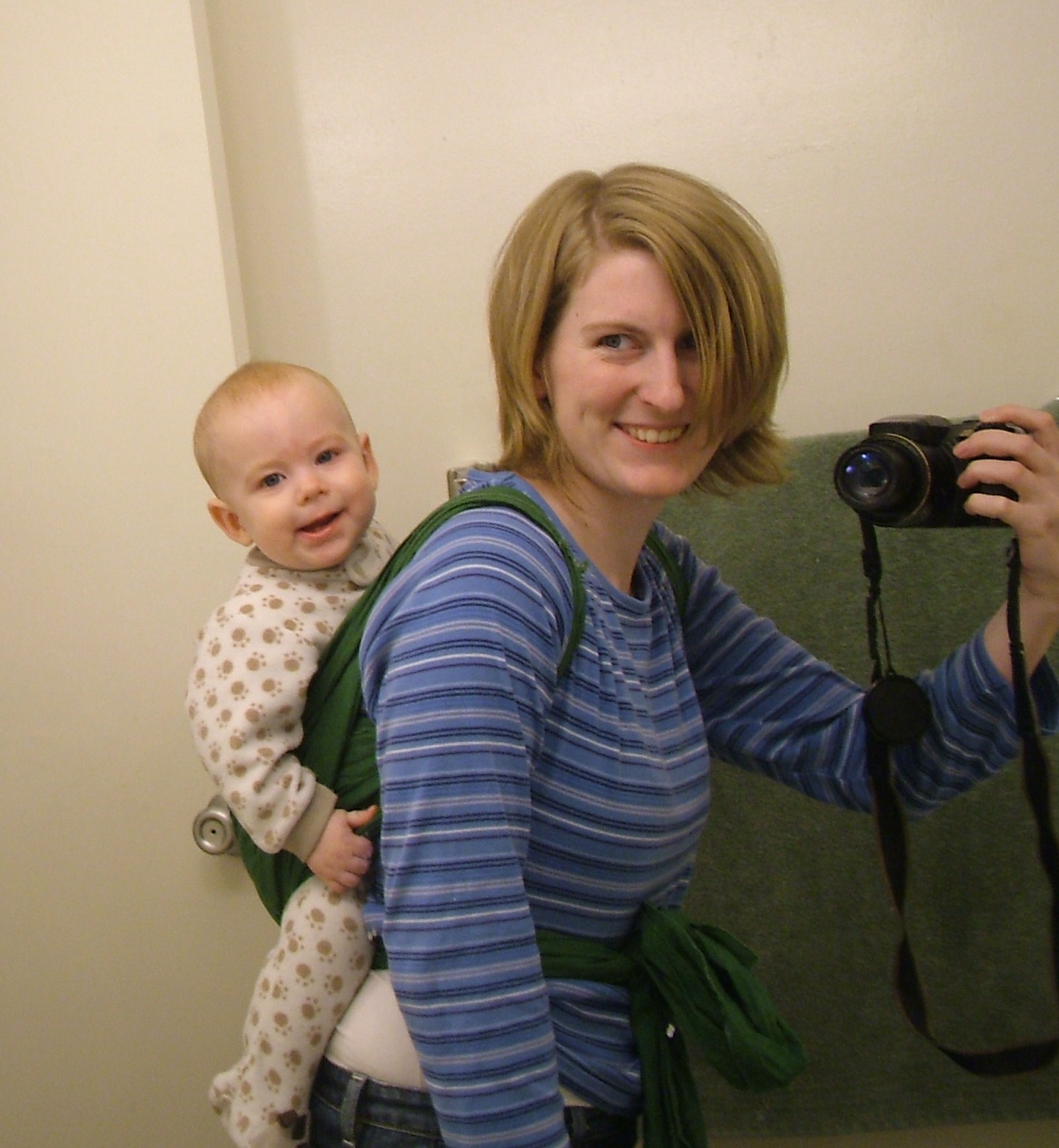
And what about the kids? The children went where their parents went. Babies stayed with their mother, on her back or in a nearby cradle while she worked. Older children might go into the fields or the workshop to watch their father, and the oldest would begin to learn his work. Children weren't separated from real life, they were part of it, taking on a gradually increasing role with age. This was good for the children as well as for their parents.

Luckily, childcare is not a job that takes 100% of your attention, 100% of the time. It's a job that takes a little of your attention, all the time, and all your attention some of the time. Babies flourish just as well rocked by the motion of their mother's back as she bends over to pick rice as rocked in a cradle by a mother who has nothing else to do but rock.

Unfortunately, there's a problem of place nowadays. Work is done in one place, a quiet office or dangerous factory, and childcare is done somewhere else, at home or in a daycare. And it's no longer done for the family itself, on its terms. There's now a boss who feels it inappropriate for his secretary to strap her baby on her back before going to work like women have done throughout history. There are rules and regulations. There are coworkers who have gotten used to their adults-only space.

Because of all this, women aren't being allowed to combine their two jobs. I think this is a problem. I think, as much as possible, this should change.

I know bringing babies to work is not a total solution. There are many jobs where it wouldn't work at all. But it would be a start.

When childraising stops being considered a privilege, a disability, a demand, and is considered just something women do, something essential to what women are, something we can bring with us anywhere as we bring our breathing, maybe this dilemma will begin to fade away. When employers realize that men who use the restroom and take smoking breaks lose productivity, and unmarried women who space out at their desk for five minutes lose productivity, and mothers with babies lose productivity, but not enough that it can't be made up by hard work, maybe we'll be getting somewhere. When society acknowledges that the raising of our next generation is important work, work that has to be done by someone, work that will harm all of us if it isn't done well, perhaps everyone will start trying to be part of the solution, shuffling things around so that parents can parent. When people recognize (as, in my case, they do) that inviting me somewhere means inviting my baby, I won't feel that I am being forced to choose between work society considers valuable, and work I consider valuable.

It's a dream of mine, one that I have been able to pursue as I bring my baby to work, thus making me one of a very small minority of mothers who do not feel torn about the way they spend their time. I only wish more of us had that option.

Tuesday, November 30, 2010

Potato pizza crust


I have been field-testing some different grain-free pizza crusts lately, since John's biggest grain craving is pizza. He seriously loves the stuff, but even gluten-free pizza crust made him really sick. So I've been experimenting a bit. Zucchini pizza was okay. It varies quite a bit depending on how dry you drain the zucchini, and even at its best it reminds me of an omelet, but it did allow you to shovel pizza into your mouth with relative ease.

This time I decided to try potato pizza. I invented the recipe myself. Potatoes aren't allowed on the "primal" diet, but John and I eat potatoes all the time, because they're an inexpensive non-grain option that helps supply our very high calorie needs.

I definitely preferred this pizza to the zucchini pizza. It made a thicker, more substantial crust, and tasted less eggy. You can adjust it to your needs: more eggs for more strength, more cheese for more crispiness, more potatoes for a thicker crust. It does taste a bit like potato, but I happen to like potato as a pizza topping anyway.

John gave his vote of approval, so I think I'll be making it again!

Potato pizza

3 medium potatoes (about 2 cups mashed)
2 egg whites*
1/2 to 1 cup grated cheese

Cook the potatoes, either by boiling whole or by baking. Let cool and peel the skins off. Mash the potatoes by smooshing with a fork or passing through a ricer so that there are no chunks or lumps (or as few as possible). Add the cheese. Beat the egg whites until they form soft peaks and fold them into the potato mixture.

Spread onto a baking mat or parchment paper and form into the desired shape. Press as flat as you want it, making sure there are no gaps. Bake at 350 degrees for 15 minutes or until firm. You can remove the crust from the parchment paper at this point, if you want it to brown better. Then add toppings (you may want to go easy on the cheese because there's so much in the crust) and bake till the cheese is melted and toppings are warm. Let cool a little bit -- it firms up as it cools -- and enjoy!

*It would probably work fine if you used a whole egg and didn't beat it, but I use my yolks for so many other things that it was a saving just to use the whites.

This post is included in Fight Back Friday with Food Renegade. I forgot to say that earlier ... there are tons of great posts about real food, so go have a look!

That carnival post, and a recipe

My cosleeping post is finally up! Yes, I know you've been holding your breath for it. Well, you can finally go on with life knowing our journey to become part-time cosleepers.

Since I wrote that post for the November Carnival of Natural Parenting, we've had some ups and downs, especially as the baby's been sick. Lately he's been waking up a lot, I think due to separation anxiety. It's weird because he's never minded being on his own before, but this is the age for it. I've found that all it takes is for me to be nearby -- either lying beside him, or standing by the crib with my hand on his back. (Guess which is easier?)

Marko still sleeps most of the night in his crib, but I am glad to have cosleeping as an option.

Here's a baby-led weaning recipe I devised the other day. Marko loves his pumpkin, and I mean LOVES, but it's a huge mess. He'd be coated with it, the high chair would be coated with it, and the carpet would have little blobs of pumpkin. So I was hesitant to give it to him because I knew it would be a huge production: high chair on a drop cloth, nice outfit off, bib on, then a huge wipe-down and/or bath. I ended up using potato starch to make the pumpkin into some yummy fritters!

Grainfree Pumpkin Fritters

1/4 cup pumpkin puree
1 tablespoon blackstrap molasses
2 tablespoons potato starch
oil -- whatever you have introduced; I've used olive oil and bacon drippings

Mix pumpkin and molasses. (The molasses is rich in iron, important for babies, especially if they're not eating fortified cereals like mine isn't!) Add the potato starch, a little at a time, until the pumpkin is thickened a bit. (You can add more to make a dough, if you want to be able to shape them. The more starch, the chewier a fritter you'll get.) Heat the oil over medium heat and drop in the pumpkin mixture by spoonfuls. Flatten a bit with the spoon if you can. Turn them once they're relatively firm to the touch on the bottom (you don't want them to be too crispy or brown for little babies) and cook the other side till it's firm too.

Dice into tiny pieces for babies, or leave whole for toddlers and grownups. It's a great finger food that doesn't require any grains!

Saturday, November 27, 2010

Working with baby

An old friend of mine contacted me the other day on Facebook, asking about how I've managed going back to work after the baby was born. I answered her, but then I realized that I haven't explained very much about it on this blog, and I probably should. After all, the number of moms who bring their babies to work with them is quite small, but I think there's a lot of room for this to become a more popular option.

Here's what I wrote to my friend:

I never intended to go back to work after the baby was born. But the school where I had taught before contacted me, saying they had just one class that they needed me for. Since they were going to let me bring the baby with me, I saw no reason why not -- I'm a firm believer in keeping the baby with me all the time.

He was 5 months old when the school year started. I think I could have managed from, say, 3 months on. When he was tiny, I probably wouldn't have wanted to expose him to all the germs at school.

My one class takes less than an hour a day, and the prep work is pretty light, so it's a pretty easy situation. I also ended up volunteering to be on the sub list, so I've subbed for longer, and even working the whole morning long hasn't been a problem. I probably wouldn't want to do the whole day, though, because he does need a nap.

While I work, I usually wear him in a baby carrier like a sling or my Moby Wrap. (That thing is great -- he feels so light in it.) The kids (high school age) aren't usually too distracted by him, and he behaves really well. I do have an unusually easy baby, but I think most babies like getting out and getting some stimulation. I haven't had a problem with him crying in class more than once or twice, and the office says I can leave him with them if that happens. I don't do that, though; instead I just assign the kids some desk work so I don't have to yell over his fussing.

Overall it's been really great. I don't make a ton of money at it, but the little I take home is really handy right now. From what I know, most Catholic schools are very adaptable about babies, so you may well be able to swing a similar deal.

A couple things to keep in mind:

Your baby might not sleep through the night until s/he's much older. So you do have to be prepared for dragging yourself out of bed to go to work when you'd really rather sleep.

I have taken many more sick days than I used to, because if either the baby is sick or I'm sick, we can't go. So far this year I think I've taken three (including today).

I'm breastfeeding, but I don't feel comfortable nursing in front of the kids. With younger kids I might, but with high school kids, it's tougher. So I nurse in the teacher's lounge right before class, or else at home before I leave, and generally he lasts fine till class is over. It takes some careful scheduling to make sure he's hungry at the right times, but he's a pretty predictable kid. Once he was really fussy during a test, and I put the diaper bag on the desk to block the view and just nursed him. It wasn't a problem. I wish I could manage nursing in the sling, but I've never gotten the hang of it.

Our school has a lot of evening events the teachers are expected to go to. I begged off of all I could, and for the few I really had to make, I've left the baby at home with John.

That's all I can think of. If you can, it would be great to wait until the baby's born to decide, since all babies are different and you don't know how you'll handle it, but I suppose that's not always possible. In any event, you should talk to your school and see how far they are willing to accommodate you.

Hope that helps!

Sheila


Overall, I have no regrets about having returned to work. I was very resolved not to leave the baby -- not to mention I have no affordable childcare available. Being allowed to bring the baby has made it possible for me to care for him and be a part of the workforce. From my perspective, it's the best of all possible worlds.

I think more workplaces should provide this option, instead of requiring the forced dichotomy that women are often faced with: spend time with children or work. In an economy where two incomes are almost required, while childcare is expensive (and not the ideal for many women), we need to be thinking of more creative solutions like this.

Service-oriented jobs tend to be the easiest to combine with parenting. I've heard of receptionists, hairdressers, pediatric nurses, and daycare providers babywearing on the job. Babies love interaction, and as long as they're cozy in a sling, most have few needs. Moms will need adequate break time, and many find it helpful for a coworker to be on backup for them in case both the job and the baby need their full attention at the same time. Part-time is much easier, though I've heard of moms managing their babies at work full-time.

Here's a good source for more information.

Any other readers who have brought their babies to work? How did it go?

Friday, November 26, 2010

Our grainfree Thanksgiving, with pictures

Our Thanksgiving went great! I hope all of yours were happy and blessed, too.

I posted the other day about what I intended to do for Thanksgiving. In the end, I decided to expand the menu quite a bit, but I still kept it 100% grainfree! Taking pictures of every dish helped motivate me to make everything just right, even without guests (and with a husband who barely cares what he eats).

First off, I decided we needed an appetizer. I had chickpeas I'd promised to make into hummus, but wasn't quite sure what to put it on -- normally I like crackers or pita wedges. I decided on celery and carrots. John was quite pleased and said that was a very good idea! I think the celery went with the hummus best, but then, I've been on a bit of a celery kick lately. We ate the hummus about lunchtime, to tide us over, since we'd decided to have Thanksgiving dinner at six p.m.


After that, I decided to make some cranberry sauce, mainly because I had a whole bag of cranberries and I knew the cranberry apple casserole wasn't going to use them all. John happened to mention that he didn't like cranberries, and I made a decision: I was just going to make what I wanted to eat, because I was tired of saying, "Well, making X for just one person would be a waste, so I'll just go without." By golly, one day a year, I'm going to the trouble to make what I want. (Meanwhile, I am slowly training my child to eat what I eat, to put that picky husband of mine in the minority. (John believes that he is not picky. He says I'm the one who's picky because I insist on dinner being hot when I eat it. Different strokes, different folks.))

My recipe was simple: one cup of orange juice, one and a half cups of cranberries, and a few tablespoons of sugar. It's a great way of adding flavor while using much less sugar than traditional recipes. I nearly burned the sauce on two different occasions because I was distracted with the baby, but luckily it escaped unharmed.

Dear readers, it was the best cranberry sauce I have ever had.


The most delicious part of the meal turned out to be an afterthought. I was walking into the kitchen a little before the turkey was due to come out, and the delicious smell of it roasting made me think of sage and celery. I hadn't planned to have stuffing -- my thought Wednesday was that it's just wet bread stuffed up a bird's behind, no big deal -- but at that moment I felt I had to have it! Quite a frustrating realization when you passed up 99 cent boxes of stuffing only the day before, and you have no idea how to make it from scratch (I could probably guess, though I'm not sure). And, of course, stuffing is not at all grain-free!

I decided to just follow my usual instinct for grain-free recipes: just make it as usual, but leave the grain out and increase the other ingredients. It worked great for beef stroganoff, after all. So I chopped up some celery and onion and sauteed them in olive oil. When they smelled absolutely delicious, I poured in some of the giblet stock I had simmering for the gravy, and seasoned the whole thing with poultry seasoning (mostly sage, thyme, and rosemary). The stock pretty absorbed completely, so I dumped the whole thing on a plate and put it the oven to keep warm. That also made it a bit crusty on top, yum!


Today I made the same thing for lunch, only I replaced the turkey stock with water to be vegetarian and added mushrooms. Definitely mushrooms need to be a part of this recipe.

Technically, this is dressing, not stuffing -- I would not recommend putting it inside a bird. Anyway, it was really delicious, and my favorite part of the meal. I keep forgetting how much I love celery, particularly if it's cooked right, and then every Thanksgiving I remember.

Here's the bird, in all its glory:


He weighed a good 12 pounds -- and only cost 46 cents a pound! I'm so glad I waited and browsed the local stores ... Aldi kept the price at 99 cents clear through Thanksgiving (and they are probably still 99 cents now).

It wasn't as juicy as last year's, though I can't think why. I did the exact same thing: cooked it breast-down, in my Pyrex dish, at 350 degrees. Perhaps it was just a drier bird. It was still good though. I rubbed the outside with olive oil and poultry seasoning, and John asked "Are you giving the bird a back rub?" Yes, dear. Yes, I am.

I did not find arrowroot powder for the gravy, but I did find potato starch. You're supposed to dissolve 2 tablespoons in 1/4 cup of cold water, add it to the stock/drippings, and boil for a minute. That's what I did, and it turned out fine -- though more transparent than I'm used to. Still thick enough, so I had no complaints.

The gravy was composed of a mix of drippings and stock made from the giblets (including the neck), celery, carrot, and onion. As usual, it was delicious. John mashed the potatoes that went with it, and those were good too -- but, you know, with me, potatoes are only a vehicle for gravy.

The apple-cranberry casserole, such as it was, was pretty simple: cut-up apples, cranberries, and a dusting of sugar, baked for 45 minutes. I didn't realize, though, that the streusel was playing a valuable role in the original recipe -- it kept the fruit from drying out. So it was drier than I'm used to. Next time I'll add a little water or something -- or just keep the streusel topping, seeing as John didn't eat any anyway.

I ate this with ice cream, and it was delicious!


John's contribution was the seven-layer salad. To be honest, guys, I really don't know what-all was in it. I know it had scads of vegetables, and also a mayonnaise-based dressing, and cheese. It was really good.


Here's the guest of honor, shoving pumpkin in his mouth like there's no tomorrow, while staring at the dining room fan:


Here's the table all set and pretty -- which I did for you, dear readers, because no one else cared. Oh, and for me. I definitely cared.


Here's my plate, all dished up with some of everything. I had forgotten the cranberry sauce. Don't worry, I had some later!


The lack of grains may have helped more than just John -- I felt great after this meal, not overstuffed, just satisfied. I had seconds of turkey and a little more mashed potatoes, but I didn't feel like eating any more than that. And I didn't feel the least bit bloated or sleepy, like I often do after Thanksgiving dinner.

Afterward, we played Scrabble and I ate my apple-cranberry casserole. The baby, who had been cranky and miserable all afternoon, suddenly flipped a switch and stayed up playing happily an hour and a half after his bedtime. I wasn't going to mess with a happy kid, so I just let him.


All in all, it was a success! Quite a huge feast for three people, one of whom ate nothing but pumpkin and mashed potato, but it was a comfort to me to have a traditional meal at a time when I'm missing my family something awful. There's something about the completely predictable menu that gives me a sense of continuity with the past. I can understand why Jewish people get so much out of their Seder meal. Our nation's traditional meal has no "meaning," as such, but it's a vehicle for us to practice some very meaningful things: gathering with family and friends, memory, gratitude.

Yes, it was a good Thanksgiving.

Wednesday, November 24, 2010

Our grain-free Thanksgiving

Sorry there haven't been any posts lately. Baby and I have been sick. Any parents will know what a long story that sentence hides ... a lot of me sick, then baby sick, then me sick again, and some with us sick simultaneously; a baby too congested to sleep or nurse, me coughing too hard to let the baby sleep or nurse; a baby who needs to be bounced and walked around all day while I need to lie in bed with the covers pulled up all day ... Well, it's been rough. We're feeling somewhat better now, thank God.

Anyway, for Thanksgiving this year, I'm planning only grain-free dishes. I was going to make at least some stuffing for our guests, but sadly we could not dredge up a single one! Last year, you might remember, we had what I call an "orphans' Thanksgiving," where we invited two guests who didn't know each other a bit, and had a lovely time. I tried to do the same this time, but no one could come, sigh.

Here's our menu for tomorrow:

Turkey: a 12-pounder, the smallest I could find, but also on such a deep sale (46 cents a pound) that I was happy to buy what I could. You're just not going to find meat cheaper than that.

Gravy: I'm hoping to thicken this with arrowroot powder, if I can find it. Other grain-free thickeners include tapioca and potato starch.

Mashed potatoes: with butter and milk.

Salad: John's "ancestral recipe" is seven-layer salad. I don't think we've got all seven layers worth of vegetables, but it will have lettuce, cucumber, tomato, green peppers, peas, and carrots.

Apples and cranberries: My "ancestral recipe" is apple-cranberry casserole with streusel topping. I'm just omitting the streusel, so it's just apples, cranberries, and sugar, baked together.

That's all. I could do sweet potatoes, but John doesn't care for them, and with only the three of us, I don't want to overdo things. The baby will probably just eat turkey, apples, some of the salad vegetables, and maybe his first try of potatoes.

It'll be a quiet Thanksgiving, and I do wish we could have some company (ah, for the lovely company we had last year!), but I think we'll have fun. In any event, that turkey will feed us for weeks!
Related Posts Plugin for WordPress, Blogger...