Okay, I admit it, I'm grouchy. If I were in a better mood, I might say these people were misguided or that they didn't think things through. Instead, I'm kind of offended.
I'm talking about the United Way Hunger Challenge. These people want us all to sympathize with the plight of the poor by living on $7 worth of food each day, for five days. Apparently this is the maximum benefit for an individual on food stamps.
Problem: my food budget, which feeds two (and a half!), is somewhat less than $7 a day. These people who are trying to empathize with the plight of the hungry are spending more for food each day than I do.
Part of me is insulted that I am being grouped as a "poor person" according to their system.
Part of me is outraged that you can get a better food budget from the state than from working. Though I know more of the poverty problem in this country is not food, but rent, heat, doctor bills, and so forth -- which, of course, food stamps are no help for.
Part of me is scornful at the people who are doing this. "Wimps," I found myself muttering. They are complaining half the time that they can't eat the way they're used to, and the other half of the time they're patting themselves on the back at how well they are managing "so little" and how in solidarity with the poor they are.
And the food they eat just seems ridiculous to me. For example, this, from the Foodista blog:
"Now then, I started off my $7 day with a slice of .16 oat bran bread with a .15 slather of pure peanut butter. On the side I had one 1/2 cup of defrosted frozen strawberries (.25 from $1.69 package) in one 1/2 cup of plain yogurt (.31 from $2.50 quart). I drank 1 cup of organic milk for .37 (from a $2.99 half gallon)."
Who eats that fancy of a breakfast on a daily basis? I don't know, I guess some people take breakfast kind of seriously. But I leave for work early, so I don't have time for all that. Instead I had a peanut butter and jelly sandwich and a glass of milk. My estimated price for this was something under 70 cents. (However, I didn't actually spend this much, because the jam was from John's mother. I haven't bought jam in months.)
Or the lunch: "For lunch I had a citrus salad made from a grapefruit (.20, bought on sale for 5/$1), a navel orange (.33), and 1/4 cup organic arugula (.50). I also had 1 pan-fried egg (.20) with a negligible sprinkle of sea salt and some baked potato wedges (.10 for 1/2 pound) with ketchup (.08). I had water with lunch." Total: $1.46.
A working person doesn't generally have time for that kind of food prep for lunch. I either have leftovers or something premade. A ramen cup is 50 cents. Canned soup generally costs $1.20 or so, depending on the variety. If I had time to home-cook a lunch, I could save a ton. But I don't usually, so I tend to have canned soup, and for other snacks at work (I eat several), I have granola bars (a bigger expense than I'd like, but I'm hoping to homemake these this weekend), a banana, crackers, or something similar. I promise you, no one "poor" is eating organic arugula on a regular basis. No one.
Now, I could do healthier with a bit more money and/or effort. I just don't have the time to spend on these meals. So dinner ends up being my big time focus (though it is often cheaper than lunch).
I actually respected this blogger's dinner: it was a pineapple chicken coconut curry. Rather gourmet, but she went to an Asian market to get the ingredients quite frugally (you will find ethnic food is often significantly cheaper than standard American fare, because of these ethnic stores), and she made enough for four meals, so that she could live off the leftovers. I am all in favor of leftovers.
I can't share what we ate this week, because I have been so exhausted and lazy I haven't made dinner on a regular basis, so I can't even remember what we ate. Some days it was leftover stew, some days sandwiches, and some days we fended for ourselves. But in an average week, I'm likely to make the same food count for several meals.
Last week, I seem to remember that I roasted a chicken on the weekend. That was Sunday's dinner: a drumstick and a thigh for John, and a wing for me (my appetite has gone down a bit lately). Then there was some kind of vegetable on the side. Monday, we had the other drumstick, thigh, and wing, as well as all the meat we could get off the back. Tuesday, I pulled off the breast meat and made a pasta dish with it, along with the drippings from the chicken to go in the sauce. I think the other ingredients were cream cheese, onions (a bag of them costs barely more than a single onion), and peas. Wednesday I can't remember for sure, I think it was one of my extremely cheap vegetable-potato soups. (Broccoli-cheddar is my favorite, but cheese has been expensive lately.) Thursday I simmered the chicken carcass and the giblets to make stock, and made a chicken soup with rice and peas. It was a little thin, so I added some of this failed lentil dish I made over the weekend to up the thickness and the protein, and I believe I put in an egg drop as well. It wasn't very good, mainly because I forgot to take the liver out of the other giblets, and I ended up eating a big bite of it. However, I'm sure it's for the best, as I'd had blood drawn that morning. Friday, I baked fish with lemon juice and served canned spinach on the side. I used to find fish too expensive, until I found a 3-lb. bag at Aldi for $3.99, and discovered it takes us about four or five meals to finish one. And Saturday was that venison stew -- something that would normally be quite expensive and not on our usual menu, but which cost almost nothing to make, thanks to the generosity of friends.
I doubt a single one of these dinners cost more than $3. The chicken was about $5, sure, but it lasted for three dinners. Eating frozen vegetables on the side of each meal keeps the price way down, over fresh. (I do buy fresh carrots and celery from time to time, and fresh fruit.)
I'm not 100% sure where I'm going with telling you all I'm eating. Mostly, I think I'm bragging a bit. These people might have more money than me, but when it comes to eating cheaply, they haven't got half my mojo. And this is what I do while working a full-time job -- when I can stay home, I know I will do better, both for better health and less money.
Aside from that, I guess I just wanted to show it can be done. It is not hard to live on less than $7 a day. In fact, I would maintain that most of us shouldn't be spending a whole lot more than that -- if we do, we're probably either wasting food, overeating, or spoiling ourselves. We Americans tend to imagine our luxuries are necessities. They're not.
Elsewhere in the world, there are people who are actually starving. People for whom a cup of rice that costs a few cents would make all the difference. Who wants to practice solidarity with those people? More importantly, who wants to lend a hand?

Friday, January 29, 2010

Wednesday, January 27, 2010
The Real Food Religion
It seems I can't turn around these days without running into someone else going on and on about "real food." Now, I can't exactly point fingers, because I'm a fan of the traditional food movement myself. I believe in making food from scratch, avoiding highly processed food, and eating foods that come complete with their natural fats.
I always have been a believer in making as much as possible from scratch, simply because it tastes better that way and is better at expressing my love for the people I'm cooking for. When a friend's mother gave me Nourishing Traditions for a bridal shower gift, I learned a lot and got pretty into the idea of cooking in a more natural way. I would like to do even more -- like baking bread from scratch and lacto-fermenting foods.
However, I discovered that I am not even much of a dabbler compared to most of the whole-foods types out there. The blogs I read all seem to be written by women who make whole foods the focus of their efforts. They make everything from scratch, and every week there's another post about some food we ought to avoid. And I'm always seeing panic and guilt in a few of these posts -- not constantly, but appearing as a recurring theme. These women cry out, "What about this? What about that? I switched to whole wheat -- am I now giving my kids unhealthy phytates? I am using real butter now -- but I feel guilty because it's not grass-fed! I know I shouldn't eat battery eggs, but I can't afford any other kind!" The more they do, the more they feel they ought to be doing. And other things fall by the wayside. I nearly yelled at my computer when I read one blogger confess that, though she had intended to homeschool, she'd sent her little girl to kindergarten because she was too big of a distraction from cooking. I wanted to tell this woman, "It won't matter how well-nourished she is if she doesn't have the attention of her mother!"
That's one problem I see with the whole-foods crowd. Another is the quasi-religious attitude toward food. Normally I see it in New Age types, who do various vegan, probiotic, or other fad diets and talk about the "positive energy" in food. But lately I've been finding it in Catholics: women who consider it their duty as Catholic wives and mothers to provide their families with a certain kind of food. It is no wonder the anxiety and guilt attacks them -- they're taking on a mammoth task and endowing it with the same attitude they take toward their faith. It is impossible not to commit nutritional "sins" all the time. I read an article recently saying that "food is the new sex," pointing out that modern people make all kinds of rules about food, suffer from food guilt, and make a religion of eating the right food, while believing that sexuality is completely without any moral compass. It's true -- modern man (and especially woman) obsesses about food to an insane degree and tends to ignore the morality of more important things.
Another issue, I'm more likely to see in the posh types I meet at work. The area surrounding the school is an area famous for upper-class Catholics (which is how I managed to get a paying job here, after all, so it's not like I resent this). All of these classy Catholic women seem to make a hobby of gathering around talking about the healthy food they are eating. "I just made my own jam!" "Oh, really? I made chicken stock the other day from free-range chickens!" It's like the organic version of the more secular moms who stand around at soccer games and discuss their tummy tucks, their home renovations, or their shopping trips. (I used to make my daily bread off of that crowd instead.)
Then I might happen to mention, in the presence of these ladies, that I brought canned soup for lunch, or that I don't think I could afford to buy raw milk from a farm. And they open their eyes wide: "But that is so BAD for you!" "But raw milk is really WORTH the expense!"
What they don't understand is that, no matter how "worth it" the expense is, if you can't afford it, you can't afford it. Their income is such that they are able to pay my salary. But it just doesn't occur to them that I can't match their standard of living. Food, to them, is just one more way of "keeping up with the Joneses," one which seems more selfless than other consumerist things they could be doing, but which still becomes a class-based activity.
I don't eat free-range or locally-grown meats. I never buy anything organic, not because I wouldn't like to, but because I simply can't afford it. If I were going to put that much stock in an organic label, I would be in a panic right now, because it would double our food budget to eat those things that we're "supposed" to. The bloggers' advice is that, once you cut out junk food and impulse purchases, you'll find there's tons of money left over to buy healthy food with. But what if you already cut those out in order to pay the heating bill and the student loans? And their other tip, "Eat less food," is hardly much of an option when one of us is pregnant and the other is skinny as a rail and bikes four miles each way to get to work. I have promised a number of people that I won't let myself go hungry. And when it's go hungry or eat the food that may have MSG or BPA or any other nasty letters, I go ahead and eat the food with the chemicals. Luckily I never got far enough into whole foods that this throws me into a panic.
Instead I do what I can. I make from scratch what I can -- which isn't as much as I'd like, since I'm a working wife, but it's a lot. I make sure that our food budget goes first to meat, milk, eggs, and vegetables before any of it gets spent on nutritionally-weaker things like noodles or crackers. I have gone to Whole Foods once, at the prodding of people at work who insisted that what I wanted could only be found there, and wasn't really sold on it. Which is good, because John insists that our main shopping be done at Aldi. I am aware that there's some trade-off in quality for the lower prices there, but I think we counterbalance it by being able to afford more meat, cheese, and so forth. I've done some research on wholesalers as well, and we've been able to find inexpensive meats this way too.
And yet, I don't feel guilty. Even Nourishing Traditions reassures its readers that a healthy person on a fairly good diet can handle all kinds of toxins -- not that we should be eating them with gusto, but that the body can deal with the occasional chemical without becoming sick. After all, most people are fairly healthy, even without following any of the real food philosophy. Luckily, whole foods aren't a diet that you have to do completely for it to be any good. Even a small change helps. My efforts (which I'm not really sticking to at the moment) to cut out sugar certainly made me feel a lot better, even though I didn't, at the time, do a single other thing the books suggested.
So -- for now, I'll accept Christ's words: "Do not ask, 'What are we to eat?' or 'What are we to drink?' or 'What are we to wear?' All these things the pagans seek ... Seek first the kingdom of God and his righteousness." I have a job and a husband and a baby coming very soon. I'll do what I can for these, and any preferences for food are going to have to come second. I wish more people would remember this, even as they follow a whole-foods mentality: that their efforts in the kitchen are all in vain if they are put above other, more important goods.
Thoughts? I don't think I have any real-foodies reading this blog, but I may be wrong. Do you think this is a fair assessment? Have you struggled to find a balance between feeding healthy food and all the other tasks on your plate?
I always have been a believer in making as much as possible from scratch, simply because it tastes better that way and is better at expressing my love for the people I'm cooking for. When a friend's mother gave me Nourishing Traditions for a bridal shower gift, I learned a lot and got pretty into the idea of cooking in a more natural way. I would like to do even more -- like baking bread from scratch and lacto-fermenting foods.
However, I discovered that I am not even much of a dabbler compared to most of the whole-foods types out there. The blogs I read all seem to be written by women who make whole foods the focus of their efforts. They make everything from scratch, and every week there's another post about some food we ought to avoid. And I'm always seeing panic and guilt in a few of these posts -- not constantly, but appearing as a recurring theme. These women cry out, "What about this? What about that? I switched to whole wheat -- am I now giving my kids unhealthy phytates? I am using real butter now -- but I feel guilty because it's not grass-fed! I know I shouldn't eat battery eggs, but I can't afford any other kind!" The more they do, the more they feel they ought to be doing. And other things fall by the wayside. I nearly yelled at my computer when I read one blogger confess that, though she had intended to homeschool, she'd sent her little girl to kindergarten because she was too big of a distraction from cooking. I wanted to tell this woman, "It won't matter how well-nourished she is if she doesn't have the attention of her mother!"
That's one problem I see with the whole-foods crowd. Another is the quasi-religious attitude toward food. Normally I see it in New Age types, who do various vegan, probiotic, or other fad diets and talk about the "positive energy" in food. But lately I've been finding it in Catholics: women who consider it their duty as Catholic wives and mothers to provide their families with a certain kind of food. It is no wonder the anxiety and guilt attacks them -- they're taking on a mammoth task and endowing it with the same attitude they take toward their faith. It is impossible not to commit nutritional "sins" all the time. I read an article recently saying that "food is the new sex," pointing out that modern people make all kinds of rules about food, suffer from food guilt, and make a religion of eating the right food, while believing that sexuality is completely without any moral compass. It's true -- modern man (and especially woman) obsesses about food to an insane degree and tends to ignore the morality of more important things.
Another issue, I'm more likely to see in the posh types I meet at work. The area surrounding the school is an area famous for upper-class Catholics (which is how I managed to get a paying job here, after all, so it's not like I resent this). All of these classy Catholic women seem to make a hobby of gathering around talking about the healthy food they are eating. "I just made my own jam!" "Oh, really? I made chicken stock the other day from free-range chickens!" It's like the organic version of the more secular moms who stand around at soccer games and discuss their tummy tucks, their home renovations, or their shopping trips. (I used to make my daily bread off of that crowd instead.)
Then I might happen to mention, in the presence of these ladies, that I brought canned soup for lunch, or that I don't think I could afford to buy raw milk from a farm. And they open their eyes wide: "But that is so BAD for you!" "But raw milk is really WORTH the expense!"
What they don't understand is that, no matter how "worth it" the expense is, if you can't afford it, you can't afford it. Their income is such that they are able to pay my salary. But it just doesn't occur to them that I can't match their standard of living. Food, to them, is just one more way of "keeping up with the Joneses," one which seems more selfless than other consumerist things they could be doing, but which still becomes a class-based activity.
I don't eat free-range or locally-grown meats. I never buy anything organic, not because I wouldn't like to, but because I simply can't afford it. If I were going to put that much stock in an organic label, I would be in a panic right now, because it would double our food budget to eat those things that we're "supposed" to. The bloggers' advice is that, once you cut out junk food and impulse purchases, you'll find there's tons of money left over to buy healthy food with. But what if you already cut those out in order to pay the heating bill and the student loans? And their other tip, "Eat less food," is hardly much of an option when one of us is pregnant and the other is skinny as a rail and bikes four miles each way to get to work. I have promised a number of people that I won't let myself go hungry. And when it's go hungry or eat the food that may have MSG or BPA or any other nasty letters, I go ahead and eat the food with the chemicals. Luckily I never got far enough into whole foods that this throws me into a panic.
Instead I do what I can. I make from scratch what I can -- which isn't as much as I'd like, since I'm a working wife, but it's a lot. I make sure that our food budget goes first to meat, milk, eggs, and vegetables before any of it gets spent on nutritionally-weaker things like noodles or crackers. I have gone to Whole Foods once, at the prodding of people at work who insisted that what I wanted could only be found there, and wasn't really sold on it. Which is good, because John insists that our main shopping be done at Aldi. I am aware that there's some trade-off in quality for the lower prices there, but I think we counterbalance it by being able to afford more meat, cheese, and so forth. I've done some research on wholesalers as well, and we've been able to find inexpensive meats this way too.
And yet, I don't feel guilty. Even Nourishing Traditions reassures its readers that a healthy person on a fairly good diet can handle all kinds of toxins -- not that we should be eating them with gusto, but that the body can deal with the occasional chemical without becoming sick. After all, most people are fairly healthy, even without following any of the real food philosophy. Luckily, whole foods aren't a diet that you have to do completely for it to be any good. Even a small change helps. My efforts (which I'm not really sticking to at the moment) to cut out sugar certainly made me feel a lot better, even though I didn't, at the time, do a single other thing the books suggested.
So -- for now, I'll accept Christ's words: "Do not ask, 'What are we to eat?' or 'What are we to drink?' or 'What are we to wear?' All these things the pagans seek ... Seek first the kingdom of God and his righteousness." I have a job and a husband and a baby coming very soon. I'll do what I can for these, and any preferences for food are going to have to come second. I wish more people would remember this, even as they follow a whole-foods mentality: that their efforts in the kitchen are all in vain if they are put above other, more important goods.
Thoughts? I don't think I have any real-foodies reading this blog, but I may be wrong. Do you think this is a fair assessment? Have you struggled to find a balance between feeding healthy food and all the other tasks on your plate?
Saturday, January 23, 2010
My first venison stew -- and my first cooking photoblog
So I am always reading these cooking blogs where they catalog every step of their recipe with gorgeous photos that have you drooling and trying to eat the screen. (Well, almost.) I thought I'd try it just for kicks, while making stew out of the delicious venison that Sean brought us last weekend.
My verdict? Too much work, trying to take pictures in the middle of cooking something, especially when you've got your hands all gunky with raw venison and have to keep washing them in order to take pictures. So I doubt I'll do it again, unless I get an assistant with enough time on his hands to photograph every stage for me. But it was kind of fun nonetheless.


This knife made the work easy. If I were a professional blogger, I would tell you what brand it was, but I'm not and so I don't actually know. It was a wedding gift from my grandma, a more serious (and talented) cook than I will ever be.


Meanwhile, the completed batches of meat sat in another pan. It's a good use for this pan, as it heats unevenly and everything in the world sticks to it.

Mm, yummy browned meat! It's not good to eat yet, though -- only the outside of each piece is cooked, and I did leave some pink spots anyway.


I threw the onions into the pot with the last batch of browned meat.


My verdict? Too much work, trying to take pictures in the middle of cooking something, especially when you've got your hands all gunky with raw venison and have to keep washing them in order to take pictures. So I doubt I'll do it again, unless I get an assistant with enough time on his hands to photograph every stage for me. But it was kind of fun nonetheless.
First, a picture of the meat:
Doesn't it look good? Nice, dark red color; very little gristle. It even smelled good! (I've come a long way: it used to disgust me even to see someone else working with raw meat; now I like the smell.) I don't know how much of it I had; several pounds at least.
Then I cut it up into small pieces.
This knife made the work easy. If I were a professional blogger, I would tell you what brand it was, but I'm not and so I don't actually know. It was a wedding gift from my grandma, a more serious (and talented) cook than I will ever be.
Next I dredged the pieces in flour. This helps keep them absolutely dry, which is important when you're going to be browning meat. Now the flour itself isn't strictly necessary, but I think the browned flour adds a bit of color and thickness to the stew liquid, so I stuck with it.
Then off they go into the pot for browning, a small batch at a time. The small batch is important, as they won't brown if they're crowded in the pan. The pan has to be hot, too -- I set my burner at about six out of ten. Then I drizzled a little olive oil into the pan before each batch, and browned the meat.
Oh, no, some bits are sticking to my pan! No, actually this is a good thing. Those browned bits are called the "fond," and end up giving flavor to the stew by the end. This is why I did my browning in the pot I was going to cook in instead of in a separate pan. Luckily I have an enameled cast-iron dutch oven (another wedding gift!) which is good for both browning and simmering the stew, and the "fond" doesn't stick too badly. By the time all the batches were browned, the bottom of the pan was completely covered with brown gunk and I was hoping hard that it wouldn't stick.
Meanwhile, the completed batches of meat sat in another pan. It's a good use for this pan, as it heats unevenly and everything in the world sticks to it.
Mm, yummy browned meat! It's not good to eat yet, though -- only the outside of each piece is cooked, and I did leave some pink spots anyway.
Looks good all the same, though!
Next for my onion, which I chopped as various batches were browning (necessitating more handwashing, as I switched among chopping meat, dredging meat, and chopping onions (also taking pictures and eating nachos -- I'm a multitasker) ). I used about an onion and a half, because I love onions.
I threw the onions into the pot with the last batch of browned meat.
Once they were a little bit cooked, I dumped in all the browned meat. I added some water -- about a cup -- along with the juice from the bag of meat, and debated adding this wine:

Was it worth opening a bottle just for this stew? I decided yes. (We were out of the Chianti which has stood me in such good stead for so many dinners.) Unfortunately John was disappointed that I'd opened it ... perhaps he was saving it for something. Moral of the story is, call your husband before getting into his good wine and using it for cooking.
But it did look and smell delicious going into the pot (the kind of delicious that makes me chant to myself "my baby is going to need his brain later" to keep myself from having a glass. I did, however, lick my fingers, and it was indeed quite good wine). It added a bit of color, which the stew was lacking a bit. Either I didn't brown the meat quite right (as I usually don't -- I've only really had success with this once when making beef stew) or venison is just a little lighter. The wine remedied this wonderfully:
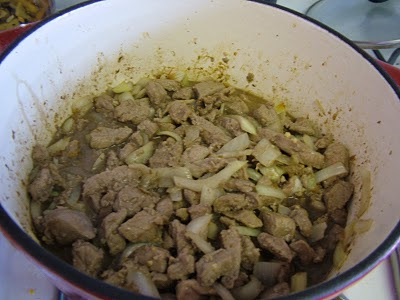
You see that, although the meat is kind of greyish, the broth is darker. That's the wine. Wine also has a tenderizing effect on meat. In fact, it is so essential to stew that I would hesitate to make stew without wine ever again. The difference is that huge.
With the liquids added and the stew looking like a stew, it was time to scrape a bit at the "fond" and see if it would come off. Amazingly, it did, even though I used a plastic spatula (the dutch oven warns not to use metal utensils as they will scrape the enamel off). And it definitely did add its color to the stew, so I hoped the taste was improved by it as well.
The last thing I added before putting on the lid was garlic. If I'd had fresh, I would have used it, but, as I didn't, this is a good substitute:
Much better than just garlic powder. I didn't add any other seasonings at this point, because I have heard that herbs like rosemary and thyme lose their flavor if you cook them too long. (As a result, I almost forgot to add them altogether. Oops!)
Then I put on the lid and let it bubble.

You see I've got it set to 2 on the stove, which is a slightly higher simmer. 1 occasionally fails to simmer at all, so I thought 2 would be better. After this I took a bath and (accidentally) a long nap. Oh well, good use of a Saturday!
I woke up to a delicious smell about two and a half hours later. My stew was ready:

John got home about a half hour later, which was lucky, because I don't know how long I could have held myself off from starting in. Then he wanted to go to confession, so we both went, letting the stew get another half hour of simmering. (They do say the longer it simmers, the better!)
When we got back, I cooked up some macaroni to serve the stew over. Next time I serve it (because, believe me, this is not a one-dinner meal!) I'll probably do potatoes, but I like noodles better. I didn't thicken the sauce, as some people like to do, because I prefer it as-is. (If I had been going to thicken it, a flour-and-water paste would probably work fine. Just make sure to simmer that for awhile for it to actually take effect -- I have ruined a lot of things by continually adding more flour and water, thinking what I put in hadn't worked, and then having it congeal in the fridge later. Yuck.)
For seasonings, I added salt, garlic salt, and poultry seasoning. The poultry seasoning had thyme, rosemary, marjoram, black pepper, and sage, so it had everything I would have wanted to put in.

Then I served it over the macaroni and finally got to try some.

It was pretty good! John had three helpings. Hope he doesn't get tired of it, because we're having it tomorrow, too.
One note on the flavor, though: most venison recipes advertise that they take away "that gamey flavor" and that it "tastes just like beef." This one doesn't. It tastes like venison. So if you are cooking venison and don't like the gamey flavor, I would suggest marinating the meat beforehand. Apple cider vinegar is great for this. Do, however, remember to dry off the meat afterward if you intend to brown it.
You may notice that I didn't add any vegetables. This was mainly because I didn't have any, and secondarily on the thought that I might want to add different things to it on different days, since it made such a huge batch. My plan, once I get to the store, is to add mushrooms and carrots. I think those would do a lot for it. Especially the mushrooms ... yum.
So, this was fun to do, and good to eat, too. Don't my pictures look nice? I always thought those food bloggers did something special to make the food in their pictures look so yummy, but apparently not. I didn't even have trouble with lighting, as I cooked it in the middle of the day and had the blind open. Feel free to comment!
Friday, January 22, 2010
Fixed!
Sorry for the long gap in posts ... my computer was in the shop. Right around Christmas, it had a sudden wig-out moment, where the screen went on the fritz and then blanked, and then it wouldn't start up at all. I ended up taking it to the computer store, where they told me they had no idea what was wrong and no idea how much it would cost to fix, but that they would send it away for repair. After three weeks or so, they finally called me back, saying they had discovered it was the motherboard, and it would cost me an arm and a leg to repair. But a new laptop was slightly more expensive, and it had been a long time since I'd backed up any files. So I reluctantly coughed up the cash, and now the dear thing is mine again. I have given it a stern warning that it can't expect to have that amount of money spent on it again. And so I am back with you.


Christmas was quite nice. I was afraid of being homesick since I had wanted to go home and couldn't make it. It was also John's first Christmas away from home. But it was actually wonderfully peaceful. I had forgotten that these days, all it takes is us both having the day off to make it an extremely special day. That kind of day doesn't come often! And both of our families felt very present. We both got nice conversations on the phone with our families, and they were also both very generous with their sweet and thoughtful gifts. I don't know if I have ever gotten so many wonderful presents. We even have a crib for the baby now!
Over my Christmas break, I went down to Georgia for the Wedding of the Century, that is to say, the wedding of our dear friends Dave and Stephanie. John has been friends with Dave since the very beginning of our college career, and (after a brief rivalry over who would be John's best friend) I ended up making friends with him too. For the first year and a half or so, the three of us were pretty much inseparable. Then somehow something started showing up between John and me, and Dave inevitably began to feel left out. He began to bemoan his lack of girlfriend. Unbeknownst to him, Stephanie, a friend of mine, had already set her heart on him. This situation continued for a long, long time, until sometime in Rome he seemed to wake up and notice the attractive young lady making eyes and historical references at him. The rest, as they say, is history.
Appropriately, too, because I have never seen two bigger history buffs in all my born days. Their point of commonality is in Spain ... Charles V, Isabella, Ferdinand, all send their pulses racing just as I am dozing off. Therefore their wedding date coincided with some important Spanish victory over the Moors. Now, John didn't actually have any time off for it, but he managed to arrange his "weekend" and the day off for New Year's, and we drove down with some friends. The drive, in total, was about 15 hours, close to five times as long as I have ever been in a car before. It was half awesome road trip, and half utter exhaustion. I did very little of the driving, but it was still tiring.
Georgia was nicer than I had been led to believe. I had thought it would be dry and dusty, for some reason. I expected a few cotton plantations or something. Instead it was covered in pine forest and rustic charm. (Note that I consider shacks of rotting wood standing by the side of the road, "rustic charm." I happen to like the South.) Then we discovered something truly amazing and wonderful about Georgia, viz., Waffle House. Why had we not seen one of these before? While we were down there, we went to Waffle House something like three times. It's the kind of place where you can have grits and biscuits and gravy and eggs, all for under five dollars. Smiles and friendly banter from short-order cooks come free of charge. I ate ... so ... much. Not only did I pack in the various Southern breakfasty things I'd ordered, but I also finished everything anyone else didn't want. I never wanted "Are you going to eat that?" to be my catchphrase, but, sadly, it became so. Baby was hungry, I guess! (Though, who am I kidding? I have always had this appetite.)
The wedding was just lovely. It was much lower-key than ours. I had thought ours was low-key, but there was a lot of energy and excitement to it even though the costs were low. Dave and Steph's was out-and-out mellow. The reception was pure mingling around -- no dramatic kisses, toasts full of advice, or crazy dancing. But it was very them. And they seemed to be having a good time. The bride was also absolutely gorgeous, I almost forgot to mention. She's normally quite a nice-looking girl, but this was like her normal beauty squared -- without looking like anyone but herself. (This is the number one wedding fashion mistake, I have decided: brides who look like somebody else on their wedding day. (The number two fashion mistake is looking like an exotic dancer, another one Steph avoided, being wise as well as attractive.) )
Then we returned to Philadelphia, where it has been work, work, work, all the time, ever since. I admit I am counting the days till my maternity leave starts. The exhaustion just keeps increasing, while it's getting harder and harder to get a good night's sleep. I don't expect either of these to get better after the baby's born, but at least I won't have to commute an hour and a half or more every day, and I will have only one child's needs to be responsible for.
However, I am still quite healthy. Even though the doctor said I gained too much weight in the past month. Wonder if it was the Waffle House. Still, I haven't gained all that much overall, so I'm not concerned. I got all my blood work done, and should hear back about it soon. Then I have to go in and get my Rhogam shot (to which I am NOT looking forward: I hate shots!). This is because I am Rh-negative, to keep me from making antibodies against the baby -- or actually future babies. I worry about this one, but all should still be fine. Thanks to modern medicine, a condition that would have doomed me to having at most one or two surviving children is now simply a matter of getting a couple shots. I will remember this if modern medicine drives me nuts at the birth.
And that's all the news I can think of for now. I'll just stick in a few pictures and wish you all well till next time.
My Christmas present from John. He is not a cat lover (to put it mildly) and made this sacrifice for me. Her name is Pandora, but she goes by Kitty. She is a snuggle hog ... I have not yet seen her get tired of sitting on my lap and getting her ears scratched. She also gets heartbroken about being shut out of the bedroom at night. I like her, but -- it's hard enough to sleep without a cat lying on your face.

Me, a bit before Christmas. Of course, I know everyone just wants to see my gut. But I have to please my readers! It's a bit bigger now, but not by a ton. I feel huge, though.
Wednesday, December 23, 2009
Cooking lessons from my husband
Okay, so I know this blog has begun to be (like me) rather obsessed with food. I spend a lot of time cooking it, and probably even more time planning what I will cook. Then there's the time I spend looking up recipes and food blogs.
But there's a reason I spend so much time thinking about food. First, of course, I like food and I like cooking. But second, I have a ton of limitations to work around.
First, the budget. It's low. Every penny we can spare goes into my I'm-quitting-my-job-in-the-spring fund. This means I can't shop at Whole Foods, I have to shop at Aldi -- where the variety is sometimes quite underwhelming. I also have to make due with the kitchen implements I have, and not zip out and buy a ricer, a wand blender, or a food processor just because a recipe demands it.
Second, time. I am that busy creature, the working wife. I can safely say that I don't want to be that forever, at ALL. There isn't time for fancy things on weeknights, and considering that John often comes home ravenous, it really ought to be done when he walks in. However, it mustn't suffer by being held awhile, because he is sometimes held awhile himself, at work.
Third, John's tastes. He is not exactly a picky eater. That is to say, he will eat whatever I serve him, and generally not complain about it either. However, I'm not aiming for toleration when I have an audience of one for my art. I'm aiming for rave reviews.
To get the rave reviews -- which, in John language, come in the form of no leftovers -- I have to follow some very strict rules.
1. No "ethnic" food. He is okay with Italian and Hispanic food, if neither is too heartburn-inducing, but my usual tendency of doing Indian curry one night, Asian stir-fry the next, does not appeal.
2. Spices are kept to a minimum. Salt and pepper, garlic and onion, are pretty much the limit. An occasional use of adobo is okay. But my containers of dill, tabasco sauce, and curry aren't getting used much.
3. Soups are great, but they should be thick. Otherwise "it's like water with food floating in it." So, cream soups and stews are the best, but there are a lot of other interesting thickeners I've been using.
4. Meat shouldn't be hidden away in a casserole, but shining on center stage. I am not a huge fan of most meat, so that's counterintuitive to me.
5. There should be at least one side dish. This is more for economy than for anything else -- otherwise, he will eat a whole chicken and leave no leftovers.
When we first got married, these limitations seemed overwhelming. I mean, I was looking at a future of cooking chicken and ground beef, rice and potatoes, every single night, without the possibility of varying things by giving it a different "ethnic flavor" every night like I used to do. I thought the menu would look like this:
Day 1. Chicken with rice on the side.
Day 2. Ground beef with potatoes on the side.
Day 3. Chicken with potatoes on the side.
Day 4. Ground beef with rice on the side.
John would actually probably be fine with this. I wouldn't. I hate eating the same things all the time, and I really hate cooking the same things all the time. Cooking is an art to me -- having no room for creativity would take all the fun out of it.
Well, we've been married for close on six months, and I have to say I am getting the hang of it. Better yet, I'm coming to enjoy the things I've been making. It took my palate awhile to adjust to the milder flavors -- after all my strong ethnic cooking, shepherd's pie seemed pretty boring. But when you get used to it, all the subtler flavors of the ingredients come through instead of being masked by the seasonings. I think this is the appeal of English and Irish cuisine -- the ingredients, rather than the spices. If the ingredients aren't really fresh and cooked just right, the whole thing will be ruined, whereas with Italian food or Indian food, you can generally hide the faults of the ingredients.
So, a few of the delicious meals I've conjured up lately:
Meatloaf and meatballs -- made on the same recipe. I made two meatloaves and one set of meatballs, so one day's cooking lasted for three meals. I should do this again soon.
Chicken soup. My solution to the "thin soup" problem was to add a whole lot of rice to the soup. That way, it's almost like a damp chicken-and-rice mix or a stew, rather than a really brothy soup. The budget-friendly part of this is that I can use the chicken bones or carcass from our last time having chicken to make the stock. With real stock in it, I can get away with having very little actual chicken -- generally just the giblets and a bit of leftover chicken. The stock provides the vitamins and protein.
Beef stew. I've tried this a half-dozen different ways. The slow cooker helps a lot. The very best stew so far was the time I used Dr. Thursday's excellent Chianti in it. Normally I might call that a waste of Chianti, but this way I get to have some. I am awfully careful about consuming alcohol otherwise.
Fish. I got a bag of fish fillets for $4 at Aldi. I thought this was a big expenditure on my part, something to be a special treat. Turns out the bag lasted us for four or five meals. Some days I baked it with butter and lemon, but the day they really got the rave reviews was the day I breaded and panfried them. We both really loved them that way, and it didn't take a lot of time to make, either.
Salmon burgers. Unfortunately, I tried to eat the leftovers for breakfast right when the morning sickness was bad. So I can't make myself eat them again, even though they were good.
Split pea soup. Not my favorite, but John loved it. I thought that huge pot would last forever, and it lasted about 24 hours.
Lentil soup. Those legumes sure do go a long way for cheap! I made this one in chicken stock, with some veggies in it, and that was pretty much it. I put sour cream in my bowl, and can testify that sour cream definitely makes every soup better.
Potato-garlic soup. Another nice thick one. For lack of a blender, I use a potato masher for blended soups, and it works great.
Carrot soup. This was mostly just onions, carrots, and roux. I think I put potatoes in there too. John will never mind more potatoes, and they make the soup go much further. As it was a Friday night, I left the chicken stock out. I used the Chianti in this one as well, and it definitely added something!
Broccoli-cheddar soup. Oh so good! Again, potatoes make a huge budget difference, as well as helping the texture. I made this last night, and had the last of it for lunch. Yum!
Roast chicken. I buy chickens whole now, because they seem to be cheaper this way, and because it's a good way to cook once for several days. The last time, I cut off the wings and drumsticks to try fried chicken. (It was okay, but I still like KFC's better, and it was kind of a lot of work.) Then I roasted the rest. Today I'm going to pick the last of the meat off the carcass and make stock.
Shepherd's pie. Always a big hit with John, and you can use pretty much whatever vegetables you have.
Beans and rice. A little dull, but I add cheese and sour cream, plus lots of salsa on my helping, and it makes a nice cheap meatless protein.
So, turns out I'm not living on the same four meals over and over again after all! Varying the vegetables is a big part of it -- you can make different things depending on whether you have carrots or broccoli or whatever. Legumes are also a real help.
But the really big surprise is how much I'm enjoying this. Cooking under my limitations is like writing a sonnet: the strict limits are actually really freeing, because you aren't dealing with every conceivable possibility, but with the few you have open to you. Also, it keeps me creative. I can't just borrow my mother's recipes (though I've been using quite a few!) as I thought I would; I have to invent a lot of things from scratch.
I am learning so much about cooking from this husband of mine. He's teaching me that "highbrow" cooking isn't always the best -- sometimes, it's a cop-out. I read on food blogs about the fancy things other people did, and feel like they're almost cheating: of course you're going to wow the crowd if you have some new ingredient none of your guests have had. But when you're limited, it all depends on your own ingenuity. I'm also learning to enjoy simple, homely food, without a lot of fanfare or surprises. It's just simple good cooking which everyone can enjoy. And, of course, I'm learning a skill I will use all my life: the ability to cook nourishing food on a budget and a timeframe, food which everyone is likely to enjoy.
But there's a reason I spend so much time thinking about food. First, of course, I like food and I like cooking. But second, I have a ton of limitations to work around.
First, the budget. It's low. Every penny we can spare goes into my I'm-quitting-my-job-in-the-spring fund. This means I can't shop at Whole Foods, I have to shop at Aldi -- where the variety is sometimes quite underwhelming. I also have to make due with the kitchen implements I have, and not zip out and buy a ricer, a wand blender, or a food processor just because a recipe demands it.
Second, time. I am that busy creature, the working wife. I can safely say that I don't want to be that forever, at ALL. There isn't time for fancy things on weeknights, and considering that John often comes home ravenous, it really ought to be done when he walks in. However, it mustn't suffer by being held awhile, because he is sometimes held awhile himself, at work.
Third, John's tastes. He is not exactly a picky eater. That is to say, he will eat whatever I serve him, and generally not complain about it either. However, I'm not aiming for toleration when I have an audience of one for my art. I'm aiming for rave reviews.
To get the rave reviews -- which, in John language, come in the form of no leftovers -- I have to follow some very strict rules.
1. No "ethnic" food. He is okay with Italian and Hispanic food, if neither is too heartburn-inducing, but my usual tendency of doing Indian curry one night, Asian stir-fry the next, does not appeal.
2. Spices are kept to a minimum. Salt and pepper, garlic and onion, are pretty much the limit. An occasional use of adobo is okay. But my containers of dill, tabasco sauce, and curry aren't getting used much.
3. Soups are great, but they should be thick. Otherwise "it's like water with food floating in it." So, cream soups and stews are the best, but there are a lot of other interesting thickeners I've been using.
4. Meat shouldn't be hidden away in a casserole, but shining on center stage. I am not a huge fan of most meat, so that's counterintuitive to me.
5. There should be at least one side dish. This is more for economy than for anything else -- otherwise, he will eat a whole chicken and leave no leftovers.
When we first got married, these limitations seemed overwhelming. I mean, I was looking at a future of cooking chicken and ground beef, rice and potatoes, every single night, without the possibility of varying things by giving it a different "ethnic flavor" every night like I used to do. I thought the menu would look like this:
Day 1. Chicken with rice on the side.
Day 2. Ground beef with potatoes on the side.
Day 3. Chicken with potatoes on the side.
Day 4. Ground beef with rice on the side.
John would actually probably be fine with this. I wouldn't. I hate eating the same things all the time, and I really hate cooking the same things all the time. Cooking is an art to me -- having no room for creativity would take all the fun out of it.
Well, we've been married for close on six months, and I have to say I am getting the hang of it. Better yet, I'm coming to enjoy the things I've been making. It took my palate awhile to adjust to the milder flavors -- after all my strong ethnic cooking, shepherd's pie seemed pretty boring. But when you get used to it, all the subtler flavors of the ingredients come through instead of being masked by the seasonings. I think this is the appeal of English and Irish cuisine -- the ingredients, rather than the spices. If the ingredients aren't really fresh and cooked just right, the whole thing will be ruined, whereas with Italian food or Indian food, you can generally hide the faults of the ingredients.
So, a few of the delicious meals I've conjured up lately:
Meatloaf and meatballs -- made on the same recipe. I made two meatloaves and one set of meatballs, so one day's cooking lasted for three meals. I should do this again soon.
Chicken soup. My solution to the "thin soup" problem was to add a whole lot of rice to the soup. That way, it's almost like a damp chicken-and-rice mix or a stew, rather than a really brothy soup. The budget-friendly part of this is that I can use the chicken bones or carcass from our last time having chicken to make the stock. With real stock in it, I can get away with having very little actual chicken -- generally just the giblets and a bit of leftover chicken. The stock provides the vitamins and protein.
Beef stew. I've tried this a half-dozen different ways. The slow cooker helps a lot. The very best stew so far was the time I used Dr. Thursday's excellent Chianti in it. Normally I might call that a waste of Chianti, but this way I get to have some. I am awfully careful about consuming alcohol otherwise.
Fish. I got a bag of fish fillets for $4 at Aldi. I thought this was a big expenditure on my part, something to be a special treat. Turns out the bag lasted us for four or five meals. Some days I baked it with butter and lemon, but the day they really got the rave reviews was the day I breaded and panfried them. We both really loved them that way, and it didn't take a lot of time to make, either.
Salmon burgers. Unfortunately, I tried to eat the leftovers for breakfast right when the morning sickness was bad. So I can't make myself eat them again, even though they were good.
Split pea soup. Not my favorite, but John loved it. I thought that huge pot would last forever, and it lasted about 24 hours.
Lentil soup. Those legumes sure do go a long way for cheap! I made this one in chicken stock, with some veggies in it, and that was pretty much it. I put sour cream in my bowl, and can testify that sour cream definitely makes every soup better.
Potato-garlic soup. Another nice thick one. For lack of a blender, I use a potato masher for blended soups, and it works great.
Carrot soup. This was mostly just onions, carrots, and roux. I think I put potatoes in there too. John will never mind more potatoes, and they make the soup go much further. As it was a Friday night, I left the chicken stock out. I used the Chianti in this one as well, and it definitely added something!
Broccoli-cheddar soup. Oh so good! Again, potatoes make a huge budget difference, as well as helping the texture. I made this last night, and had the last of it for lunch. Yum!
Roast chicken. I buy chickens whole now, because they seem to be cheaper this way, and because it's a good way to cook once for several days. The last time, I cut off the wings and drumsticks to try fried chicken. (It was okay, but I still like KFC's better, and it was kind of a lot of work.) Then I roasted the rest. Today I'm going to pick the last of the meat off the carcass and make stock.
Shepherd's pie. Always a big hit with John, and you can use pretty much whatever vegetables you have.
Beans and rice. A little dull, but I add cheese and sour cream, plus lots of salsa on my helping, and it makes a nice cheap meatless protein.
So, turns out I'm not living on the same four meals over and over again after all! Varying the vegetables is a big part of it -- you can make different things depending on whether you have carrots or broccoli or whatever. Legumes are also a real help.
But the really big surprise is how much I'm enjoying this. Cooking under my limitations is like writing a sonnet: the strict limits are actually really freeing, because you aren't dealing with every conceivable possibility, but with the few you have open to you. Also, it keeps me creative. I can't just borrow my mother's recipes (though I've been using quite a few!) as I thought I would; I have to invent a lot of things from scratch.
I am learning so much about cooking from this husband of mine. He's teaching me that "highbrow" cooking isn't always the best -- sometimes, it's a cop-out. I read on food blogs about the fancy things other people did, and feel like they're almost cheating: of course you're going to wow the crowd if you have some new ingredient none of your guests have had. But when you're limited, it all depends on your own ingenuity. I'm also learning to enjoy simple, homely food, without a lot of fanfare or surprises. It's just simple good cooking which everyone can enjoy. And, of course, I'm learning a skill I will use all my life: the ability to cook nourishing food on a budget and a timeframe, food which everyone is likely to enjoy.
Saturday, December 12, 2009
Babbling Like the Pagans
Oh, dear, something else at school to get me riled up. Generally speaking, I'm enjoying the way we're getting into the Advent spirit, although sometimes the 1950's-sentimental side of the school gets blended with the Catholic side in odd ways. (Sitting on the knee of St. Nicholas dressed as a bishop and telling him what you want for Christmas -- huh?)
But this one really bothered me. Right at the beginning of Advent, the principal appeared in our classroom with photocopies of a prayer. You've probably heard it:
Hail and blessed be the hour and moment in which the Son of God was born of the most pure Virgin Mary, at midnight, in Bethlehem, in piercing cold. In that hour vouchsafe, we beseech Thee, O my God, to hear my prayer and grant my desires, through the merits of Our Savior Jesus Christ, and of His blessed Mother. Amen.
It's not too terrible, though I do take issue with the rather emphatic insistence that Christ was born at midnight, and that it was cold. We have no idea what time of day He was born, and even the date is just a tradition. Considering all the changes the calendar has gone through since then, I would not be at all surprised if the date has shifted around a good deal. I don't think it matters what exact moment the Nativity happened, and I think it's important not to put undue emphasis on things like that when you're talking to kids. Little kids put a lot of significance on being told nothing other than the exact truth, and they will take every word you say literally unless you tell them otherwise.
But my real beef is not with the prayer at all. I was told to lead this prayer with the kids at the beginning of each period, and I do. What bugged me was what the principal said next:
"You say this prayer 15 times a day from today to Christmas, and on Christmas you'll get whatever you prayed for."
Say WHAT? That sounds an awful lot more like a chain letter than sound doctrine to me. What are these kids going to think when, after slavishly saying this prayer the appropriate number of times, they don't get a new bike or a new baby brother? Are they going to conclude, like adult Catholics do, that their prayer was not within the will of God, and try to submit themselves to His will? Or are they going to assume that this whole prayer thing that we've been teaching them about all this time doesn't really "work"?
Non-Catholics tend to like the Bible passage, "When you pray, do not babble like the pagans do." They link "babbling" to the Rosary, and any other repetitive prayer. However, the real issue is the second half of the verse, "who think they will be heard because of their many prayers." We pray the same prayers over and over again because they help us focus, because they use words from the Bible or from saints, or because we have trouble thinking of words of our own. We do NOT pray the same prayers over and over again because we think they have some kind of magical quality in them that will "make" God do what we ask him to.
That is the difference between the prayer of pagans and that of Christians. Pagans prayed to their gods in order to get certain things. The ceremonies had to be performed just so, or there would be hell to pay. (Take the Agamemnon, for instance, or read Livy.) If the right prayers were said and the request wasn't granted, it meant that the god wasn't strong enough, and you would have to go and find a new god who could deliver. I don't think there were many ancient Romans who loved Jupiter -- but they believed Jupiter was a powerful god who could deliver.
Christians pray to unite ourselves closer to God. We ask for things, but in the knowledge that "the Father knows what you need before you ask." We also know that God knows better than us what we need, and when our prayers aren't granted, it's because they weren't to our benefit or part of God's will. So we never demand what we want from God, or consider the granting of our prayers to be "God's end of the bargain" that He must hold up for us to keep holding up our end.
I'm just afraid that this pagan attitude is exactly what prayers like the one of the above encourage. The St. Jude prayer is the same -- you know, the one where you're supposed to make insane numbers of copies of the prayer and leave it around, and satisfaction is 100% guaranteed. For there to be a 100% guarantee on prayer granting, God would have to stop being God, and put us in charge of our destinies instead of Himself. When I think of all the things I have prayed desperately for, longing and longing to have my prayer granted, which I didn't get, I'm thankful. Looking back, in 90% of those cases I can see exactly why God let things go the way they did. He was causing all things to work together for my good -- thank goodness He didn't feel obliged to give me what I thought I needed!
I can't contradict the principal, but I'm trying to make sure the kids get the idea of what prayer is and isn't in our religion classes. They've got plenty of places, in within Catholic circles, that will be handing out wrong ideas right and left, and I try to innoculate them as well as I can with what I have -- which is a picture Bible and the Baltimore catechism. After all, many of a person's ideas on religion are formed at this age, even before they are old enough to make many decisions based on those ideas.
But this one really bothered me. Right at the beginning of Advent, the principal appeared in our classroom with photocopies of a prayer. You've probably heard it:
Hail and blessed be the hour and moment in which the Son of God was born of the most pure Virgin Mary, at midnight, in Bethlehem, in piercing cold. In that hour vouchsafe, we beseech Thee, O my God, to hear my prayer and grant my desires, through the merits of Our Savior Jesus Christ, and of His blessed Mother. Amen.
It's not too terrible, though I do take issue with the rather emphatic insistence that Christ was born at midnight, and that it was cold. We have no idea what time of day He was born, and even the date is just a tradition. Considering all the changes the calendar has gone through since then, I would not be at all surprised if the date has shifted around a good deal. I don't think it matters what exact moment the Nativity happened, and I think it's important not to put undue emphasis on things like that when you're talking to kids. Little kids put a lot of significance on being told nothing other than the exact truth, and they will take every word you say literally unless you tell them otherwise.
But my real beef is not with the prayer at all. I was told to lead this prayer with the kids at the beginning of each period, and I do. What bugged me was what the principal said next:
"You say this prayer 15 times a day from today to Christmas, and on Christmas you'll get whatever you prayed for."
Say WHAT? That sounds an awful lot more like a chain letter than sound doctrine to me. What are these kids going to think when, after slavishly saying this prayer the appropriate number of times, they don't get a new bike or a new baby brother? Are they going to conclude, like adult Catholics do, that their prayer was not within the will of God, and try to submit themselves to His will? Or are they going to assume that this whole prayer thing that we've been teaching them about all this time doesn't really "work"?
Non-Catholics tend to like the Bible passage, "When you pray, do not babble like the pagans do." They link "babbling" to the Rosary, and any other repetitive prayer. However, the real issue is the second half of the verse, "who think they will be heard because of their many prayers." We pray the same prayers over and over again because they help us focus, because they use words from the Bible or from saints, or because we have trouble thinking of words of our own. We do NOT pray the same prayers over and over again because we think they have some kind of magical quality in them that will "make" God do what we ask him to.
That is the difference between the prayer of pagans and that of Christians. Pagans prayed to their gods in order to get certain things. The ceremonies had to be performed just so, or there would be hell to pay. (Take the Agamemnon, for instance, or read Livy.) If the right prayers were said and the request wasn't granted, it meant that the god wasn't strong enough, and you would have to go and find a new god who could deliver. I don't think there were many ancient Romans who loved Jupiter -- but they believed Jupiter was a powerful god who could deliver.
Christians pray to unite ourselves closer to God. We ask for things, but in the knowledge that "the Father knows what you need before you ask." We also know that God knows better than us what we need, and when our prayers aren't granted, it's because they weren't to our benefit or part of God's will. So we never demand what we want from God, or consider the granting of our prayers to be "God's end of the bargain" that He must hold up for us to keep holding up our end.
I'm just afraid that this pagan attitude is exactly what prayers like the one of the above encourage. The St. Jude prayer is the same -- you know, the one where you're supposed to make insane numbers of copies of the prayer and leave it around, and satisfaction is 100% guaranteed. For there to be a 100% guarantee on prayer granting, God would have to stop being God, and put us in charge of our destinies instead of Himself. When I think of all the things I have prayed desperately for, longing and longing to have my prayer granted, which I didn't get, I'm thankful. Looking back, in 90% of those cases I can see exactly why God let things go the way they did. He was causing all things to work together for my good -- thank goodness He didn't feel obliged to give me what I thought I needed!
I can't contradict the principal, but I'm trying to make sure the kids get the idea of what prayer is and isn't in our religion classes. They've got plenty of places, in within Catholic circles, that will be handing out wrong ideas right and left, and I try to innoculate them as well as I can with what I have -- which is a picture Bible and the Baltimore catechism. After all, many of a person's ideas on religion are formed at this age, even before they are old enough to make many decisions based on those ideas.
Saturday, November 28, 2009
Four turkey sandwiches, and one soup
So it's time to eat leftover turkey. In the past, I've not been very fond of the stuff, mostly because I would always find it masquerading as other meats in places where I didn't think it belonged (tacos ... "beef" stroganoff ... spaghetti). And turkey does have a very distinctive flavor which doesn't blend well with everything -- especially the dark meat.
Therefore, as I eat my leftover turkey, of which I have a good quantity, I'm trying to stick to a few turkey-appropriate recipes and not wander too far off the beaten path. This is especially important considering that I am pretty sure my husband does not want turkey curry or turkey stirfry, or indeed anything international and strongly flavored. (More's the pity.)
So far, I have come up with a very large pot of soup. I estimate that the turkey carcass got me at least a half gallon of stock, probably more. I put a quart in the freezer and made soup out of the rest. John and I ate, between the two of us, about four bowls of soup. The rest fit into a medium-sized pot, which will probably serve us for at least one more dinner and one more lunch.
My recipe for the soup was very basic: the turkey stock, the meat from picking over the carcass (this was actually enough, without getting into any of the carved meat. It included the neck meat and the giblets, as well as all kinds of little bits that clung to the bones and were really nasty to pick out this morning from the cartilage and fat), brown rice, peas, onions, and carrots. These last two I sauteed in butter before putting them in.
Now this made a very boring soup, even after I salted, peppered, and garlicked it. However, I knew it had been as seasoned as John would like it. So I left it as it was, but in every bowl of it I eat, I intend to season it a little more. Today's dinner was turkey curry soup. I put in a good shake of curry and some sour cream. It was delicious! Other ideas include soy sauce and Mexican spices (not at the same time!).
Aside from the soup, I've also been enjoying the turkey in sandwiches. I find sandwiches are best with the white meat ... at any rate, that is how I like to eat all that white meat. (This turkey had so much white meat and so little dark! How do turkeys walk when they're so ... well-endowed?) I have come up with four different combinations, not all of which I've tried this time around, but which I intend to.
1. Turkey on white bread with cranberry sauce. That's it. It was delicious toasted.
2. Turkey on wheat bread with lettuce, tomato, onion, and ranch dressing. Also good toasted. Would have been even better with bacon.
3. Turkey on white bread with gravy. Traditionally served hot and open-faced.
4. Turkey on wheat with lettuce, tomato, etc. (John's sandwiches get very vegetable-y, to good effect: lately cucumbers and green peppers are in evidence) and brown mustard.
I've read up a little on turkey sandwich combinations, but unfortunately most of them are loaded with ingredients I don't have. I just don't keep avocado or kale around the house in case of a sandwich craving, and I don't really plan my grocery shopping around gourmet sandwiches. Luckily all of the above sandwiches are made with things most people have in their fridge this time of year. Let me know if you improve on any of them ... or have another easy-to-make turkey sandwich idea. I've got to eat lunch all week, after all.
Therefore, as I eat my leftover turkey, of which I have a good quantity, I'm trying to stick to a few turkey-appropriate recipes and not wander too far off the beaten path. This is especially important considering that I am pretty sure my husband does not want turkey curry or turkey stirfry, or indeed anything international and strongly flavored. (More's the pity.)
So far, I have come up with a very large pot of soup. I estimate that the turkey carcass got me at least a half gallon of stock, probably more. I put a quart in the freezer and made soup out of the rest. John and I ate, between the two of us, about four bowls of soup. The rest fit into a medium-sized pot, which will probably serve us for at least one more dinner and one more lunch.
My recipe for the soup was very basic: the turkey stock, the meat from picking over the carcass (this was actually enough, without getting into any of the carved meat. It included the neck meat and the giblets, as well as all kinds of little bits that clung to the bones and were really nasty to pick out this morning from the cartilage and fat), brown rice, peas, onions, and carrots. These last two I sauteed in butter before putting them in.
Now this made a very boring soup, even after I salted, peppered, and garlicked it. However, I knew it had been as seasoned as John would like it. So I left it as it was, but in every bowl of it I eat, I intend to season it a little more. Today's dinner was turkey curry soup. I put in a good shake of curry and some sour cream. It was delicious! Other ideas include soy sauce and Mexican spices (not at the same time!).
Aside from the soup, I've also been enjoying the turkey in sandwiches. I find sandwiches are best with the white meat ... at any rate, that is how I like to eat all that white meat. (This turkey had so much white meat and so little dark! How do turkeys walk when they're so ... well-endowed?) I have come up with four different combinations, not all of which I've tried this time around, but which I intend to.
1. Turkey on white bread with cranberry sauce. That's it. It was delicious toasted.
2. Turkey on wheat bread with lettuce, tomato, onion, and ranch dressing. Also good toasted. Would have been even better with bacon.
3. Turkey on white bread with gravy. Traditionally served hot and open-faced.
4. Turkey on wheat with lettuce, tomato, etc. (John's sandwiches get very vegetable-y, to good effect: lately cucumbers and green peppers are in evidence) and brown mustard.
I've read up a little on turkey sandwich combinations, but unfortunately most of them are loaded with ingredients I don't have. I just don't keep avocado or kale around the house in case of a sandwich craving, and I don't really plan my grocery shopping around gourmet sandwiches. Luckily all of the above sandwiches are made with things most people have in their fridge this time of year. Let me know if you improve on any of them ... or have another easy-to-make turkey sandwich idea. I've got to eat lunch all week, after all.
Subscribe to:
Posts (Atom)
