Every climate is different. I even have different results here, in my low-lying garden on a ridge, than a friend might have across town. So when people from far away ask me "How do I garden?" I feel a little at a loss. I'd rather have them ask their neighbors, or a local blog. My next-door neighbor and I consult about when to plant stuff, and that helps. I also like reading blogs of other gardeners in the area .... though unfortunately most of them are like me and don't blog every detail of their gardens.
Virginia is a great place to garden because of our long growing season and abundant rain. I rarely have to water, but at the same time we also get plenty of sun.
It's an awful place to garden because of the soil, which is heavy and sticky -- especially gardening on a suburban lot, where the soil is just subsoil shoved into place when the house was built. You can't work clay soil when it's wet, or you'll destroy the structure, compact it, and it will turn into brick the moment it dries. But you also can't work it when it's dry because it's hard as a rock. There might be one perfect day to work it -- and odds are, you're busy that day!
I deal with the soil issue by not digging in the garden at all. In the fall I lay as much mulch as I can get -- leaves, usually, but hay or straw is fine, or grass clippings. (If you are building a new bed, you might want to cut off the sod first. Whether you do or not, that sod will try to come back for the next decade because that's what sod does. Ugh.) Manure is nice if you have it, under the mulch, to feed the microbes and worms.
In the spring, I pull back the mulch to let the soil dry out and warm up. Clay is the slowest soil to warm up, and under mulch it stays cold and wet practically forever. Pulling back the mulch gives me a huge thrill -- the soil is always soft and fluffy, due to worm action and frost heaving, and there are tons of worms and bugs eating up the decaying plant matter. Who knew rot could be so exciting?
Every year is different, but in the years I've lived here, I've noticed a pattern to spring. The dates aren't predictable, but the pattern is always the same. First it's cold, cold, cold, with occasional warmer days that leave us all saying "maybe this is spring?" But it isn't spring for a long time yet. I start some broccoli inside as an act of faith.
There's usually a really warm week which gets you really excited. That's when I get everything ready, pulling back mulch, yanking out weeds, and repairing the beds. Then for awhile it's warmer and wet .... highs in the forties and fifties, lows in the thirties. This isn't real spring either, because the plants know to hold back. You do see some weeds starting to grow, though, and the grass starts to get green. I start harvesting dandelions.
Ideally, I plant my first seeds on the last warm day before the wet spell. That wet spell is sprouting weather! I plant peas, lettuce, radish, spinach, beets, and chard. Potatoes should also go in about now. This year this time came right around the last week of March. I wait till the whole ten-day forecast has lows above 30; that's my general rule. Also the daffodils will have come up.
Because the soil here is so heavy, I don't actually bury the seeds -- not if the weather is damp. At least, the lettuce just gets patted into place. The peas get poked in and covered, but not deeply. Carrots are the toughest, because they take so long to sprout. I failed three years running to sprout a one! But finally I tried this, which worked: I laid the seed on top of the soil, in a little groove I made with my rake. Then I covered it with sand. The sand keeps the seed from washing away and keeps it damp, but it doesn't crust over like the clay soil does. I imagine peat moss or potting soil would do the same thing.
I transplant the broccoli a little later, but since it always grows so badly indoors, it's never really ready. I try for maybe the second warm, damp spell of spring. Transplants like overcast weather with light rain when they first go in.
To plant warm weather crops like tomatoes and peppers (from transplants), cucumbers, squash, beans, etc., you have to wait through several more damp spells. You wait till the cool-weather crops come up. You wait through one very hot week (we just finished it) where you just cannot beLIEVE it's not time. (But it isn't, there's at least one more frost ahead. Check the ten-day forecast; it's almost always on there.) Then suddenly spring starts showing up in earnest -- redbud and dogwood appear; the trees all look covered with a green mist; cherry blossoms and magnolia flowers fly on the wind. At that point we usually get another wet week. It's amazing how it goes. One day the trees have teeny little buds on them -- the next it's pouring rain so you don't go out -- and then as soon as you look outside again, everything has leaves! It's an intense growing time; so easy to miss. At Christendom it always happened over spring break, it seemed. I'd leave on Friday with all the trees bare, and come back ten days later to find it now looked like summer.
And that's when you plant the warm stuff -- as soon as that rainy period ends and there aren't any frosts on the ten-day forecast. (There may still be a frost yet; you just have to hope, and keep something handy to cover your transplants with like a row cover or mason jars or whatever you can find.) Again, a day with rain predicted soon is a good choice. You can plant seeds on a hot day and wait for the rain to activate them -- the transplants you want to do when it isn't too sunny, like when it's overcast. Failing that, do them in the afternoon and water them well. You don't want them to wilt in their first full day of sun.
Clay holds water so well, especially mulched, that you don't really have to water during the summer unless there's a drought. BUT, during this first bit of spring when you've got fragile transplants and seeds, you do have to water. Where you have seeds, you want the soil to be visibly damp. If it isn't dark with dampness, water it (with a light spray so you don't wash away your seeds). On some of these hot days, that might be twice a day or more! The transplants can take a little more dryness, but not much -- there should be moisture right below the surface.
When the seeds have sprouted and the transplants have been in place about a week, you can stop worrying and let the plants grow deeper roots if they want water. If you keep them waterlogged now, they'll never grow the kind of roots they should and they'll be fragile forever. Especially considering the sort of wind and storm we get in the summertime, you want your plants to have deep roots so they don't get uprooted (as my tomatoes have!). The crust that forms on the surface of the soil is now your friend -- it will stymie a lot of the weeds that try to grow. You'll have to pull the rest, though.
Once the plants are big enough not to be lost in it, you can replace your mulch. That will do several things: it will keep moisture in the soil in hot weather; it will keep the soil from washing away and compacting in dry weather; it will add organic matter to the soil (which, in a suburban lot, you desperately need); and it will block all but the toughest weeds from coming up. Keep that mulch on there, and add more if you have it! Every time I mow, I throw the clippings on the garden.
After that, there's not much to say. If I don't get a good rainstorm every week, I call it a drought and start watering. You want to really soak the garden when you do water, so that the water actually penetrates. Five minutes of sprinkling ain't gonna cut it. I move the hose from bed to bed as each starts looking really flooded and puddly. And then if I've gone through them all and the first one's puddles have dried up, I do them again. Even so I never seem to water as well as the rain does, so I might need to water every day or two until we get rain again.
Stake the tomatoes, because the storms will rip them right up if you don't. You might want to hill the soil around their stems too, especially when a storm is predicted. Your bean trellises had better be sturdy. I've had lots of things break.
Expect the growing season to go clear through October. Around Halloween we get the frost that kills my tomatoes. When it's predicted, you go through and pick all the green tomatoes to ripen inside, because if you leave them out, they'll be ruined. (Or drape the plants with old sheets -- that sometimes works! I actually had plants survive under snow if they were mulched.) The hardy plants will keep going right through November -- I had broccoli still alive (though not really producing) till Christmas. One year, lettuce that was up against the house lived all winter long. But lettuce does not survive well here in summer, even the supposedly heat-tolerant kinds. If you have a way to shade yours, you might have better luck.
My big successes here in Virginia are tomatoes, squash, and beans. My big failures are peas ... they like cool spring weather, which we rarely have much of before it gets hot. I keep trying, though, because I love them. Bugs can be a real menace some summers. All you can do is study up on common pests and pick them off. I've suffered from Mexican bean beetles, squash borers, squash bugs, and cabbage moths. But it really depends on the year. I'm hoping for a mild bug year because our winter was so cold.
Does anyone else here garden in Virginia? For those who garden elsewhere, is it very different?

Showing posts with label Gardening. Show all posts
Showing posts with label Gardening. Show all posts
Tuesday, April 15, 2014

Saturday, July 20, 2013
Garden bounty
Ah, July. The time when it's too hot to be outside, but suddenly you have to because the garden is producing fit to burst!
Really, I'm not picking very much -- just plums, green beans, garlic, and the occasional carrot. Tomatoes and pumpkins are still green, no sign of cucumbers, lettuce has gone to seed, and cabbage and broccoli look like they've decided to just stay leafy forever. Beets were a dead loss, Michael pulled up every one.
But oh, how things are growing! Take a look:
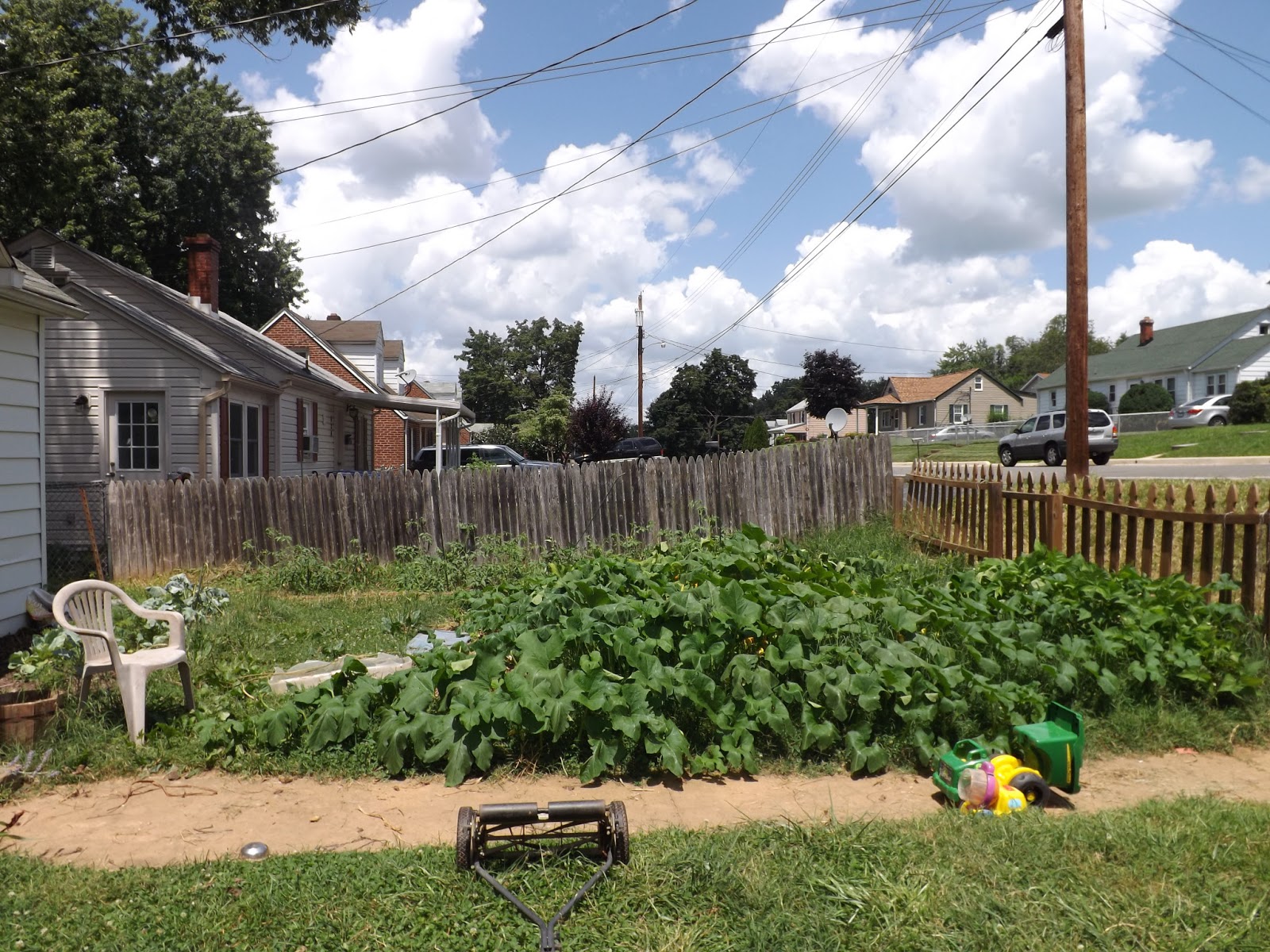
Yeah, that whole side of the yard has basically been taken over. I thought it would be fun for the kids to run around between the different beds, but no such luck. The pumpkins have grown into the cucumber bed on one side and the bush beans on the other, and they are still growing! Tendrils are heading toward the cabbage-and-carrot bed and under the fence to crawl up the hill. All that mass of pumpkin vine is THREE plants. Planted in May. Those things never cease to amaze me!
The day I took this, the back corner (where it's starting to grow into the tomato bed) was looking a bit wilty. I figured it was the heat, but the next day all those leaves were yellow, and then brown the day after. I found out it's probably squash borers, so tomorrow I'll have to go take a look. Basically the only thing for it is to cut off the dead leaves and slit open the stems to see if there are worms inside. If I'd caught them at the wilty stage, I might have found a way to kill the worms without killing the plant, but at this point those leaves are dead anyway. Luckily the rest of the vine seems unaffected.
 There are quite a few of these little green pumpkins -- perhaps a
dozen. And that's just those I can see -- it's hard to trek through the
prickly vines to look for more! Last year I had six around the end of
July, and six more before frost. This year I think the weather is too
cool to get a double harvest like that -- the frost is likely to come
sooner -- but you never know.
There are quite a few of these little green pumpkins -- perhaps a
dozen. And that's just those I can see -- it's hard to trek through the
prickly vines to look for more! Last year I had six around the end of
July, and six more before frost. This year I think the weather is too
cool to get a double harvest like that -- the frost is likely to come
sooner -- but you never know. 
The green beans look good. The bush beans (not shown because they're inundated in pumpkin vines) have been bearing for about two week, and the ones on the trellis just bore their first bean. I get a handful or two every day or two. Luckily I love green beans. The kids don't as much ... though they do if I pickle them!


Usually my tomatoes are the pride of the garden! This year they've been a struggle. My seedlings mostly died and what I did plant, I planted late. Then I neglected them when it was time to stake them, and so they're everywhere. But then that happens every year: I get some great new idea for how I'm going to stake them, and then I miss that crucial couple of weeks when they get tall and suddenly flop over all over everything.


Here is the cabbage-carrot-broccoli-garlic bed. Carrots are doing great, and from time to time I pull one up. They're small yet, but delicious. The cabbage and broccoli is just puttering along, not particularly interested in growing up, long after my neighbor has harvested his broccoli and the cabbage is all in nice heads. Really, I think the soil here is not good -- that, and of course I put it all in very late. The garlic which grew so fabulous for me last year didn't put on as good a showing this year. Each plant grew a head, but a rather small one. Probably they're disappointed at the cooler, wetter summer. That, and the dog ran over them about twenty times too many.
I didn't get a picture of the watermelon plant. I put it on the hillside, outside the fence. It has a few yellow flowers and a tiny little melon, but looks rather like a bonsai plant. Perhaps that's due to competition from all the other plants on the hill. I didn't want to clear too large a space for it for fear of erosion. Maybe we'll get a melon or two.

It's taken me three harvests to figure out the trick to this tree. First, it needs to be harvested often, because the fruit ripens fast and the instant it is dead ripe, it falls off. Then it gets a bruise and the bugs have all burrowed into it within a few hours of falling. Second, it's okay to harvest a little unripe, for the same reason. Third, I need to clear away all rotten fruit right away. It discourages the bugs, and it makes it easy to see if any fruit has fallen more recently that is still good for sauce. I threw four ice-cream buckets of rotten fruit into the compost, which is sad. I wish I had a pig. And fourth, I'll never get the fruit at the top of the tree (though standing on chair helps) so I just have to get out there often to pick up all the fallen fruit, cut out the bruises, and get it going for sauce. I've been making sauce every day, because the fruit doesn't hold at all.
Neat thing about plum sauce -- you don't have to peel the fruit. The peels actually dissolve into the sauce and turn it from golden to pink, and make it tarter. I do have to add a bit of sugar to correct for that, but it's easier than peeling hundreds of plums.
I'm finally seeing fewer plums on the tree now, so plum time is beginning to come to an end. I saw the first ripe plum with excitement, but I'll pick the last plum with relief. Packing away fruit is exhausting!
There is really nothing in the world like eating out of the garden. I feel so self-sufficient, so tied to the land, so rooted in tradition, and so ... wealthy. I love having more than enough food to eat. When I am worried about the grocery budget or the contents of our fridge, I invariably eat too much because I'm subconsciously afraid of going hungry. When I have boundless quantities of plums and green beans all over the place, I feel satisfied. I don't need to eat a lot because I know we have enough. It's a beautiful feeling. It also feels great to knock on my neighbors' doors and ask if they want plums, or to invite my friends over to pick them. I feel like for once I have something of value to give. It means so much to me.
Here are two great green bean recipes.
#1
Saute them in olive oil or butter till they're just a bit brown in spots. Done! But if you want to take it to the next level, sprinkle on parmesan cheese. You can do this with almost any veggie. Try one you don't like, and see if you now love it. Eggplant is great this way, though you want to get it as dry as you possibly can first. I sliced mine, wrapped it in a dishtowel, and left it in the fridge for three days. It was kind of dessicated, but that meant it got crispy and perfect when I sauteed it. Mmmm.
#2
Dilly Beans
Take a pint jar and a handful of green beans. Snap off stems and rinse if you feel they need it. Pack the beans in as tightly as you can, along with a clove of garlic and a sprig (or generous sprinkle) of dill. Pour in 1 1/2 tsp of salt and fill the jar with filtered or dechlorinated water. Leave the jar on the counter for 3-7 days, tasting from time to time to see how you like the beans. When they taste like a dill pickle and have just the right amount of crunch, they're done. The kids LOVE these -- though I have to call them pickles, not beans, or Marko won't eat them. I just keep the jar open while I'm making dinner and when they come around begging for food NOW, I hand them dilly beans. Doesn't spoil their appetite and it's good for them.
What's growing in your garden? What gambles have paid off, and which have flopped?
Wednesday, May 22, 2013
May garden pictures
Spring is that magical time of year when we can actually play in the backyard. It's shady and cool and the bugs haven't arrived yet. So we have been making mudpies. Or rather, I have been making mudpies and the kids keep getting in my mud.

What I'm actually trying to do is make clay to make some flowerpots. If the process is a success, I'll share it here. But mainly it's consisted of the boys dumping out my buckets and splashing in the puddles. Which is cool too, you know?

But when we're not there, we're in the front yard gardening. Or rather I'm gardening, Marko is following me saying, "MY turn! MY turn!" and Michael is climbing off the porch into the lettuce bed. He thinks it's hilarious when I come to fetch him out. I'm almost sure Marko must have been this difficult, but I barely remember it.
So far it promises to be a good year of gardening. My lettuce is doing great.
 The light green stuff is Black-Seeded Simpson lettuce, from the packets they sell at the grocery store. The dark green heads on the top right are Mignonette Bronze, which I saved from last year. The first year I planted lettuce, I sowed and sowed and sowed and got one plant. The second year, I sowed a few times and got five plants or so. I let them go to seed.
But since I'd had such a failure the previous times, I decided to try something different from sowing them the same old way. Instead of stripping the seed from the heads -- which was incredibly time-consuming anyway -- I just broke up the whole seed heads and stuck them in a bag indoors till fall. In October, I threw them out on the bed where I wanted to plant them and tossed old leaves over the top for mulch. The thought was to get the kind of crop that you get when you let them self-seed, but while still being able to rotate the lettuce to a different bed.
 I thought they'd wait till spring. Instead, a few sprouted right away and were looking great in January! They appeared to freeze a few times, and they were snowed on many times, but they sprang right back and grew huge as soon as the weather got warm. And then the rest started sprouting, and I've had no end of lettuce. But I threw down some spinach seed (which mostly hasn't grown) and some Black-Seeded Simpson, just to diversify. The Mignonette Bronze is heat-tolerant, which is why I bought it, but it gets a bit bitter in the heat and it's not very delicate at the best of times. So I wanted something else to go in my salads along with it.
Oh, and the giant bush is last year's parsley.

This bed above is my pride and joy. It's full of stuff I've never successfully grown before. The garlic I did do last year, and it did well. It was just grocery-store garlic that I broke into cloves and stuck in the ground in the fall. It needs no attention at all until it turns brown in midsummer, at which point you pull it up, dry it in the sun for a week, and then store it for the year. For some reason the garlic I grow is spicier than what I buy, even though they are the same variety -- I guess it's my organic soil.
Just above the garlic is a row of broccoli, then the carrots, which as you see I didn't have the heart to thin as well as I was supposed to. Then cabbage, which at this point looks no different from the broccoli, and then, almost invisible, are a few beet plants.
I thought my plants were doing pretty well, if a bit scrawny. But then I looked over the fence and saw my neighbor's broccoli and cabbage are almost ready to start forming heads. So I guess I'm behind after all. That's what you get for starting them late, almost killing them several times, and not having enough light indoors. Then I transplanted them when they weren't really ready to go out (but they'd basically stopped growing indoors because it was so dark). And then I direct-seeded some, which works best for me for most things, but the seedlings got chomped by something.
Not sure those brassicas are going to be a success for me. Nothing that needs pampering is a good fit for my garden. But I do like them so much ... so I had to at least try.

Here are two potato plants that I hadn't planned to grow. I just had some red potatoes sprout in the cupboard so I stuck them in the ground right after the last snow we had. Well, they took off, so I may get one meal of potatoes out of them. Maybe next time I will buy actual seed potatoes of some interesting variety. Potatoes are too cheap to be economically worth growing, but you can grow a lot more varieties than you can find at Aldi.

Here is my healthiest, biggest tomato plant. In other words, tomatoes are not doing well. I did with them what I did with the brassicas: half killed them inside and planted them out before they were ready. You're supposed to wait till they have true leaves, but I hardly ever do because nothing ever gets true leaves in my house. They just freeze and only their spindly stem appears to grow. I worried that their roots were outgrowing their tiny pots, but that wasn't it. They had hardly any. It's just the lack of light in here.
Anyway, I've got a few solutions here, all of which are non-optimal. I can baby the remaining three plants and call it good. I usually do eight, so that would be a big loss for me. I hauled in a bumper crop last year, but I never, ever have trouble finding things to do with them. I love tomatoes. And if I can't eat them all fresh, they can, freeze, and pickle easily. Three plants are just not enough.
Or I can do what I have already done, and try direct planting. That's never worked for me before, but why not try? I've heard tomatoes grow taproots if they're direct-sown, and that makes them more drought-tolerant. I just laid them on the soil and sprinkled a bit of sand on top, which is what worked for finally sprouting my carrots this year. And of course I'm hovering over them, watering often. We'll see.
But if that fails, I will probably have to admit defeat and just buy seedlings. Which is lame. I'll be stuck with the same old varieties, the pot-bound roots, and the overgrown stems. But my neighbor was able to get his tomatoes and peppers out in a single weekend by buying his seedlings, and that's also how he managed to get his cabbages and broccoli so far ahead of mine.
I'm not even including a picture of my pea and bean beds because they're so lame. Here, the failures were all mine. First, planting peas too soon and letting them get snowed on. They never sprouted at all. And then running out of seeds. I had eight Kentucky Wonder pole beans and three Thai Long Green bush beans, and so that's what I planted. To fill in the rest, I just planted chickpeas, even though they didn't do well for me last year. I'm just going to have to buy more seed this weekend. As of now, I have three pole bean seedlings with their leaves eaten off, one bush bean seedling that's doing fine, and five chickpea seedlings.

I also have some strawberries growing well. A friend brought them last spring when Michael was born, and I didn't have the energy to do more than turn over a paving stone and stick the plants in the hole. This spring I cleared away the weeds and found the plants already blooming! And now they have little greenish-white strawberries all over them, which hopefully I can eat before the birds do.
And the plum tree, as always, is preparing for a bountiful year. My neighbor says that it has never had a bad year since it was put in. Certainly last year it gave more than I could pick, despite being a dwarf tree. It's all covered with marble-sized green fruit.
Next job is to plant some herbs ... and then just watch everything grow!
Tuesday, April 17, 2012
Things are finally growing!
It felt like spring for a long time before anything would really grow. I admit I jumped the gun and took all springlike weather as permission to plant stuff. Some did grow a little ... but it didn't really get off the ground until a few weeks ago. I think the real trick was day length. Until those plants were getting a summerlike dose of full sunshine each day, they weren't going to grow much no matter how warm it was. Especially since my front yard gets kind of a lot of shade in the afternoon.
Now, though, I have peas! I planted these way too early (some Feb. 21st, some March 11th -- which came up within a week of each other, because February was just too early) but they grew all the same. For a long time they were just teeny things, prone to being stepped on by the two-year-old. But now they are really beginning to put on size, and I finally had to build them a trellis!

After all my griping about lettuce, some did sprout. Five plants, to be exact. I also transplanted two dozen that I started indoors ... of which two very pathetic ones survive now. Every day another would keel over, despite my trying a number of different things to save them. They just weren't having it. But the ones that sprouted on the spot look great, although I think that's got to be maybe a 3% germination rate. All in the same general area. I wonder if there's something different about the soil there. The sad thing is that I'll have to thin them, while leaving the rest of the bed empty.

Spinach I've planted twice and nothing's come up. Carrots I think I've done three times, without seeing a sprout. I know they're supposed to take a long time, but the one bed's been sitting empty for a month now. I think I must have been too careless about keeping the bed "constantly moist." How the heck are you supposed to do that, anyway? (And yes, I tried putting cardboard over it. It dried out anyway, and became a home for about a million pillbugs.)
But the garlic from last fall is shooting up. Can't wait to see how big those bulbs get.

Next bed is tomatoes and cucumbers. I took a leap of faith and transplanted my tomatoes. They could have stayed inside longer, and it's nowhere near when I'm supposed to plant them, but I was going crazy. I felt like there was no way I could have this baby until those tomatoes were in the ground. Because there's no way I nurtured them for over a month just to let someone else plant them. Is anyone else this possessive over their garden? I can't let anyone else do anything because I'm afraid they'll do it wrong, but I can't seem to explain what I want so they can do it right. That would be why I keep hurting my back doing all this gardening work when I'm really way too pregnant to be hunched over digging in the dirt. (You would think it would be good for my back to be on my hands and knees. But it sure does hurt afterwards.)
Here are the Jersey Giants. It's a new variety to me, which is supposed to be good for sauce. Of these two lovelies, one is going to have to go. There were two in this pot and I couldn't bear to thin them, so I decided to transplant both in case one keeled over. Only they both handled it great so now it's still a matter of choosing which perfectly healthy plant to kill. I keep wondering if I can carefully pick one out and move it without disrupting the other's roots.

I'm also growing the Cherokee Purples again, because how could I not? They did so fabulously and tasted so good. (The trick is to learn what "really ripe" looks like and not touch them till they reach that point -- they are much too bland until they are kind of soft and purplish on the bottom while the shoulders are just a little green.) I transplanted in two of each variety, and direct-seeded two more of each. Direct-seeding tomatoes? Worth a shot, I figured. I've heard they grow much better taproots that way, and so are less sensitive to the flood-and-drought summers we have here. Also, I kind of stink at growing things indoors, especially with no good south-facing windows. Direct-seeded stuff, if it comes up at all, always does so much better in my garden. I think it's because it's already adapted to the environment it'll have to live with later.
I'll have to show a better picture of my cucumber-and-tomato trellis when it's done. Right now you can only see the cucumber part. But I'm connecting the two cucumber trellises with long pieces of twine on each side, so that the tomatoes will be confined to a long rectangle. Hopefully that will give them just a bit of support without restricting them too much. All I know is, tomato cages are not good enough for the punishment my tomatoes inflict. What kind of cage would it take to support an 8-foot tomato plant?

You can see how I just pulled back the mulch from the middle of the bed to stick the tomatoes in, leaving the rest to continue to mellow and not grow a crop of weeds for me. This area is the one that always grew the best, thickest, longest grass -- which tells me it will be very fertile, but it also means there are still a lot of runners in there. Once the tomatoes are bigger and the cucumbers are up, I'll re-cover the whole thing. I'll have to keep an eye on it, though -- I do want to make sure slug season is past before bringing the mulch too close to my plants. I don't want to make a habitat for the beasts. We did have some slugs last year, especially where I'd mulched, though they weren't a major problem. (I had to explain to my mom, who's only grown tomatoes in Washington, that when I say "we have slugs" I don't mean, "we have giant monster slugs that devour everything in sight." We have teeny-tiny slugs that seem to prefer eating decaying matter to eating actual plants.)
I planted the beans way too early, too. (See a pattern?) I put them in and then read about how awful it is to plant them in soil that hasn't completely warmed. And then we had a cold wet week. But once the sun came out and warmed things up again, they started coming up. The bush beans (Thai Star) didn't seem a bit fazed by the delay.

The pole beans (Kentucky Wonder) have been a little less consistent. First there was only one sprout. Then two. Now there are four, and I haven't yet decided whether to plant more or wait and see if more come up.

You can definitely see my cilantro is doing well! I transplanted it outside on March 27th because it was outgrowing its pot. I've had to set a bucket over it for several frosts, but it wasn't bothered. The basil I later transplanted next to it, though? Vanished without a trace. Most of it was dead before I even brought it outside. I'm not sure what was wrong with it. (Well, half of the seedlings lost out to the toddler. Sigh. But the rest are a mystery.)
The only thing left is the pepper and pumpkin bed. Right now it is a glorious heap of leaves and cut grass, warming up in the sun while I wait for my green peppers to be ready to go in. (I'm not as anxious about them as I was about the tomatoes. They can wait till late May if they have to.) I did pull aside the mulch and dig a bit today to make the pumpkin hills. And then, having made the hills, what was there to do but stick a few seeds in each, just for the heck of it? Yes, I did, and I'll let you know if they come up.
This stage of gardening is exciting. But not half as exciting as the picking and eating phase. Looking forward to that part.
For the record, I'm 37.5 weeks pregnant now ... so we'll see when this baby shows up, won't we? I'll try to at least post a picture as soon as possible so you all know. I can do that from my phone now so it should be easy. Wonders of modern technology.
Now, though, I have peas! I planted these way too early (some Feb. 21st, some March 11th -- which came up within a week of each other, because February was just too early) but they grew all the same. For a long time they were just teeny things, prone to being stepped on by the two-year-old. But now they are really beginning to put on size, and I finally had to build them a trellis!

After all my griping about lettuce, some did sprout. Five plants, to be exact. I also transplanted two dozen that I started indoors ... of which two very pathetic ones survive now. Every day another would keel over, despite my trying a number of different things to save them. They just weren't having it. But the ones that sprouted on the spot look great, although I think that's got to be maybe a 3% germination rate. All in the same general area. I wonder if there's something different about the soil there. The sad thing is that I'll have to thin them, while leaving the rest of the bed empty.

Spinach I've planted twice and nothing's come up. Carrots I think I've done three times, without seeing a sprout. I know they're supposed to take a long time, but the one bed's been sitting empty for a month now. I think I must have been too careless about keeping the bed "constantly moist." How the heck are you supposed to do that, anyway? (And yes, I tried putting cardboard over it. It dried out anyway, and became a home for about a million pillbugs.)
But the garlic from last fall is shooting up. Can't wait to see how big those bulbs get.

Next bed is tomatoes and cucumbers. I took a leap of faith and transplanted my tomatoes. They could have stayed inside longer, and it's nowhere near when I'm supposed to plant them, but I was going crazy. I felt like there was no way I could have this baby until those tomatoes were in the ground. Because there's no way I nurtured them for over a month just to let someone else plant them. Is anyone else this possessive over their garden? I can't let anyone else do anything because I'm afraid they'll do it wrong, but I can't seem to explain what I want so they can do it right. That would be why I keep hurting my back doing all this gardening work when I'm really way too pregnant to be hunched over digging in the dirt. (You would think it would be good for my back to be on my hands and knees. But it sure does hurt afterwards.)
Here are the Jersey Giants. It's a new variety to me, which is supposed to be good for sauce. Of these two lovelies, one is going to have to go. There were two in this pot and I couldn't bear to thin them, so I decided to transplant both in case one keeled over. Only they both handled it great so now it's still a matter of choosing which perfectly healthy plant to kill. I keep wondering if I can carefully pick one out and move it without disrupting the other's roots.

I'm also growing the Cherokee Purples again, because how could I not? They did so fabulously and tasted so good. (The trick is to learn what "really ripe" looks like and not touch them till they reach that point -- they are much too bland until they are kind of soft and purplish on the bottom while the shoulders are just a little green.) I transplanted in two of each variety, and direct-seeded two more of each. Direct-seeding tomatoes? Worth a shot, I figured. I've heard they grow much better taproots that way, and so are less sensitive to the flood-and-drought summers we have here. Also, I kind of stink at growing things indoors, especially with no good south-facing windows. Direct-seeded stuff, if it comes up at all, always does so much better in my garden. I think it's because it's already adapted to the environment it'll have to live with later.
I'll have to show a better picture of my cucumber-and-tomato trellis when it's done. Right now you can only see the cucumber part. But I'm connecting the two cucumber trellises with long pieces of twine on each side, so that the tomatoes will be confined to a long rectangle. Hopefully that will give them just a bit of support without restricting them too much. All I know is, tomato cages are not good enough for the punishment my tomatoes inflict. What kind of cage would it take to support an 8-foot tomato plant?

You can see how I just pulled back the mulch from the middle of the bed to stick the tomatoes in, leaving the rest to continue to mellow and not grow a crop of weeds for me. This area is the one that always grew the best, thickest, longest grass -- which tells me it will be very fertile, but it also means there are still a lot of runners in there. Once the tomatoes are bigger and the cucumbers are up, I'll re-cover the whole thing. I'll have to keep an eye on it, though -- I do want to make sure slug season is past before bringing the mulch too close to my plants. I don't want to make a habitat for the beasts. We did have some slugs last year, especially where I'd mulched, though they weren't a major problem. (I had to explain to my mom, who's only grown tomatoes in Washington, that when I say "we have slugs" I don't mean, "we have giant monster slugs that devour everything in sight." We have teeny-tiny slugs that seem to prefer eating decaying matter to eating actual plants.)
I planted the beans way too early, too. (See a pattern?) I put them in and then read about how awful it is to plant them in soil that hasn't completely warmed. And then we had a cold wet week. But once the sun came out and warmed things up again, they started coming up. The bush beans (Thai Star) didn't seem a bit fazed by the delay.

The pole beans (Kentucky Wonder) have been a little less consistent. First there was only one sprout. Then two. Now there are four, and I haven't yet decided whether to plant more or wait and see if more come up.

You can definitely see my cilantro is doing well! I transplanted it outside on March 27th because it was outgrowing its pot. I've had to set a bucket over it for several frosts, but it wasn't bothered. The basil I later transplanted next to it, though? Vanished without a trace. Most of it was dead before I even brought it outside. I'm not sure what was wrong with it. (Well, half of the seedlings lost out to the toddler. Sigh. But the rest are a mystery.)
The only thing left is the pepper and pumpkin bed. Right now it is a glorious heap of leaves and cut grass, warming up in the sun while I wait for my green peppers to be ready to go in. (I'm not as anxious about them as I was about the tomatoes. They can wait till late May if they have to.) I did pull aside the mulch and dig a bit today to make the pumpkin hills. And then, having made the hills, what was there to do but stick a few seeds in each, just for the heck of it? Yes, I did, and I'll let you know if they come up.
This stage of gardening is exciting. But not half as exciting as the picking and eating phase. Looking forward to that part.
For the record, I'm 37.5 weeks pregnant now ... so we'll see when this baby shows up, won't we? I'll try to at least post a picture as soon as possible so you all know. I can do that from my phone now so it should be easy. Wonders of modern technology.
Saturday, March 31, 2012
I fail at lettuce
I've had no trouble growing tomatoes, herbs, peas, or beans. So I thought this gardening thing was easy. But then I came up against lettuce.
Really, it shouldn't be too hard. Everyone grows lettuce. The gardening books have no special warnings, and act like growing lettuce can be easily described in three paragraphs before moving on to melons.
I tried to grow it last fall. I didn't know what date to start it on, so I sowed more every week or so throughout August and September. I tried different methods. I planted it 1/4 inch deep, 1/8 inch deep, sprinkled a dusting of fine soil over it, or left it right on the surface. I tried two different varieties (Mignonette Bronze and iceberg). In the end, I got about six seedlings, of which three actually made it so far as to be eaten. They made a very small salad.
This year, I've tried more things. I tried them early, direct-seeded in the garden, but no luck. I figured the soil hadn't had time to warm. I started them inside, and they did okay. That is, the iceberg lettuce sprouted, grew leggy, and collapsed before it had even unfolded its cotyledons. The Mignonette, despite being leggy as well (the light isn't great in any room of the house, and even with being carried from sunny spot to sunny spot all day, it's definitely not getting enough) actually did develop a few spindly true leaves, so I set it out and am hoping for the best. The first few days were like a horror movie ... every day I'd go out, and there would be one fewer. Vanished without a trace. But now I have 12 that look like they're going to pull through.
I direct-seeded some more lettuce two weeks ago, with no results. I've done similarly with carrots and spinach. I'm beginning to think there is just a rule around here: If it comes in a tiny seed, you will not be able to grow it. I mean, why would it survive? These seedlings are so teeny tiny when they sprout. A raindrop would flatten them. (Perhaps that's what happened.) Or wash the seeds away. The wind blows the mulch over them and smothers them. The sun is apparently too much for them. The seedbed gets dry and crusted if I don't water it really often, but if I do water it, am I just washing all the seeds away? (It's really hard to achieve a fine mist over the seedbed with just my thumb in the hose, but I don't have a proper sprayer or a watering can. I'll probably have to spring for those if I ever want to grow anything from seed.) I can sprout pretty much any seed in purchased soil, but my garden soil is so full of clay, I'm hardly surprised to find nothing is growing there.
Otherwise, my garden's going fine. My peas are all up and looking hearty. I know I shouldn't have done it so early, but I planted some beans just for kicks when it was hot. It promptly turned cooler again, so I will probably have to replant those. I also transplanted my herbs. I've been growing them inside since February, and they haven't been doing too well, despite my setting them outside every sunny day. When I turned them out of their sour cream containers, I mean pots, I saw the trouble. Though there wasn't much to see on the surface, their roots had filled up all the available space. So they should be much happier there in my garden. As an added bonus, the sky is not going to forget to water them or expose them to the sun the way I tend to do. My usual habit of total neglect does much better outdoors than in.
Today I peeled up the newspaper and mulch in the bed where the green peppers will grow. It's the only part left completely undug. I did the other half of that bed, which is destined for pumpkins, by just cutting the sod off and turning it over before replacing the mulch. I had to call in John's assistance for the tomato-and-cucumber bed, where he did the same thing. But I wasn't up to digging the pepper bed, and there was grass sticking up in rips in the newspaper. I figured it was pretty much a lost cause. Turns out, except for those few isolated grass clumps I could see, most everything was decomposed under there. There was some white, withered grass, which I carelessly yanked up some handfuls of and left the rest. I pulled up the big clumps that were sticking through and filled in the gaps in the newspaper. I honestly don't think I'll bother digging there at all. The soil texture looks great. Of course, if I remove the mulch, the grass will grow again. That stuff is really invasive, and the roots are still there waiting for a chance. The onion grass is even worse. But if I leave the mulch right where it is, and just cut holes to stick the pepper plants in ... it might work a lot better than trying to remove the paper and add a new mulch. I can do the same with the tomatoes in the other bed, leaving the newspaper on all summer. I'll just have to clear spots for the cucumbers and the pumpkins, since those are direct-seeded.
This is my first season trying to do a "full" garden with all the things I want to grow. I have to admit, I'm greener than I thought, even after spending all winter reading gardening books, making charts and calendars, and daydreaming. There isn't a ton of work -- less than I'd like, in fact, because I'm so anxious to get moving -- but I'm realizing I don't really know what I'm doing.
Can you grow lettuce? What's your secret?
Really, it shouldn't be too hard. Everyone grows lettuce. The gardening books have no special warnings, and act like growing lettuce can be easily described in three paragraphs before moving on to melons.
I tried to grow it last fall. I didn't know what date to start it on, so I sowed more every week or so throughout August and September. I tried different methods. I planted it 1/4 inch deep, 1/8 inch deep, sprinkled a dusting of fine soil over it, or left it right on the surface. I tried two different varieties (Mignonette Bronze and iceberg). In the end, I got about six seedlings, of which three actually made it so far as to be eaten. They made a very small salad.
This year, I've tried more things. I tried them early, direct-seeded in the garden, but no luck. I figured the soil hadn't had time to warm. I started them inside, and they did okay. That is, the iceberg lettuce sprouted, grew leggy, and collapsed before it had even unfolded its cotyledons. The Mignonette, despite being leggy as well (the light isn't great in any room of the house, and even with being carried from sunny spot to sunny spot all day, it's definitely not getting enough) actually did develop a few spindly true leaves, so I set it out and am hoping for the best. The first few days were like a horror movie ... every day I'd go out, and there would be one fewer. Vanished without a trace. But now I have 12 that look like they're going to pull through.
I direct-seeded some more lettuce two weeks ago, with no results. I've done similarly with carrots and spinach. I'm beginning to think there is just a rule around here: If it comes in a tiny seed, you will not be able to grow it. I mean, why would it survive? These seedlings are so teeny tiny when they sprout. A raindrop would flatten them. (Perhaps that's what happened.) Or wash the seeds away. The wind blows the mulch over them and smothers them. The sun is apparently too much for them. The seedbed gets dry and crusted if I don't water it really often, but if I do water it, am I just washing all the seeds away? (It's really hard to achieve a fine mist over the seedbed with just my thumb in the hose, but I don't have a proper sprayer or a watering can. I'll probably have to spring for those if I ever want to grow anything from seed.) I can sprout pretty much any seed in purchased soil, but my garden soil is so full of clay, I'm hardly surprised to find nothing is growing there.
Otherwise, my garden's going fine. My peas are all up and looking hearty. I know I shouldn't have done it so early, but I planted some beans just for kicks when it was hot. It promptly turned cooler again, so I will probably have to replant those. I also transplanted my herbs. I've been growing them inside since February, and they haven't been doing too well, despite my setting them outside every sunny day. When I turned them out of their sour cream containers, I mean pots, I saw the trouble. Though there wasn't much to see on the surface, their roots had filled up all the available space. So they should be much happier there in my garden. As an added bonus, the sky is not going to forget to water them or expose them to the sun the way I tend to do. My usual habit of total neglect does much better outdoors than in.
Today I peeled up the newspaper and mulch in the bed where the green peppers will grow. It's the only part left completely undug. I did the other half of that bed, which is destined for pumpkins, by just cutting the sod off and turning it over before replacing the mulch. I had to call in John's assistance for the tomato-and-cucumber bed, where he did the same thing. But I wasn't up to digging the pepper bed, and there was grass sticking up in rips in the newspaper. I figured it was pretty much a lost cause. Turns out, except for those few isolated grass clumps I could see, most everything was decomposed under there. There was some white, withered grass, which I carelessly yanked up some handfuls of and left the rest. I pulled up the big clumps that were sticking through and filled in the gaps in the newspaper. I honestly don't think I'll bother digging there at all. The soil texture looks great. Of course, if I remove the mulch, the grass will grow again. That stuff is really invasive, and the roots are still there waiting for a chance. The onion grass is even worse. But if I leave the mulch right where it is, and just cut holes to stick the pepper plants in ... it might work a lot better than trying to remove the paper and add a new mulch. I can do the same with the tomatoes in the other bed, leaving the newspaper on all summer. I'll just have to clear spots for the cucumbers and the pumpkins, since those are direct-seeded.
This is my first season trying to do a "full" garden with all the things I want to grow. I have to admit, I'm greener than I thought, even after spending all winter reading gardening books, making charts and calendars, and daydreaming. There isn't a ton of work -- less than I'd like, in fact, because I'm so anxious to get moving -- but I'm realizing I don't really know what I'm doing.
Can you grow lettuce? What's your secret?
Wednesday, March 14, 2012
Spring fever

I love spring. Really, who doesn't? Except maybe for T.S. Eliot and people with allergies.
What do I love about it? Gee, pretty much everything. I love feeling warm again. I love being outside, getting fresh air, having the windows open. I love watching things grow. I love digging around in the dirt and planting stuff. I love seeing bugs and birds come back to the neighborhood. I love waking up with tons of energy even though I got hardly any sleep. (Seriously, by past experience, I need 1-2 fewer hours of sleep per night when the weather is warm.) The warm weather makes me want to hug my son, kiss my husband, go jogging, plant flowers.
About three weeks ago, in a hopeful mood, I planted some peas. That spell of warm weather didn't last, and they didn't come up right away. Well, during this warm spell, they came up! I have plants! Sprouting! In my garden!
This warm spell, by the way, is no joke. It hit the 80's yesterday. No freezing weather is to be seen anywhere in the 10-day forecast. So I abandoned restraint and just started planting stuff this week. On Sunday: more peas. On Monday: some iceberg lettuce I'd started inside. On Tuesday: a row each of iceberg lettuce, leaf lettuce, and spinach. Today: indoor pots of tomatoes, green peppers, and marigolds to set out after the last frost.
I am so freaking excited. I water my seedbeds obsessively. I read the backs of all my seed packets and browse through garden books. Marko's getting into it too -- mostly in the realm of playing in the dirt. He needs a bath pretty much every day.
I've said before that children are like plants. Indoors, they're a ton of trouble and you can never seem to give them everything they need. Set them outside and they suddenly start flourishing without any input from you. Marko plays inside for short spurts before coming to me, climbing into my lap, and demanding attention and entertainment. But outside, I've watched him play in the dirt for a solid hour without even looking at me. Just today, I was worried how I might get him to nap and make up some of the sleep he missed last night. Well, around noon he got tired of playing, climbed into my lap, and passed out in five minutes, just watching the birds and the bugs and listening to the droning of the bees. I hated to bring him in, so I plopped him in his stroller in the shade and he's sleeping still. Really, in this weather, there's no need to go inside much at all.
The only downside right now is my back. My pelvic girdle is in as bad shape as ever. Its recipe for success is very light exercise only. My desires include digging garden beds and taking hour-long walks and chasing a toddler around the park all day. I really overextended it yesterday so that I'm not doing "anything" today. Meaning I roamed around the yard with clippers and trimmed stuff before admitting that I really ought to be sitting down. Outside. Reading garden books.
All I can think of right now is: Two more months and it will be summer for real! (Around here at least.) And I will have this baby out! And I'll throw the baby in the sling and we'll walk and garden and go to the park and do everything I want to do! I am so, so glad I've so far had babies in the spring. Spring is such a lovely time for babies.
Considering I'm seven months pregnant and it's acting like spring, is it any wonder I'm a little bouncy and excited?
Saturday, February 18, 2012
Ruth Stout and no-till gardening
This past week, in a fit of frustrated gardening impulse, I read The No-Work Gardening Book by Ruth Stout. It lays out her no-till gardening method. Very simply, instead of plowing her garden every year (what? you're supposed to plow every year?) she started just throwing down a deep mulch of spoiled hay. Not only did she have a lot less work to do all of a sudden -- no plowing and hardly any weeding or watering -- her yields all stayed the same or got better.
I probably would have gotten more out of the book if I knew more about traditional gardening. I mean, I always thought you dug a bed once, and then you didn't have to dig it anymore! Only I'm pretty sure that wouldn't have worked very well, because every time I've dug a bed in our heavy clay soil, it's looked great only until the first rain. Then it flattens out like a pancake, bakes in the hot sun, and looks like a brick pavement within a week or two. The plus side is that very few weeds ever get through that. The minus side is that nothing else does, either, and that the soil erodes a lot. Since we only get rain on two settings -- "none" and "cats and dogs" -- the soil parches except when it's turning into soup. That always made my tomato plants topple over and the soil compact further with every rain.
Really, tilling once a year isn't enough. You kind of need continuous tilling. Of course you can't do that while you've got plants growing. So the secret is to enlist the earthworms to help you out. Putting a ton of organic matter -- mulch -- on your garden beds tempts them to come in droves and keep digging. They break down the organic matter and draw it into the soil. This builds a wonderful rich, loose soil. And since the mulch protects the soil from drying out and from heavy rain, you don't have the constant cycle of soup-bricks-soup again that compacts it.
The usual purpose of mulch is to keep weeds down, and a nice deep layer of organic matter will do the trick. Ruth Stout recommends a layer eight inches deep. (Of course, throughout the growing season it will flatten out quite a bit.) Plastic is often used for the same job, but plastic has many flaws. It's more expensive than an organic mulch (since most mulches you could choose are available for free or nearly free), it doesn't allow rain through (which is why many people who use it end up needing drip irrigation as well), and it doesn't enrich the soil at all.
Of all the possible options, though, it seems that bare soil is the worst. It doesn't protect the soil at all, so it's at the mercy of rain, sun, and erosion. And because weeds can easily take hold there, you've got to spend all summer weeding or hoeing. Remember, nature abhors a vacuum. You will never, ever find a bare patch of ground in nature. Either it is taken over by weeds, or it's covered with a blanket of fallen leaves or pine needles.
For adding organic matter to the soil, you could use compost. It does require keeping a compost pile going and digging it into your garden every year. But it will do the trick. Stout's question, though, is why would you go to all that effort when you could just put the organic matter on the soil and let it compost on the spot? (I'm not giving up my compost pile, by the way. But that's mainly so I still have a place to put my kitchen scraps.)
What makes a good mulch? This was my problem last year. I had no idea what to use, and nothing readily available. Stout used mostly spoiled hay, which isn't something readily available to me.
The obvious answer for most of us in the suburbs is leaves. The problem with that is that you have to plan ahead a bit. I didn't get nearly as many as I could have, because I was feeling all first-trimesterish and yucky during leaf season. All I have is our yard's leaves. But anyone who wants to spend half an hour getting free mulch can go along the edge of the street at the right time of year and shovel up bags of them. (I recommend a snow shovel and a big trash can for the job.) All they're doing is blocking the storm drains -- no one wants them. In many neighborhoods, a truck will come eventually and pick them up. In ours, they eventually all rotted or blew away.
My own leaves, though, are still in my yard where I left them. All the ones in the front yard got raked onto the beds first thing. No more trouble than raking them into a trash can. And the ones in the back yard just kind of lay there in heaps and decayed. I've been raking them up lately and throwing them onto the beds.
The best thing about leaves is that they are very rich in nutrients. Trees have deep roots and can draw minerals from much deeper in the soil than, say, grass can. The downside of leaves is their tendency to blow away. So I usually wet them down after I get them in place, if they're dry. If they're damp and half-rotted when you rake them up, they stay put much better.
Cut grass is another good mulch that's readily available, though you never do seem to have enough of it. Shredded newspaper is fine, if not that nutritious or attractive. (I do use it as a bottom layer when I'm killing grass.) Bark mulch is kind of expensive, so if you were going to buy something, I'd pick straw instead. Really, though, as long as it's organic, and you can get a lot of it, it should be fine. The wreckage of last year's garden can be included, too, if it's not diseased.
All you do is heap your mulch on your bed, as deep as you can manage -- 8 inches is good, but less is still better than nothing. Do it in the fall for best results, or in the spring if you didn't do it in the fall. Stout says that she was told to put down some cottonseed meal along with it (manure would be just as good) to provide nitrogen, to help the soil microorganisms break the mulch down, but that she hadn't noticed a difference between when she used it and when she didn't. If I can get some chicken manure (I think I have a source for it!), I'll put a little on, but if not, I won't worry too much.
When it's time to plant, just pull the mulch aside to expose the bare (loose, rich) soil. If you're direct-seeding, plant your seeds as you're accustomed to, and leave the mulch off until the seedlings are tall enough not to be lost in it. (I have heard the recommendation to lay some cardboard or wood over your seed row until the seedlings appear, to help keep the soil moist. I play to try that. But, of course, you have to check carefully every day and take it off when you see the first sprout, so they don't smother.) If you're setting in transplants, just dig your hole, pop in the seedling, and pull the mulch back around it.
Stout also gives some suggestions I found a little crazy. For instance, she suggests laying your potatoes right on the ground instead of digging them in, and putting the mulch over the top of them. She says it worked for her, but another author I read said that all her seed potatoes ended up getting eaten by mice. So I don't think I feel up to trying that just yet.
In her own garden, Stout had been tilling for years when she stopped, so she already had well-cultivated beds. She claims you can build a bed like that from the beginning -- which I do believe you can -- but it will take some time. A bit of digging at the outset shouldn't do you any harm, and should get you growing things sooner.
In fact, there's nothing in the book that dogmatically says "thou shalt not till." Instead, Stout just says you shouldn't have to till if you use a nice, thick mulch. If you found some compacted soil or another issue, you could pull the mulch back, dig a bit, and replace it without messing up her system. (Roto-tilling, however, would probably be a bad idea: I hear it chops up the earthworms, which would set you right back to square one.)
This year, I intend to really give this whole mulch thing a shot. It's going to mean replacing a lot of mulch, because in my experience a lot of it does blow away or wash away. But I have several leaf piles going, plus some straw I found in my shed, so we'll see if I can keep a mulch on all summer long. I'll be reporting as I go -- particularly looking for solutions to last year's problems: compacted soil and erosion.
Do you dig your garden up afresh every year? Do you mulch it?
I probably would have gotten more out of the book if I knew more about traditional gardening. I mean, I always thought you dug a bed once, and then you didn't have to dig it anymore! Only I'm pretty sure that wouldn't have worked very well, because every time I've dug a bed in our heavy clay soil, it's looked great only until the first rain. Then it flattens out like a pancake, bakes in the hot sun, and looks like a brick pavement within a week or two. The plus side is that very few weeds ever get through that. The minus side is that nothing else does, either, and that the soil erodes a lot. Since we only get rain on two settings -- "none" and "cats and dogs" -- the soil parches except when it's turning into soup. That always made my tomato plants topple over and the soil compact further with every rain.
Really, tilling once a year isn't enough. You kind of need continuous tilling. Of course you can't do that while you've got plants growing. So the secret is to enlist the earthworms to help you out. Putting a ton of organic matter -- mulch -- on your garden beds tempts them to come in droves and keep digging. They break down the organic matter and draw it into the soil. This builds a wonderful rich, loose soil. And since the mulch protects the soil from drying out and from heavy rain, you don't have the constant cycle of soup-bricks-soup again that compacts it.
The usual purpose of mulch is to keep weeds down, and a nice deep layer of organic matter will do the trick. Ruth Stout recommends a layer eight inches deep. (Of course, throughout the growing season it will flatten out quite a bit.) Plastic is often used for the same job, but plastic has many flaws. It's more expensive than an organic mulch (since most mulches you could choose are available for free or nearly free), it doesn't allow rain through (which is why many people who use it end up needing drip irrigation as well), and it doesn't enrich the soil at all.
Of all the possible options, though, it seems that bare soil is the worst. It doesn't protect the soil at all, so it's at the mercy of rain, sun, and erosion. And because weeds can easily take hold there, you've got to spend all summer weeding or hoeing. Remember, nature abhors a vacuum. You will never, ever find a bare patch of ground in nature. Either it is taken over by weeds, or it's covered with a blanket of fallen leaves or pine needles.
For adding organic matter to the soil, you could use compost. It does require keeping a compost pile going and digging it into your garden every year. But it will do the trick. Stout's question, though, is why would you go to all that effort when you could just put the organic matter on the soil and let it compost on the spot? (I'm not giving up my compost pile, by the way. But that's mainly so I still have a place to put my kitchen scraps.)
What makes a good mulch? This was my problem last year. I had no idea what to use, and nothing readily available. Stout used mostly spoiled hay, which isn't something readily available to me.
The obvious answer for most of us in the suburbs is leaves. The problem with that is that you have to plan ahead a bit. I didn't get nearly as many as I could have, because I was feeling all first-trimesterish and yucky during leaf season. All I have is our yard's leaves. But anyone who wants to spend half an hour getting free mulch can go along the edge of the street at the right time of year and shovel up bags of them. (I recommend a snow shovel and a big trash can for the job.) All they're doing is blocking the storm drains -- no one wants them. In many neighborhoods, a truck will come eventually and pick them up. In ours, they eventually all rotted or blew away.
My own leaves, though, are still in my yard where I left them. All the ones in the front yard got raked onto the beds first thing. No more trouble than raking them into a trash can. And the ones in the back yard just kind of lay there in heaps and decayed. I've been raking them up lately and throwing them onto the beds.
The best thing about leaves is that they are very rich in nutrients. Trees have deep roots and can draw minerals from much deeper in the soil than, say, grass can. The downside of leaves is their tendency to blow away. So I usually wet them down after I get them in place, if they're dry. If they're damp and half-rotted when you rake them up, they stay put much better.
Cut grass is another good mulch that's readily available, though you never do seem to have enough of it. Shredded newspaper is fine, if not that nutritious or attractive. (I do use it as a bottom layer when I'm killing grass.) Bark mulch is kind of expensive, so if you were going to buy something, I'd pick straw instead. Really, though, as long as it's organic, and you can get a lot of it, it should be fine. The wreckage of last year's garden can be included, too, if it's not diseased.
All you do is heap your mulch on your bed, as deep as you can manage -- 8 inches is good, but less is still better than nothing. Do it in the fall for best results, or in the spring if you didn't do it in the fall. Stout says that she was told to put down some cottonseed meal along with it (manure would be just as good) to provide nitrogen, to help the soil microorganisms break the mulch down, but that she hadn't noticed a difference between when she used it and when she didn't. If I can get some chicken manure (I think I have a source for it!), I'll put a little on, but if not, I won't worry too much.
When it's time to plant, just pull the mulch aside to expose the bare (loose, rich) soil. If you're direct-seeding, plant your seeds as you're accustomed to, and leave the mulch off until the seedlings are tall enough not to be lost in it. (I have heard the recommendation to lay some cardboard or wood over your seed row until the seedlings appear, to help keep the soil moist. I play to try that. But, of course, you have to check carefully every day and take it off when you see the first sprout, so they don't smother.) If you're setting in transplants, just dig your hole, pop in the seedling, and pull the mulch back around it.
Stout also gives some suggestions I found a little crazy. For instance, she suggests laying your potatoes right on the ground instead of digging them in, and putting the mulch over the top of them. She says it worked for her, but another author I read said that all her seed potatoes ended up getting eaten by mice. So I don't think I feel up to trying that just yet.
In her own garden, Stout had been tilling for years when she stopped, so she already had well-cultivated beds. She claims you can build a bed like that from the beginning -- which I do believe you can -- but it will take some time. A bit of digging at the outset shouldn't do you any harm, and should get you growing things sooner.
In fact, there's nothing in the book that dogmatically says "thou shalt not till." Instead, Stout just says you shouldn't have to till if you use a nice, thick mulch. If you found some compacted soil or another issue, you could pull the mulch back, dig a bit, and replace it without messing up her system. (Roto-tilling, however, would probably be a bad idea: I hear it chops up the earthworms, which would set you right back to square one.)
This year, I intend to really give this whole mulch thing a shot. It's going to mean replacing a lot of mulch, because in my experience a lot of it does blow away or wash away. But I have several leaf piles going, plus some straw I found in my shed, so we'll see if I can keep a mulch on all summer long. I'll be reporting as I go -- particularly looking for solutions to last year's problems: compacted soil and erosion.
Do you dig your garden up afresh every year? Do you mulch it?
Tuesday, January 31, 2012
How I prepare my garden beds
The first time I had to dig a garden bed, it took awhile. That is to say, it took me about half an hour to do 10% of it, and then John took over because I was beat. And that was in a relatively bare patch of the yard, in April when the grass isn't growing much yet.
The next time, I did it in the middle of July in a thickly-sodded part of the yard. It. Was. Awful. We have this really matted kind of grass with runners connecting it all together, so you have to sort of chop at it to get through it at all. And then you've got all this sod that you don't know what to do with: either you chop it up and bury it (in which case that nasty invasive grass comes right up a week later), or you remove it and find that your garden bed is two inches lower than the rest of the yard.
I got maybe six square feet done a day, and that was working hard. I spent maybe a week on it, got enough for the beans, and gave up.
Awhile later I had the idea that I might have an easier time if I tried to kill the grass first. So I prepared the next patch by spreading newspapers over the grass, weighing the newspapers down with bark mulch, and waiting. The hot sun on the smothered grass did the job really quickly. (It did the same underneath the kiddie pool, sigh.) Two weeks later, the grass was still there, but it was yellowed and beginning to rot. I started to hack through it, and it was WAY easier. The stems, roots, and runners had all softened and were easy to cut with the side of my shovel. I did toss the dead grass, but much less soil clung to it than to the live grass in the other bed.
I prepped the next patch, and then got too pregnant to do any more. So I let the sun beat on that patch all through September and October, let it get rained on all through November, and let it get frozen in December. Today, it was another of those delightful unseasonably warm winter days (you know, the kind that drives you crazy because you feel like you need to plant tomatoes even though there is nothing alive in the whole yard) and I just had to dig that bed. (My motivation consisted of one part second-trimester energy burst, one part frustrated gardening urge, and one part conviction that there is no way I'm going to want to do this in March or April.)
Turns out "dig" was too strong a word, though. I cleared away the various sticks and leaves I'd used to mulch it, dug up a few clumps of onion grass that had poked through -- and I was done! The sod mat had completely decayed. Not only that, but the soil beneath was much softer than usual and the worm action was amazing. I usually don't find many earthworms in my yard, but this time there was at least one in every shovelful. Afraid to chop up all my lovely worms, I just raked through the top layer and covered it back over with mulch!
Next time I want to build a new bed, I'll remember to start in the fall. The effort is greatly reduced, and the result is much better -- with less soil compaction, too, I'm sure. I've also covered the grass in my last two beds in the past month, and we'll see how they do. The process seems to be working much more slowly on the dormant winter grass than it did in the summer, but hopefully it will make the last bit of digging at least a little easier. (Though let's be honest: I will not be digging those beds. They're for tomatoes and pumpkins, which go in right around the baby's due date. Either my husband, my siblings, or my in-laws are probably going to have to do the honors.)
Here's my technique, honed on several different beds:
1. Start, if possible, in late summer or fall -- but even a week or two before planting can still have good effects. Pick a day that isn't windy, with rain forecast for the next day if you can. If there's wind before your covering gets a chance to get wet, it may all blow away. It may even do this several days in a row before you get smart, if you're me.
2. Spread newspaper, if you have it, thickly over the bed. I use about three thicknesses, and I'm careful to overlap. If there is the slightest gap, the grass will grow through it. It likes to do this at the edges of the bed, too. (You can skip this step if you don't have newspaper. We just happened to have The Washington Post delivered to us in error all summer long. It helps block out weeds.)
3. Over the top of the newspaper, put some kind of mulch. Grass clippings and dead leaves are both excellent. Put as much as you have. Raid the neighbors' leaf piles if you have to, or the edges of the street where the drains are getting clogged with leaves. (This is why fall is ideal. I only wish I had gathered more leaves.)
4. Newspaper and leaves both tend to blow away at the slightest breath of wind. Add something heavy to keep it all down. Wood chips or sticks are good. If you used grass clippings, and plenty of them, those shouldn't budge. I've been using fallen tree branches, the twiggy part that's no good for firewood. You can just throw the branches back in the brush pile when you go to dig the bed, since they won't decay in just one winter.
5. If you're not expecting rain, water the whole bed thoroughly so it doesn't blow away.
In the spring, clear away the mulch and see how much digging -- if any -- there is left for you to do! The newspapers may even be completely broken down. Whatever mulch is left can be dug in or used to cover the bare ground between your rows.
Besides the new beds, I covered all of my already-broken beds from last summer with leaves and garden scraps as well. Erosion is a real problem here, plus I wanted to keep the onion grass and other winter weeds down. The soil beneath seems to be retaining its good tilth and getting some good worm action as well.
Is anyone else getting any garden work done at this time of year? That gardening bug just pays no heed to the calendar!
The next time, I did it in the middle of July in a thickly-sodded part of the yard. It. Was. Awful. We have this really matted kind of grass with runners connecting it all together, so you have to sort of chop at it to get through it at all. And then you've got all this sod that you don't know what to do with: either you chop it up and bury it (in which case that nasty invasive grass comes right up a week later), or you remove it and find that your garden bed is two inches lower than the rest of the yard.
I got maybe six square feet done a day, and that was working hard. I spent maybe a week on it, got enough for the beans, and gave up.
Awhile later I had the idea that I might have an easier time if I tried to kill the grass first. So I prepared the next patch by spreading newspapers over the grass, weighing the newspapers down with bark mulch, and waiting. The hot sun on the smothered grass did the job really quickly. (It did the same underneath the kiddie pool, sigh.) Two weeks later, the grass was still there, but it was yellowed and beginning to rot. I started to hack through it, and it was WAY easier. The stems, roots, and runners had all softened and were easy to cut with the side of my shovel. I did toss the dead grass, but much less soil clung to it than to the live grass in the other bed.
I prepped the next patch, and then got too pregnant to do any more. So I let the sun beat on that patch all through September and October, let it get rained on all through November, and let it get frozen in December. Today, it was another of those delightful unseasonably warm winter days (you know, the kind that drives you crazy because you feel like you need to plant tomatoes even though there is nothing alive in the whole yard) and I just had to dig that bed. (My motivation consisted of one part second-trimester energy burst, one part frustrated gardening urge, and one part conviction that there is no way I'm going to want to do this in March or April.)
Turns out "dig" was too strong a word, though. I cleared away the various sticks and leaves I'd used to mulch it, dug up a few clumps of onion grass that had poked through -- and I was done! The sod mat had completely decayed. Not only that, but the soil beneath was much softer than usual and the worm action was amazing. I usually don't find many earthworms in my yard, but this time there was at least one in every shovelful. Afraid to chop up all my lovely worms, I just raked through the top layer and covered it back over with mulch!
Next time I want to build a new bed, I'll remember to start in the fall. The effort is greatly reduced, and the result is much better -- with less soil compaction, too, I'm sure. I've also covered the grass in my last two beds in the past month, and we'll see how they do. The process seems to be working much more slowly on the dormant winter grass than it did in the summer, but hopefully it will make the last bit of digging at least a little easier. (Though let's be honest: I will not be digging those beds. They're for tomatoes and pumpkins, which go in right around the baby's due date. Either my husband, my siblings, or my in-laws are probably going to have to do the honors.)
Here's my technique, honed on several different beds:
1. Start, if possible, in late summer or fall -- but even a week or two before planting can still have good effects. Pick a day that isn't windy, with rain forecast for the next day if you can. If there's wind before your covering gets a chance to get wet, it may all blow away. It may even do this several days in a row before you get smart, if you're me.
2. Spread newspaper, if you have it, thickly over the bed. I use about three thicknesses, and I'm careful to overlap. If there is the slightest gap, the grass will grow through it. It likes to do this at the edges of the bed, too. (You can skip this step if you don't have newspaper. We just happened to have The Washington Post delivered to us in error all summer long. It helps block out weeds.)
3. Over the top of the newspaper, put some kind of mulch. Grass clippings and dead leaves are both excellent. Put as much as you have. Raid the neighbors' leaf piles if you have to, or the edges of the street where the drains are getting clogged with leaves. (This is why fall is ideal. I only wish I had gathered more leaves.)
4. Newspaper and leaves both tend to blow away at the slightest breath of wind. Add something heavy to keep it all down. Wood chips or sticks are good. If you used grass clippings, and plenty of them, those shouldn't budge. I've been using fallen tree branches, the twiggy part that's no good for firewood. You can just throw the branches back in the brush pile when you go to dig the bed, since they won't decay in just one winter.
5. If you're not expecting rain, water the whole bed thoroughly so it doesn't blow away.
In the spring, clear away the mulch and see how much digging -- if any -- there is left for you to do! The newspapers may even be completely broken down. Whatever mulch is left can be dug in or used to cover the bare ground between your rows.
Besides the new beds, I covered all of my already-broken beds from last summer with leaves and garden scraps as well. Erosion is a real problem here, plus I wanted to keep the onion grass and other winter weeds down. The soil beneath seems to be retaining its good tilth and getting some good worm action as well.
Is anyone else getting any garden work done at this time of year? That gardening bug just pays no heed to the calendar!
Saturday, November 12, 2011
Lessons learned from my first garden
My garden is done ... almost. The cilantro went to seed. I pulled the basil. The tomatoes died. I picked the lettuce. The green beans finally died when they were covered in six inches of snow. The sugar snap peas are miraculously not only still alive, but still producing. I heard they were frost-resistant, but this is really impressive!
Anyway, it's time to look back and see what I learned this year. My goal for my 2011 garden was not to grow a lot of food, but to learn as much as I could. The bumper tomato and green bean crops were bonuses.
Lessons from 2011:
1. Cherokee Purple tomatoes are THE BEST for our climate. They grew like weeds, weren't touched by the blight that crippled the beefsteaks, and were still producing when the snow killed them. They also taste delicious.
2. Tomato cages are completely insufficient. Those tomatoes outgrew the cages in July. By November they were sprawled all over the ground looking sad and getting eaten by slugs. Next year I want to construct some kind of trellis -- basically just two two-by-fours at either end of the row, with a twine fence between them, so that I make an aisle where the plants can grow without toppling over. I think they will have to be at least seven feet high. These are some serious tomato plants.
3. I read that tomatoes will grow a taproot if they are direct-seeded in the ground. Considering our high winds and feast-and-famine rainstorms, I'm going to try it with a few next time.
4. You can plant green beans whenever. It really doesn't matter. I missed the ideal time, planted them two months later, and I still got too many. Next time I'll do it earlier so that when I'm sick of green beans, I can let the rest mature into dry beans. This time I didn't get many dry beans because they all wanted to rot off the vine in the fall rains.
5. Plant fewer green beans. I had eight plants, and they produced way too much.
6. Do better green bean trellises. The light string tied to a fence that I used was pretty pathetic. Because it was at an angle, the beans kept trying to go elsewhere. And then they started breaking and dumping my plants on the ground. And, since they were against the fence, I couldn't get behind the plants to pick the beans. Did you know beans like to produce on the non-sun side? I didn't, but now I do. I should leave room to go behind and pick, because bean leaves are pretty scratchy and irritating.
7. Pick beans every couple of days and process (can or freeze) right away. Otherwise you end up with nasty beans at the back of your fridge all the time.
8. The younger you pick beans, the better they are. I like them best when they're five or six inches long.
9. Peas are really a spring crop. They sprout and grow best when it's cold. Mine didn't survive August very well ... less than half sprouted, and then half of what sprouted died. It was after I'd written them off as a loss that five plants suddenly started growing like weeds -- right as the weather got cold. During the past month, the hardiest two plants have actually been producing pea pods for me! I get maybe two pods a week, so it's not exactly a success, but they are sure delicious.
10. Don't pick sugar snap peas too early. They're not like beans that way. I was picking tiny ones and complaining they were bitter, but today I picked a three-inch-long pod and it was like eating dessert!
11. Ditto on the pea trellises. They didn't grow up them at all, despite all my encouragement. They sprawled out of the bed and onto the lawn. Some grew up the bean vines.
12. I have no idea when the right time to plant lettuce is. I planted several times and most didn't turn out. I think the one that did was planted in early September. I only got five lettuces out of the whole bed, too. But I suspect they will grow better in the spring.
13. Plants planted in the spring may not need water in late summer and fall. But plants planted in the fall definitely do. They're weak and have small roots, and there's way less moisture than in spring. I had to water my lettuce daily, which was annoying because I'm used to watering once a week if at all.
14. Sow lettuce very shallowly. They really only need a sprinkling of dirt over the top of them. Once you've done that, TRY to keep the dog and toddler out.
15. Herbs are hard to sprout in the garden, but they grow great if you transplant them in.
16. A bit of nitrogen mid-season is a good boost if the leaves go yellow on any plant. There are lots of natural sources ... some of which may be in your own diaper pail. :P
17. Don't neglect going out to pick every day or two. It's easier than going to the store, you just have to remember to do it.
18. The backyard is probably the best place for the dog. And the toddler. It is just impossible to keep them both out of the garden beds.
19. A toddler will happily eat any vegetable if you pick it off the plant and hand it to him to munch on outside. But if you put it on a plate indoors? Not likely.
20. Turns out my backyard, which is "partial shade," will not grow anything. My green beans and raspberries back there died a pathetic death. The front yard is it for gardening.
21. Composting is great, but you have to remember to empty the bucket often! Otherwise you will dread doing it as the stuff within gets progressively nastier.
22. The veggies grown in your own garden will spoil you for storebought stuff forever. There is no comparison at all. Especially for tomatoes. I can't make myself spend $2.50 for a little plastic carton of tomatoes that taste like nothing.
22. Gardening doesn't actually take much work at all unless you want it to. The hardest part was digging the beds. Then planting or transplanting the plants takes a little time. For the rest of the season, you just check them for ten minutes a day or so, watering if you need to water and harvesting if you need to harvest. I didn't even have to weed much once the ground got all baked and hard ... nothing would grow there, but under the crust the soil was moist. Mulch would probably do a better job, though.
23. Green tomatoes that you pick at the end of the season will ripen indoors if you leave them long enough. Or make green enchilada sauce ... yum!
24. The parts of the tomato and green bean plants that were smothered by mulch or grass survived the snowstorm. In other words, you can protect plants from an early snow or frost by using mulch or other coverings. With our long growing season, I doubt I'll be too tempted, but you never know.
25. The veggies grown in your own garden will spoil you for storebought stuff forever. There is no comparison at all. Especially for tomatoes. I can't make myself spend $2.50 for a little plastic carton of tomatoes that taste like nothing.
What did you learn about gardening this year?
Anyway, it's time to look back and see what I learned this year. My goal for my 2011 garden was not to grow a lot of food, but to learn as much as I could. The bumper tomato and green bean crops were bonuses.
Lessons from 2011:
1. Cherokee Purple tomatoes are THE BEST for our climate. They grew like weeds, weren't touched by the blight that crippled the beefsteaks, and were still producing when the snow killed them. They also taste delicious.
2. Tomato cages are completely insufficient. Those tomatoes outgrew the cages in July. By November they were sprawled all over the ground looking sad and getting eaten by slugs. Next year I want to construct some kind of trellis -- basically just two two-by-fours at either end of the row, with a twine fence between them, so that I make an aisle where the plants can grow without toppling over. I think they will have to be at least seven feet high. These are some serious tomato plants.
3. I read that tomatoes will grow a taproot if they are direct-seeded in the ground. Considering our high winds and feast-and-famine rainstorms, I'm going to try it with a few next time.
4. You can plant green beans whenever. It really doesn't matter. I missed the ideal time, planted them two months later, and I still got too many. Next time I'll do it earlier so that when I'm sick of green beans, I can let the rest mature into dry beans. This time I didn't get many dry beans because they all wanted to rot off the vine in the fall rains.
5. Plant fewer green beans. I had eight plants, and they produced way too much.
6. Do better green bean trellises. The light string tied to a fence that I used was pretty pathetic. Because it was at an angle, the beans kept trying to go elsewhere. And then they started breaking and dumping my plants on the ground. And, since they were against the fence, I couldn't get behind the plants to pick the beans. Did you know beans like to produce on the non-sun side? I didn't, but now I do. I should leave room to go behind and pick, because bean leaves are pretty scratchy and irritating.
7. Pick beans every couple of days and process (can or freeze) right away. Otherwise you end up with nasty beans at the back of your fridge all the time.
8. The younger you pick beans, the better they are. I like them best when they're five or six inches long.
9. Peas are really a spring crop. They sprout and grow best when it's cold. Mine didn't survive August very well ... less than half sprouted, and then half of what sprouted died. It was after I'd written them off as a loss that five plants suddenly started growing like weeds -- right as the weather got cold. During the past month, the hardiest two plants have actually been producing pea pods for me! I get maybe two pods a week, so it's not exactly a success, but they are sure delicious.
10. Don't pick sugar snap peas too early. They're not like beans that way. I was picking tiny ones and complaining they were bitter, but today I picked a three-inch-long pod and it was like eating dessert!
11. Ditto on the pea trellises. They didn't grow up them at all, despite all my encouragement. They sprawled out of the bed and onto the lawn. Some grew up the bean vines.
12. I have no idea when the right time to plant lettuce is. I planted several times and most didn't turn out. I think the one that did was planted in early September. I only got five lettuces out of the whole bed, too. But I suspect they will grow better in the spring.
13. Plants planted in the spring may not need water in late summer and fall. But plants planted in the fall definitely do. They're weak and have small roots, and there's way less moisture than in spring. I had to water my lettuce daily, which was annoying because I'm used to watering once a week if at all.
14. Sow lettuce very shallowly. They really only need a sprinkling of dirt over the top of them. Once you've done that, TRY to keep the dog and toddler out.
15. Herbs are hard to sprout in the garden, but they grow great if you transplant them in.
16. A bit of nitrogen mid-season is a good boost if the leaves go yellow on any plant. There are lots of natural sources ... some of which may be in your own diaper pail. :P
17. Don't neglect going out to pick every day or two. It's easier than going to the store, you just have to remember to do it.
18. The backyard is probably the best place for the dog. And the toddler. It is just impossible to keep them both out of the garden beds.
19. A toddler will happily eat any vegetable if you pick it off the plant and hand it to him to munch on outside. But if you put it on a plate indoors? Not likely.
20. Turns out my backyard, which is "partial shade," will not grow anything. My green beans and raspberries back there died a pathetic death. The front yard is it for gardening.
21. Composting is great, but you have to remember to empty the bucket often! Otherwise you will dread doing it as the stuff within gets progressively nastier.
22. The veggies grown in your own garden will spoil you for storebought stuff forever. There is no comparison at all. Especially for tomatoes. I can't make myself spend $2.50 for a little plastic carton of tomatoes that taste like nothing.
22. Gardening doesn't actually take much work at all unless you want it to. The hardest part was digging the beds. Then planting or transplanting the plants takes a little time. For the rest of the season, you just check them for ten minutes a day or so, watering if you need to water and harvesting if you need to harvest. I didn't even have to weed much once the ground got all baked and hard ... nothing would grow there, but under the crust the soil was moist. Mulch would probably do a better job, though.
23. Green tomatoes that you pick at the end of the season will ripen indoors if you leave them long enough. Or make green enchilada sauce ... yum!
24. The parts of the tomato and green bean plants that were smothered by mulch or grass survived the snowstorm. In other words, you can protect plants from an early snow or frost by using mulch or other coverings. With our long growing season, I doubt I'll be too tempted, but you never know.
25. The veggies grown in your own garden will spoil you for storebought stuff forever. There is no comparison at all. Especially for tomatoes. I can't make myself spend $2.50 for a little plastic carton of tomatoes that taste like nothing.
What did you learn about gardening this year?
Thursday, September 29, 2011
Fall garden update
Well, my fall garden is doing pretty well, considering how little attention I've been giving it! I've decided my 2011 garden is an experiment: How Little Can I Do in my Garden and Still Get a Harvest?
Pretty little. Since I planted some lettuce around the first of September, I have done nothing but harvest green beans and basil and water the lettuce a couple of times, as I remembered it. And things are actually growing!
The tomatoes look sad. I was going to pull them out but didn't get around to it. Then they miraculously came back to life ... but only at the ends. The stems still look completely dead, but some life must be passing through them, because green leaves appeared at the ends of the branches. These then flopped over on the ground, because they were way too high for the tomato cages. (Note: those cages aren't going to cut it next year. They fell over in every high wind and weren't close to big enough. I have a trellis idea in mind ....)
Now, they are actually bearing fruit. One is just beginning to turn red. I've heard that late tomatoes aren't as good as summer ones, but -- tomatoes! I miss eating fresh tomatoes ... especially because I can't stand buying them anymore. Not when they cost three bucks for a little container, taste like nothing, and come from unethical farms (probably).

Those flopped-over tomato plants do get in the way of mowing, though.
The green beans are doing great! That is, considering I planted them two months late, and then all their flimsy string trellises broke, and then half of them got eaten by a groundhog. I'm not sure why he didn't come back for the other half -- maybe letting the dog dig around in them helped leave a threatening scent. But my four remaining plants are overproducing. Every time I'm out there, I see more beans -- and heave a heavy sigh, because I am tired of them fresh and have no time to blanch and freeze them. But I pick them anyway, and have managed to put up a few bags in the freezer. I know I'll want them later, even though they're the last thing I want right now.
I need to remember to wear long sleeves while picking them, though. They make my arms all itchy with their prickly leaves, and sometimes I break out in a rash. Also, next year I am definitely staking them differently. Not only was this method flimsy, but I can't get behind the plants to get the beans. I didn't realize beans like to fruit on the back, non-sun side. So you have to reach past all those prickly leaves to get the beans. Another tip is to pick them at the right time. Over-mature green beans are just not worth eating. I've started just leaving them in the hopes of maybe getting some dry beans, but I think they're just going to rot on the vines at this rate, as we've had a lot of rain.

The peas that I planted in early August aren't looking too promising. I'm not sure when, if at all, would have been a good time to plant them in the fall. They just grow slowly, plus they suffered a bout of some disease ... to say nothing of occasionally getting romped all over by the dog and kid. Mostly dog. He likes to pull out the stakes and chew on them. It's not helping those poor sugar snaps. I doubt we get a harvest before frost.
 I am inordinately proud of my lettuce, though. I planted that patch several times. Once in early August, of which a few plants did sprout, but grew very slowly and then got eaten by grasshoppers and/or trampled by the baby and/or puppy. Once in mid-August, of which nothing sprouted. (I think I let them dry out?) And once in early September, of which four plants sprouted (out of my very heavy sowing) and are STILL ALIVE. They're growing much faster than the August bunch, too. I think they like the cooler weather and the frequent rain. Don't they look delicious?
 At our house, we mainly have iceberg, which I think is blah. This is a butterhead variety called "Mignonette," described as both delicious and heat-resistant. I think we'll stick with it.
I also did plant some spinach along with the lettuce. Not a single seedling came up. I wonder what happened? I also wonder if it would be worthwhile to try planting more now. We don't really have much growing time left, so I'm thinking not ... but I really should have tried planting it again when I replanted the lettuce. Ah well.
My head is so full of plans for next spring! And for the winter, to keep me entertained, I'm doing an herb pot. It's just a big pot divided into quarters: 1/4 basil, 1/4 oregano, 1/4 thyme, and 1/4 cilantro. My first attempt died (I took it outside for a few hours and grasshoppers ate all the tiny sprouts), so I have to try again. Luckily you can't run out of growing time for an indoor plant!
Pretty little. Since I planted some lettuce around the first of September, I have done nothing but harvest green beans and basil and water the lettuce a couple of times, as I remembered it. And things are actually growing!
The tomatoes look sad. I was going to pull them out but didn't get around to it. Then they miraculously came back to life ... but only at the ends. The stems still look completely dead, but some life must be passing through them, because green leaves appeared at the ends of the branches. These then flopped over on the ground, because they were way too high for the tomato cages. (Note: those cages aren't going to cut it next year. They fell over in every high wind and weren't close to big enough. I have a trellis idea in mind ....)
Now, they are actually bearing fruit. One is just beginning to turn red. I've heard that late tomatoes aren't as good as summer ones, but -- tomatoes! I miss eating fresh tomatoes ... especially because I can't stand buying them anymore. Not when they cost three bucks for a little container, taste like nothing, and come from unethical farms (probably).

Those flopped-over tomato plants do get in the way of mowing, though.
The green beans are doing great! That is, considering I planted them two months late, and then all their flimsy string trellises broke, and then half of them got eaten by a groundhog. I'm not sure why he didn't come back for the other half -- maybe letting the dog dig around in them helped leave a threatening scent. But my four remaining plants are overproducing. Every time I'm out there, I see more beans -- and heave a heavy sigh, because I am tired of them fresh and have no time to blanch and freeze them. But I pick them anyway, and have managed to put up a few bags in the freezer. I know I'll want them later, even though they're the last thing I want right now.
I need to remember to wear long sleeves while picking them, though. They make my arms all itchy with their prickly leaves, and sometimes I break out in a rash. Also, next year I am definitely staking them differently. Not only was this method flimsy, but I can't get behind the plants to get the beans. I didn't realize beans like to fruit on the back, non-sun side. So you have to reach past all those prickly leaves to get the beans. Another tip is to pick them at the right time. Over-mature green beans are just not worth eating. I've started just leaving them in the hopes of maybe getting some dry beans, but I think they're just going to rot on the vines at this rate, as we've had a lot of rain.

The peas that I planted in early August aren't looking too promising. I'm not sure when, if at all, would have been a good time to plant them in the fall. They just grow slowly, plus they suffered a bout of some disease ... to say nothing of occasionally getting romped all over by the dog and kid. Mostly dog. He likes to pull out the stakes and chew on them. It's not helping those poor sugar snaps. I doubt we get a harvest before frost.
 I am inordinately proud of my lettuce, though. I planted that patch several times. Once in early August, of which a few plants did sprout, but grew very slowly and then got eaten by grasshoppers and/or trampled by the baby and/or puppy. Once in mid-August, of which nothing sprouted. (I think I let them dry out?) And once in early September, of which four plants sprouted (out of my very heavy sowing) and are STILL ALIVE. They're growing much faster than the August bunch, too. I think they like the cooler weather and the frequent rain. Don't they look delicious?
 At our house, we mainly have iceberg, which I think is blah. This is a butterhead variety called "Mignonette," described as both delicious and heat-resistant. I think we'll stick with it.
I also did plant some spinach along with the lettuce. Not a single seedling came up. I wonder what happened? I also wonder if it would be worthwhile to try planting more now. We don't really have much growing time left, so I'm thinking not ... but I really should have tried planting it again when I replanted the lettuce. Ah well.
My head is so full of plans for next spring! And for the winter, to keep me entertained, I'm doing an herb pot. It's just a big pot divided into quarters: 1/4 basil, 1/4 oregano, 1/4 thyme, and 1/4 cilantro. My first attempt died (I took it outside for a few hours and grasshoppers ate all the tiny sprouts), so I have to try again. Luckily you can't run out of growing time for an indoor plant!
Wednesday, August 10, 2011
How does your fall garden grow?
When we moved here, I knew I wouldn't have time to plant much in the spring. So I put my hopes in the fall. The plan was to plant green beans, peas, lettuce, and spinach in the fall, and then to achieve my "full" garden dreams (though, you know, I'm sure to add to those) next spring.
So how is that going?
Beans are doing great. I should have planted them earlier, like right when my first planting of them failed, but I was caught up in things and didn't have much time to break ground. Then I made the mistake of breaking ground at midday on midsummer, and that wasn't so smart. But they're doing fine, and have begun to bloom. That means beans are right around the corner, right?

Next to them, I have a plot for the peas I just planted. I was waiting and waiting for the right time to plant peas, and then someone told me I should have planted them already. So I decided to stop agonizing and put them in already. I only got a little bit planted, but at least we'll see if that was the right date.

As soon as I can finish killing the grass in the rest of this bed, I'll plant more. They might not give me anything, but they'll enrich the soil anyway. This is how I kill grass: I cover it with newspaper, and then weigh down the newspaper with wood chips, cut grass, planters, tree branches -- really whatever I can find. When I pull it away, the ground is SO much easier to dig than it is with live grass. Our grass is knotted together under the surface with tons of runners and is just impossible to get out.

Last weekend I planted a little lettuce and spinach. I'm not sure if it's too early or too late, but the weather has turned and is less hot, so I thought I might as well try. Their bed gets shade after about two p.m. I planted a little of each kind, and will plant more each week for awhile. This way, either I'll have a long harvest, or at least something will survive and I'll know when the right date to plant might have been.

My tomatoes are pretty much done. I've saved my seeds for next year, and everything else I get is gravy. The beefsteak tomatoes have succumbed to their disease, and it's time to take them out.

The Cherokee Purples are doing better, but they're a bit droopy, especially since they outgrew their cages a long time ago. They still have some fruit, though it is much smaller than the first fruit that grew there. It's probably because they've exhausted the phosphorus in the soil (or something like that). Keep in mind this is unamended, plain soil here -- these plants have had no fertilizer (save one application of "Marko-nure" water), no compost, no nothing. Next year I plan to enrich the soil with a lot more organic matter, and perhaps keep some seaweed emulsion on hand if they start to look peaked.

My cilantro has gone to seed. I decided to let it, so that I could find out what coriander tastes like and save some for the winter. I think I'll also take some seeds and plant them indoors in pots during the cold weather, so that I can have delicious tacos all year long.

The basil is still producing away, albeit somewhat smothered by drooping tomato branches. And here is a mint that my dear friend Dr. Thursday brought all the way from Pennsylvania. It's survived great -- in fact, I think it's ready for me to harvest a few leaves for my iced tea!

Anyone else have a fall garden? Or are you fully in harvest mode now?
So how is that going?
Beans are doing great. I should have planted them earlier, like right when my first planting of them failed, but I was caught up in things and didn't have much time to break ground. Then I made the mistake of breaking ground at midday on midsummer, and that wasn't so smart. But they're doing fine, and have begun to bloom. That means beans are right around the corner, right?

Next to them, I have a plot for the peas I just planted. I was waiting and waiting for the right time to plant peas, and then someone told me I should have planted them already. So I decided to stop agonizing and put them in already. I only got a little bit planted, but at least we'll see if that was the right date.

As soon as I can finish killing the grass in the rest of this bed, I'll plant more. They might not give me anything, but they'll enrich the soil anyway. This is how I kill grass: I cover it with newspaper, and then weigh down the newspaper with wood chips, cut grass, planters, tree branches -- really whatever I can find. When I pull it away, the ground is SO much easier to dig than it is with live grass. Our grass is knotted together under the surface with tons of runners and is just impossible to get out.

Last weekend I planted a little lettuce and spinach. I'm not sure if it's too early or too late, but the weather has turned and is less hot, so I thought I might as well try. Their bed gets shade after about two p.m. I planted a little of each kind, and will plant more each week for awhile. This way, either I'll have a long harvest, or at least something will survive and I'll know when the right date to plant might have been.

My tomatoes are pretty much done. I've saved my seeds for next year, and everything else I get is gravy. The beefsteak tomatoes have succumbed to their disease, and it's time to take them out.

The Cherokee Purples are doing better, but they're a bit droopy, especially since they outgrew their cages a long time ago. They still have some fruit, though it is much smaller than the first fruit that grew there. It's probably because they've exhausted the phosphorus in the soil (or something like that). Keep in mind this is unamended, plain soil here -- these plants have had no fertilizer (save one application of "Marko-nure" water), no compost, no nothing. Next year I plan to enrich the soil with a lot more organic matter, and perhaps keep some seaweed emulsion on hand if they start to look peaked.

My cilantro has gone to seed. I decided to let it, so that I could find out what coriander tastes like and save some for the winter. I think I'll also take some seeds and plant them indoors in pots during the cold weather, so that I can have delicious tacos all year long.


The basil is still producing away, albeit somewhat smothered by drooping tomato branches. And here is a mint that my dear friend Dr. Thursday brought all the way from Pennsylvania. It's survived great -- in fact, I think it's ready for me to harvest a few leaves for my iced tea!

Anyone else have a fall garden? Or are you fully in harvest mode now?
Subscribe to:
Posts (Atom)
